
Mice
Mice in house? How to confirm it and what actually stops them
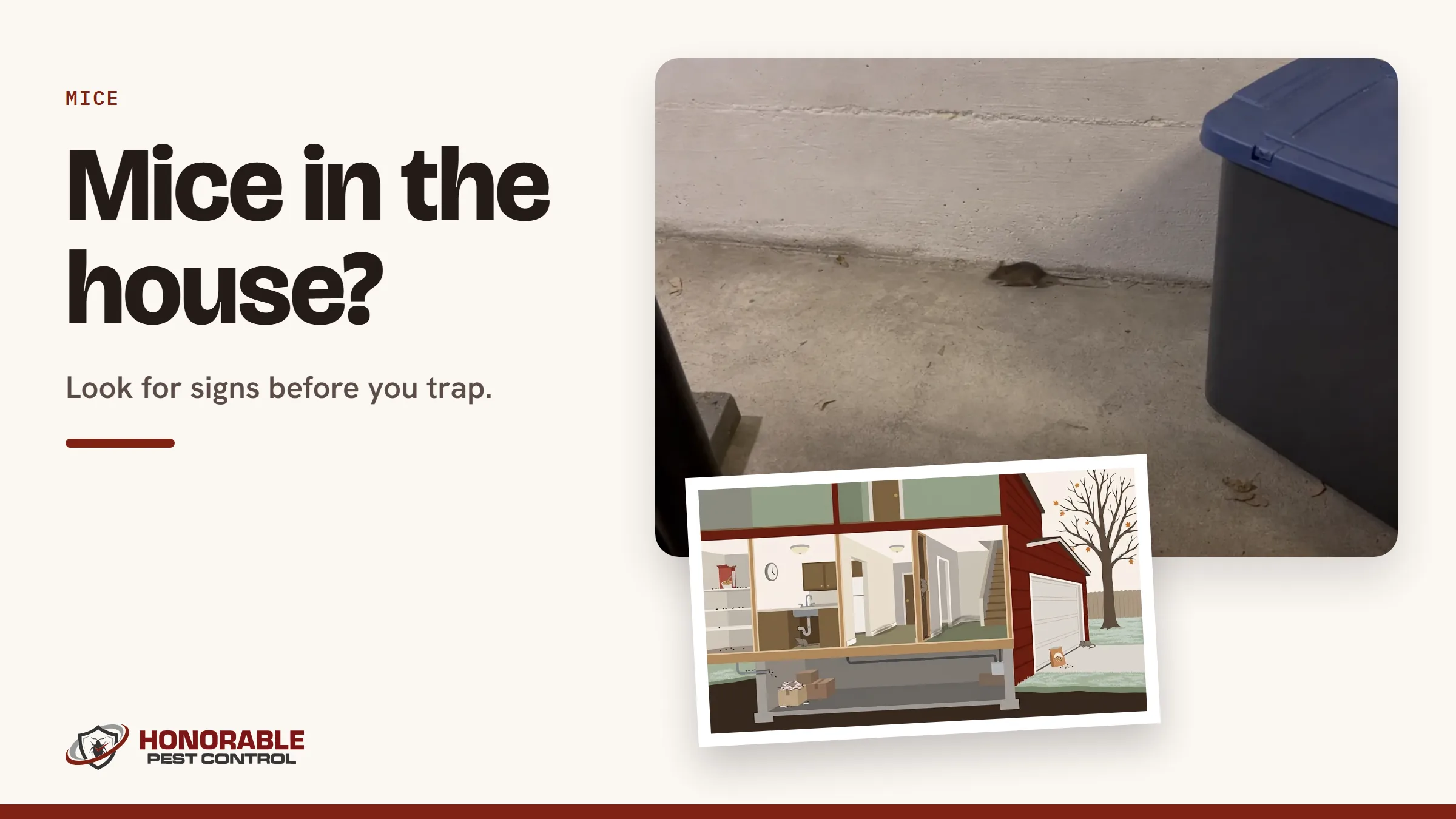
Mice in house? Before you buy a trap, grab a flashlight and walk the rooms they like. What you find shows where they're active and where to look for the way in, the first step with any mouse problem in the house.
 By Hayden Rhinehart, technician managerLicensed and insured in MichiganPublished
Summary
The short answer
Look for these signs of mice: droppings, fresh gnaw marks, greasy rub marks and nests of shredded paper. Mice are busiest at night, so scratching after dark counts too. To see if they're still around, clean one spot the wet way and check it again. New droppings mean they're still there. They want warmth, food and shelter. What lasts is closing the way in, then trapping the ones inside.
Look before you trap, and close the way in. Print the checklist and walk your house tonight.
Prefer to listen? 54 seconds.
The short version, read aloud. Read by a synthetic voice, not one of our technicians.
Mice in the house or garage? You'll usually spot the signs before you ever see one. That's what CDC says.
Signs of mice in the house: a room-by-room walk you can print
Check the places mice eat and travel. UC IPM says droppings, fresh gnaw marks and tracks show you where mice are active. Go in this order.
Printable checklist
Signs of mice checklist
Walk the house with a flashlight and tick each spot with a sign.
Inside, room by room
After dark, then outside
Last stop
Download the printable checklistPDF, one page
Not sure the signs are new? CDC says it can be hard to tell from droppings alone, and gnaw marks alone may only mean mice were there at some point. So your last stop is a cleanup and a second look.
Clean up the way CDC says. Put on gloves, spray the spot with a bleach mix or an EPA-registered disinfectant until it's very wet, let it soak, then wipe it up. Don't sweep or vacuum, since that can put viruses into the air you breathe.
Found a dirty mark by a hole outside? See how mice get in the house.
I once lay on a kitchen floor with my ear on a cabinet door, sure I heard a mouse. It was the dishwasher clicking, and the homeowner let me keep listening a while before they told me.
Ticked boxes in more than one room? Call us at (734) 519-6671 and we'll come find the way in.
Mice in house this fall? The best time to check
Early in the fall, then again once the nights turn cold. MSU Extension says that as temperatures drop, mice look for ways to stay warm, just like you. That makes mice a common problem each fall for many Michigan homeowners, MSU says. And CDC says it's easier to deal with rodents before they settle in.
To see when the cold nights come here, we counted ten falls of NOAA records for one weather station in Ann Arbor.
When the first freezing night came at the Ann Arbor U of Mich station
The first night each fall with a low of 32 F or colder at the Ann Arbor U of Mich weather station, 2016 to 2025, counted by Honorable on October 18, 2026, from NOAA's daily lows. Bars start at September 1; the earliest and latest falls are marked. Detroit Metro Airport, the other gauge we counted, averaged about three weeks later (about Nov 5). It's one thermometer, read once a day, so a date can be off by a day and your yard may freeze sooner or later. It counts cold nights, not mice, so it can't show when mice come in.
At the Ann Arbor station, the first freezing night came anywhere from Sep 19 to Oct 28, and by Oct 15 in 6 of the 10 falls. The chart can't show when mice come in, so walk the house early in the fall, and again once the nights turn cold.
Why are there mice in my house?
Your house has what they want. UC IPM says house mice are built for living close to people, and they thrive where food and shelter are plentiful.
Some houses make it easier. MSU says pet food, bird seed and uncovered garbage can attract mice, and those fall straw bales on your porch make a warm spot for them. And if you live near fields or woods, Health Canada says deer mice may move into buildings there in the fall.
For the seasonal side, read why mice come inside in winter.
"Nick is very knowledgable about his work and shows you what is going on if you are interested. I haven't had any evidence of mice since they treated the first time!"
Is it really mice? How to rule out rats and deer mice
Start with the droppings and any digging. Penn State says house mouse droppings are pointed and about the size of a grain of rice, while a rat's are blunt, like a small raisin. Health Canada says Norway rats dig burrows at ground level, so a hole dug in the dirt by your foundation points to rats.
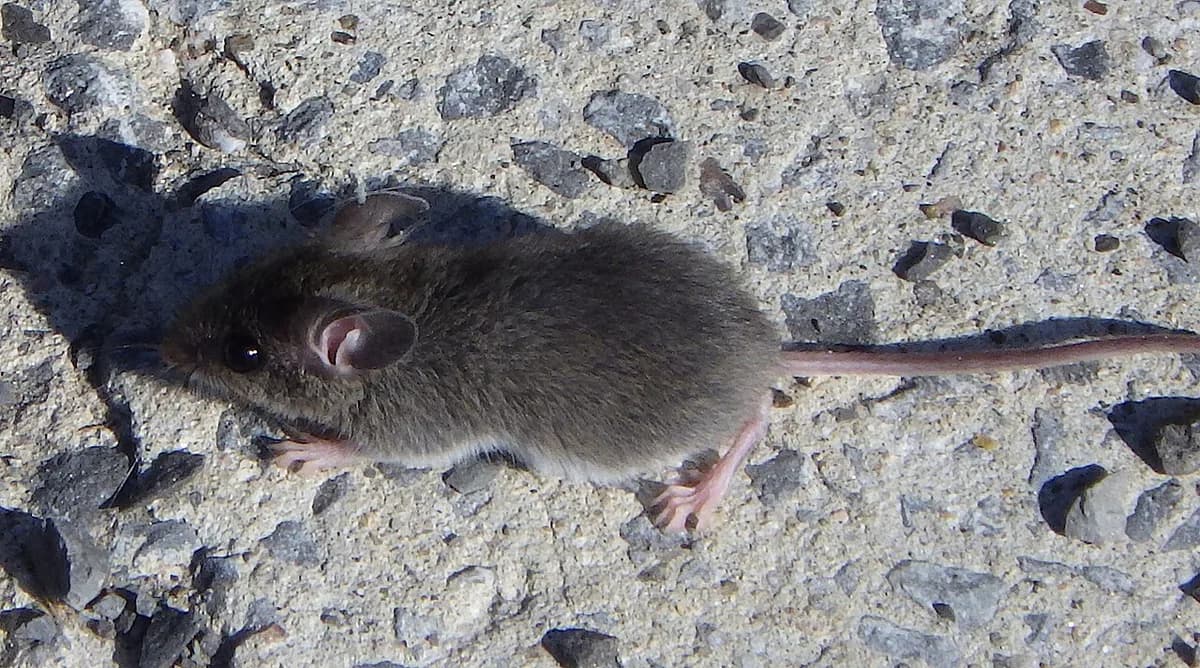
If you've seen the mouse itself, UC IPM says a house mouse is gray all over, while a deer mouse has a white belly.
| What you found | It may be | Read next |
|---|---|---|
| Droppings more like small raisins than grains of rice | A rat | mouse droppings or rat droppings |
| A hole dug in the dirt along the foundation | A Norway rat | Norway rats in Michigan |
| Scratching or scurrying in the walls at night | Mice or rats, Health Canada says | what the scratching in your walls means |
| A mouse with a white belly and white feet, near fields or woods | A deer mouse | a deer mouse or a house mouse |
What actually keeps mice out of the house?
Closing the way in, then trapping the ones already inside. UC IPM calls keeping mice out the most successful and permanent fix. CDC says to start by checking inside and out to see how they got in. Then use what your walk turned up:
- A hole with a dirty, oily mark around it? Penn State says the openings mice use may have one. For a gap that leads outside, MSU says to use heavy stuff like concrete mortar, sheet metal or heavy hardware cloth. That's for you or a contractor. We don't seal, but we'll show you every gap.
- Chewed boxes or bags? Penn State says to keep your food and pet food off the floor in hard containers with tight lids. MSU says bird seed needs a sturdy container with a tight lid, too.
- Droppings along one wall? That's where your traps go. CDC recommends regular snap traps on the floor, bait end next to the wall, since rodents like to run along walls. MSU suggests at least six where they run.
Skip the plug-in sound boxes. UC IPM says there's little evidence they drive out mice that have moved in, and mice quickly get used to a sound that keeps repeating. Even Health Canada, which allows them, says mice may adapt to them and come back. Don't count on foam on its own, either. UC IPM says expanding foam doesn't work for plugging the holes mice use.
When does a mouse problem in the house need a pro?
When the walk turns up fresh signs in more than one room, or you keep catching mice. Just a few mice in the house or garage? UC IPM says trapping takes time, but it's the preferred way when only a few are around.
If trapping doesn't fix it, CDC says to think about professional help. Health Canada says mice breed fast, so deal with a few right away.
That's what our mouse and rat control visit is for. We find the signs and the way in, and we show you every gap. Mice are part of what Honorable Shield covers.
Still finding new droppings after you've cleaned up and trapped? Call us at (734) 519-6671 or get a free quote with the form below.
Found fresh signs of mice?
We find how they get in, set locked, tamper-resistant bait stations where they run, and show you every gap. Quotes are free.
Rather not call? Get your free quote right here.
What are we dealing with?
Tap everything you have seen. Most homes have more than one.
Takes about 30 seconds. Or just call (734) 519-6671.
No obligation. We confirm availability and explain the recommended next step.
Common questions
Are mice in the house dangerous?
They can be. CDC says rodent diseases can spread when you breathe air or eat food that's tainted with their droppings, urine or saliva. UC IPM says house mouse urine is a major source of allergens. And a national US study found that people with allergies who lived with higher mouse allergen levels had higher odds of asthma symptoms. It found no such link in people who did not report allergies. Worried about hantavirus? Read about deer mice and hantavirus.
When do mice come out?
Mostly at night. UC IPM says mice are most active at night, but you might see one in daylight, and they're active at times when food is around. That's why the checklist has you listen once the house is quiet.
Do mice bite?
They can. CDC lists a bite or scratch from an infected rodent as one way rodent diseases spread to people. So don't pick one up. UC IPM says not to touch mice with your bare hands, and to wash your hands well after you handle traps.
Do mice always leave droppings?
You may not find them right away. CDC says droppings can turn up anywhere mice have been, and they're common in cabinets, drawers and other spots out of plain sight. Hearing them but finding nothing? Walk the checklist again, and see mouse droppings or rat droppings for what to look for.

About this page
Hayden wrote this. The facts come from the sources below, checked on October 18, 2026. The freeze dates are our own count of NOAA records for one thermometer in Ann Arbor. Photo: Ahunt (CC0, via Wikimedia Commons). See something wrong? Tell us and we'll fix it.
Sources
- Michigan State University Extension, Thinking like a mouse (Lisa Treiber, 2014)
- University of California Statewide IPM Program, Pest Notes: House Mouse, Publication 7483 (updated 2025)
- Penn State Extension, Is There a Mouse in the House? Eliminate Mice with IPM (updated 2017)
- Internet Center for Wildlife Damage Management, House Mice (from Prevention and Control of Wildlife Damage, Timm and Howard, 1994)
- US Centers for Disease Control and Prevention, Controlling Wild Rodent Infestations (2024)
- US Centers for Disease Control and Prevention, How to Clean Up After Rodents (2024)
- US Centers for Disease Control and Prevention, How to Trap Up to Remove Rodents (2024)
- NOAA NCEI GHCN-Daily low temperatures, Ann Arbor U of Mich station (USC00200230, linked), with Detroit Metro Airport (USW00094847) from NOAA ACIS, 2016 to 2025 (our count, pulled October 18, 2026)
- Salo and others, Exposure to mouse allergen in U.S. homes associated with asthma symptoms, Environmental Health Perspectives (2009)
- Health Canada, Rats and mice: pest control tips (modified 2016)

Ann Arbor, MI · Licensed and insured
Mice in the house this fall?
Tell us what you're finding and where you live. We'll check that we cover your street and give you the price first.
500+ Customer Reviews·Michigan pesticide business license #820457