
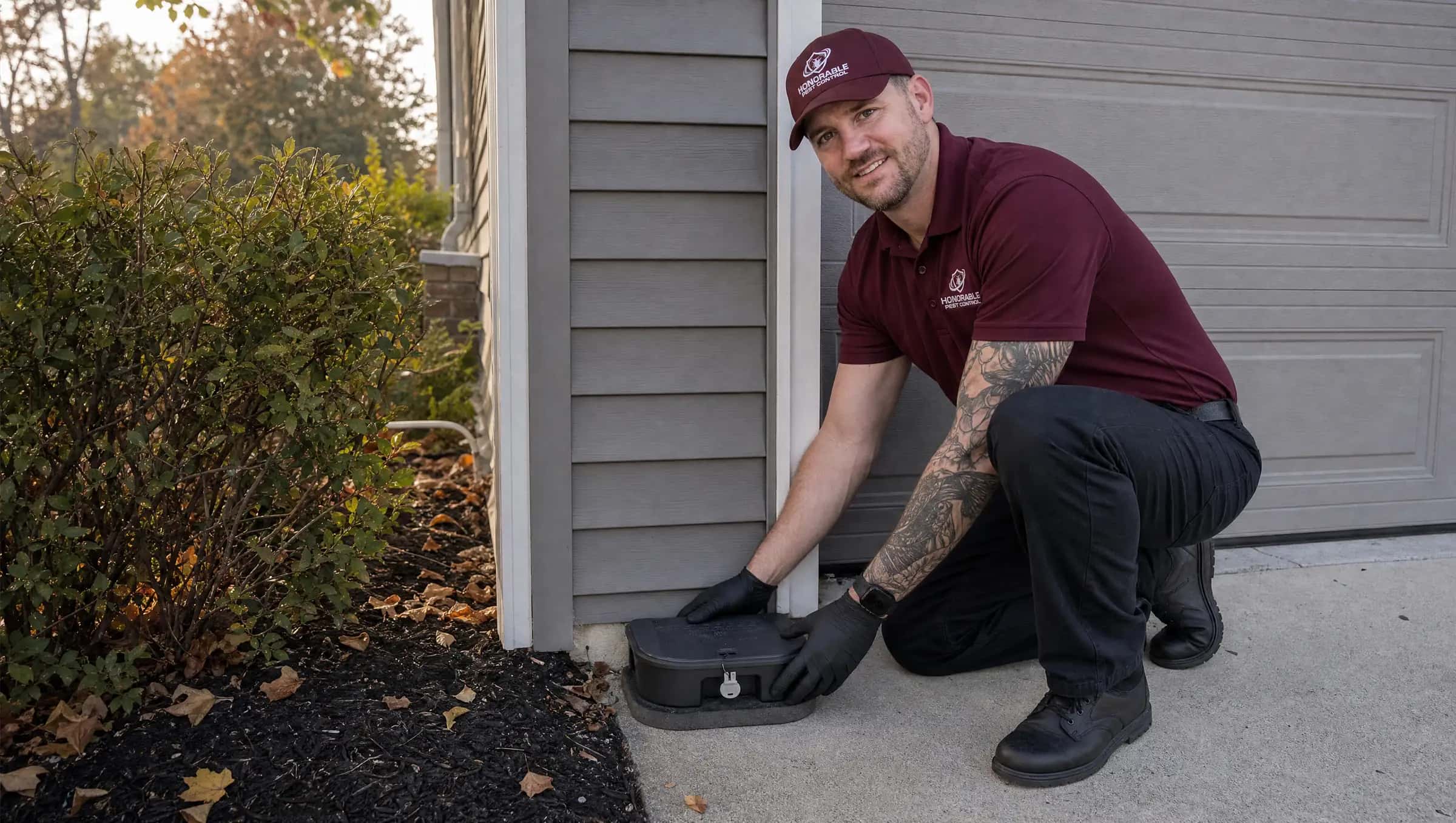
Mice and rats
Mouse droppings or rat droppings? How to tell what you found
Size tells you almost everything. Mouse droppings are 1/8 to 1/4 of an inch with pointed ends. Norway rat droppings are 3/4 of an inch or longer, thick, with blunt ends. Here is how to tell them apart, which rodent you have in a Michigan house, where each one leaves them, and how to clean them up without breathing the dust.
 By Nick Russler, ownerLicensed and insured in MichiganPublished
The short answer
- Mouse dropping
- 1/8 to 1/4 in, pointed
- Norway rat dropping
- 3/4 to 1 in, blunt
- Mice leave them
- Drawers, cabinets, walls
- Rats leave them
- Basement, garage, foundation
- Color
- Black, varies with food
- Clean up
- Spray, soak 5 min, wipe
A dropping the size of a grain of rice with pointed ends is a mouse. One three or four times longer, thicker, with blunt ends, is a Norway rat, according to Cornell University. Mice leave them where they feed and travel indoors; Norway rats burrow outside and leave them low down, in basements and garages. Either way, do not vacuum or sweep them: the CDC says to soak them with disinfectant first, so no dust goes into the air.
Prefer to listen? One minute.
The short version, read aloud. Read by a synthetic voice, not one of our technicians.
You opened a drawer, or moved the box of cereal, and there they were: small, dark and a little too many. The first question is always the same. Is that a mouse, or is it a rat?
You can almost always tell from the droppings alone. And knowing which one you have changes where you look for the way in.
Mouse or rat: start with the size
Cornell University puts mouse droppings at 1/8 to 1/4 of an inch and Norway rat droppings at 3/4 of an inch to a full inch. Mouse droppings are thin with pointed ends. Rat droppings are thicker and blunt, more like a capsule. Both are usually black, but the color changes with what the animal ate; green or red droppings can mean it has been eating bait.
How long rodent droppings are
In inches. From Cornell University IPM.
Two quick checks if you are still not sure. Rodent droppings are smooth, with no ridges along them, which is how Cornell tells them apart from cockroach droppings. And if there is dust nearby, look for footprints: a mouse leaves a trail of small dots, a rat leaves a print that looks like a small foot, often with a wavy line from the tail dragging between them.
Which rodent it is in a Michigan house
Three rodents account for nearly every call about droppings in Southeast Michigan. They look different, and they live differently.
| Rodent | Size | How to spot it | Where it lives |
|---|---|---|---|
| House mouse | 5 to 7 in with the tail | Gray-brown all over, nearly bare tail | Inside, near food, all year |
| Deer mouse | A little bigger, large eyes and ears | White belly and feet, tail dark on top and white below | Sheds, garages, cabins, empty buildings |
| Norway rat | Up to 16 in with the tail | Stocky and brown | Burrows outside, comes in at ground level |
The house mouse is the one in most kitchens. The University of California IPM program describes an adult at 5 to 7 inches including a 3 to 4 inch tail, most active at night. The deer mouse is easy to pick out by its two-tone tail and white underside, and it matters which one you have: deer mice are the main carrier of the hantavirus that causes serious lung illness. The Norway rat is a much bigger animal, and a burrower, digging in along foundations, under decks and beneath woodpiles.
Where you find them tells you what you have
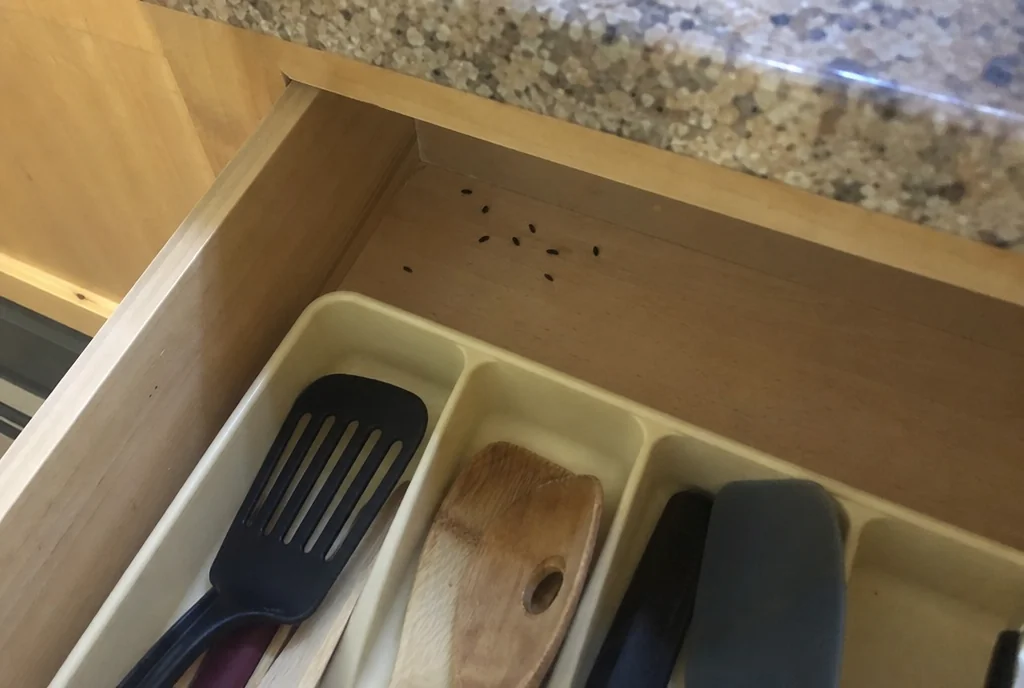
Mouse: inside, where it feeds
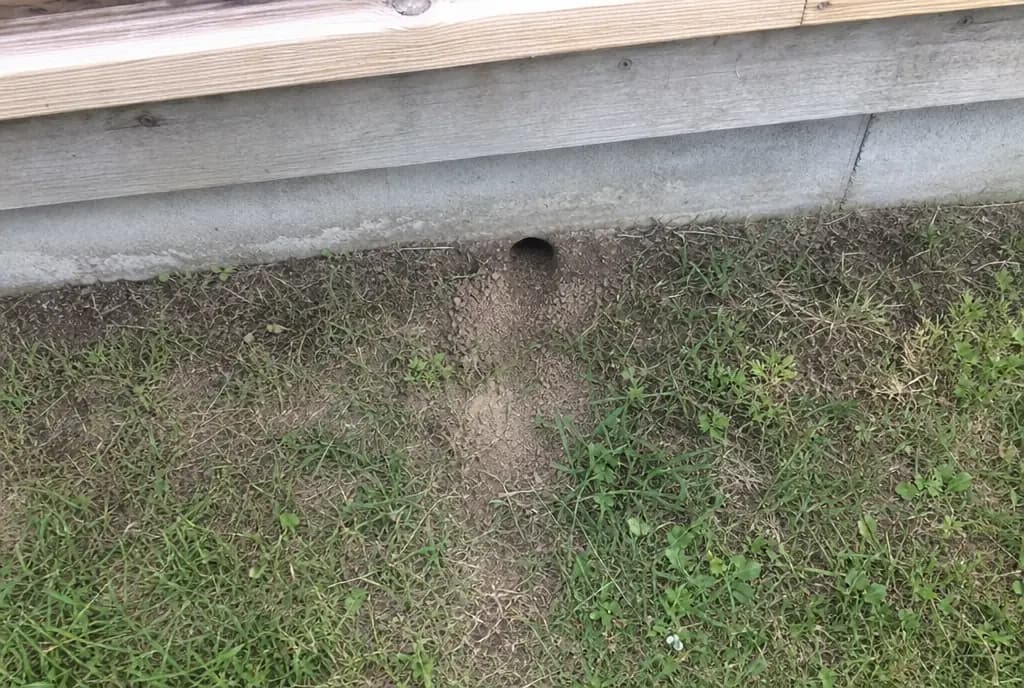
Norway rat: a burrow at the foundation
- In drawers, cabinets and along the backs of counters is a mouse. They feed in small amounts, about 200 small meals a night by UC IPM's count, so the droppings build up along the routes they use again and again.
- In the basement, the garage or at ground level, and larger, is a Norway rat. UC IPM says Norway rats that get inside usually stay in the basement and ground floor.
- Outside, next to a hole in the soil against the foundation or under the deck, is a rat burrow.
- In a shed, an attic or a closed-up cottage, with nesting material, could be deer mice, and that is the one to be most careful cleaning up.
Gnaw marks help too. Rats leave tooth marks about 1/6 of an inch wide; a mouse leaves fine scratches about half that, per UC IPM.
Why you are finding them now
Fall is when it starts. House mice that live outside move into homes in autumn as the nights get colder, and it takes very little to get in: a gap a quarter of an inch high is enough for a mouse. Young rats can squeeze under a door with a half-inch gap.
Once inside, a mouse population can grow quickly. UC IPM puts a female at 5 to 10 litters a year, of 5 or 6 young each, and the young can breed themselves within about six weeks.
How to clean them up without breathing the dust
This is the part to get right. The CDC says rodent diseases mainly spread when people breathe in contaminated dust from stirred-up droppings, urine or nesting material. So the whole method is about keeping it wet.
Do not vacuum or sweep rodent droppings
The CDC's steps for urine and droppings:
- Put on rubber or plastic gloves.
- Spray the droppings and urine until very wet with a disinfectant (check that the label says "disinfectant") or a fresh bleach solution of 1.5 cups of bleach in a gallon of water.
- Let it soak for 5 minutes, or as long as the product label says.
- Wipe it up with paper towels and put them in a covered trash can.
- Mop or sponge the area with disinfectant.
For a heavy infestation, or a closed-up shed or cabin, the CDC has extra precautions. If someone gets sick after cleaning up after rodents, tell a doctor about the exposure.
What to do next
Cleaning up tells you where they have been. Stopping it means finding how they get in.
- Find the gaps. Check where pipes and cables come through walls, the garage door seal, dryer vents and the gaps around the foundation. Anything a quarter of an inch or bigger counts.
- Use the right material. UC IPM says to seal with steel wool, wire screen or sheet metal. Foam, plastic, rubber and wood do not stop mice; they chew straight through.
- Set traps where the droppings are. Along walls, behind things and in dark corners, where they actually travel.
- Take food away. Pet food, birdseed and pantry boxes go into hard containers with lids.
A few old, dry droppings in a garage you rarely use may be from a mouse that came and went. Clean them up the CDC way and watch for new ones. New droppings after you clean up mean they are still there.
Still finding droppings after you clean up?
We find the droppings, the runs and the way in, set locked bait stations and traps where they travel, and show you every gap to seal. Mice and rats are covered by Honorable Shield. Quotes are free.
If you are finding fresh droppings every week, hearing them in the walls at night, or you have a burrow at the foundation, that is when a mouse and rat control visit pays for itself. A single old dropping in the garage is not.
Common questions
Is it safe to vacuum mouse droppings?
No. The CDC says not to vacuum or sweep rodent droppings, urine or nests, because it puts tiny droplets that can carry viruses into the air. Spray them with disinfectant, let them soak for 5 minutes, then wipe them up with paper towels.
How can one mouse leave so many droppings?
Mice eat little and often. UC IPM says a house mouse eats in about 200 small meals a night, so droppings build up along the same routes quickly, even from one or two mice.
Are these mouse droppings or cockroach droppings?
Look along the sides. Cornell notes rodent droppings are smooth, while American cockroach droppings have ridges running along them. Mouse droppings are also more pointed at the ends.
How small a hole can a mouse get through?
About a quarter of an inch. UC IPM says house mice can squeeze under gaps a quarter inch tall, and young rats under a door with a half-inch gap.
Why are there rat droppings in my garage but not in the house?
Norway rats burrow outside and often feed within 100 to 500 feet of the nest, per UC IPM. A garage, with its low door gap and stored birdseed or pet food, is often the first place they reach.
Can I fill the hole with spray foam?
Not on its own. UC IPM says foam, plastic, rubber and wood do not stop mice. Pack the gap with steel wool or cover it with wire screen or sheet metal first.
Should I worry about hantavirus in Michigan?
Take the cleanup steps seriously wherever you are. Deer mice carry the hantavirus that causes serious lung illness, and the CDC says the main risk is breathing in dust from their droppings and nests. Keeping them wet while you clean is what lowers that risk.

About this page
Written by Nick Russler, owner of Honorable Pest Control in Ann Arbor, Michigan. The sizes and habits here come from Cornell University and the University of California IPM program, and the cleanup steps are the CDC's own. All were read on September 26, 2026. If something here is out of date or wrong, tell us and we will fix it.
Sources
- Cornell University Integrated Pest Management, Mouse and Rat Biology and Behavior
- University of California Statewide IPM Program, House Mouse
- University of California Statewide IPM Program, Rats
- University of California Statewide IPM Program, Deer Mouse
- US Centers for Disease Control and Prevention, How to Clean Up After Rodents (2024)
- US Centers for Disease Control and Prevention, Hantavirus Prevention (2024)

Ann Arbor, MI · Licensed and insured
Finding droppings you cannot explain?
Tell us what you found and where you live. We check we cover your street and give you the price first.
500+ Customer Reviews·Michigan pesticide business license #820457