
Rats
Rats in Michigan: the Norway rat, and why roof rats are rare here
The rat in a Southeast Michigan yard or basement is almost always the Norway rat, a big, heavy burrower that digs in along foundations and comes inside for warmth and food in fall and winter. Here is how to tell it from a roof rat and from a mouse, where it lives, and what its burrow looks like.
 By Nick Russler, ownerLicensed and insured in MichiganPublished
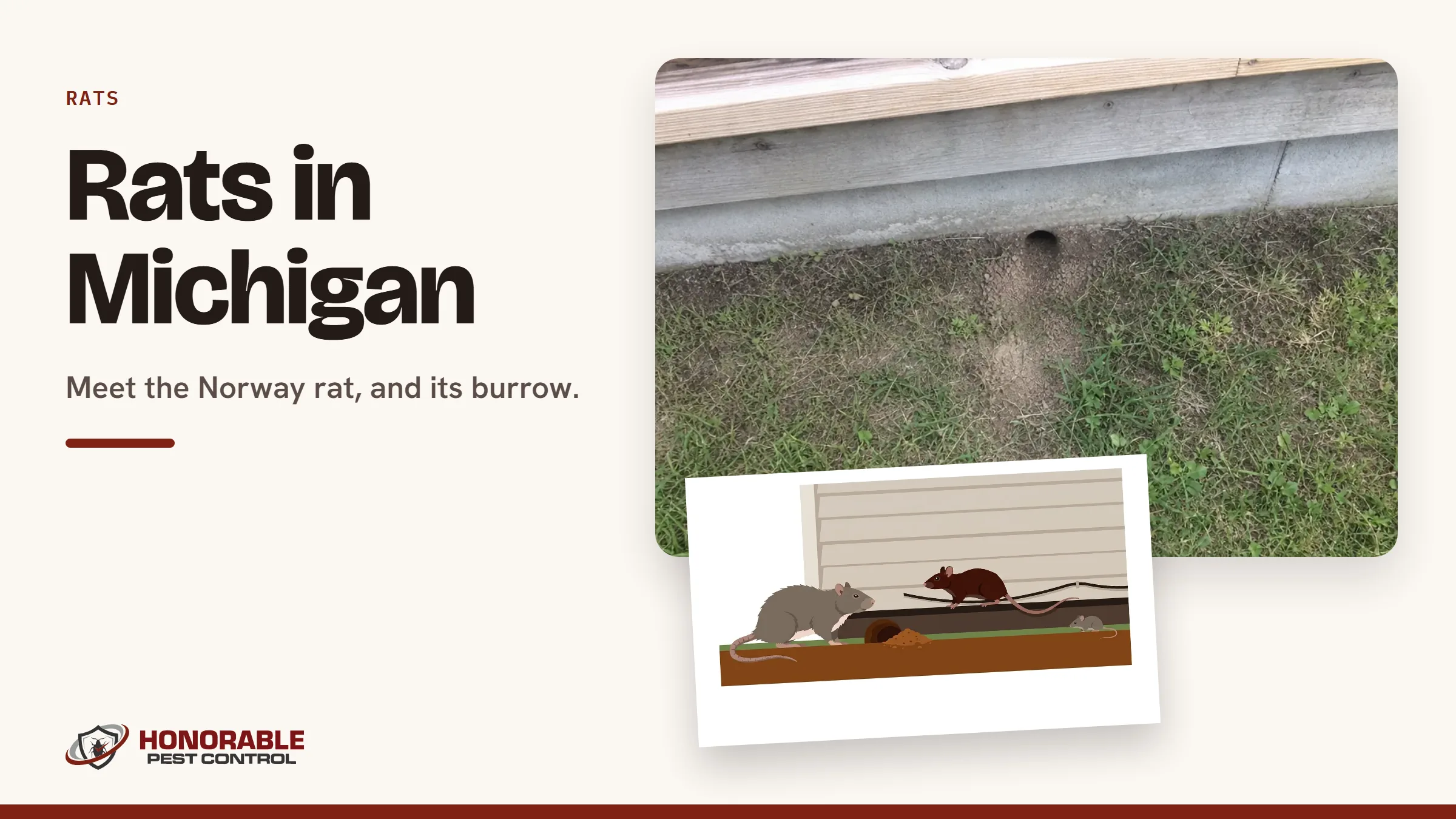
The short answer
- Rat of Southeast Michigan
- Norway rat
- Norway rat weight
- 7 to 18 oz
- Tail
- Shorter than head and body
- Lives
- In burrows, low in buildings
- Roof rat tail
- Longer than head and body
- Gap a rat uses
- About the size of a quarter
The Norway rat, also called the brown rat, lives throughout the lower 48 states, per University of California IPM. It is large and stocky, 7 to 18 ounces, with a blunt muzzle, small ears and a tail shorter than its head and body. It digs burrows along foundations, under trash and in woodpiles, and indoors it stays in the basement and on the ground floor. The roof rat is slimmer, climbs, and has a tail longer than its body. Michigan State University says rats exploit weak spots in a building especially in fall and winter, looking for warmth and food.
Prefer to listen? One minute 8.
The short version, read aloud. Read by a synthetic voice, not one of our technicians.
A big mouse, a vole or a chipmunk can all pass for a rat at a glance. So the first job is always the same: which animal is it?
If it is a rat, the answer is almost always the same animal, and it changes where you look.
Norway rat or roof rat?
| Norway rat | Roof rat | |
|---|---|---|
| Build | Large, robust | Sleek, agile |
| Weight | 7 to 18 oz | 5 to 10 oz |
| Muzzle | Blunt | Pointed |
| Ears | Do not reach the eyes when folded over | Reach the eyes when folded over |
| Tail pulled over the back | Reaches the middle of the skull | Reaches the snout or past it |
| Nests | Burrows at foundations, under woodpiles | Up high: trees, attics, wall voids |
From UC IPM. Cornell University says roof rats are generally not found in New York, a state at our latitude, and UC IPM says roof rats prefer warm climates, though their range is expanding.
Rodents reported on iNaturalist in four Southeast Michigan counties
Research-grade iNaturalist observations of Old World rats and mice (family Muridae) in Washtenaw, Oakland, Wayne and Livingston counties, pulled September 21, 2026. Deer mice belong to a different family and are not counted.
Sightings are not a census; people rarely photograph rodents. But no roof rat has turned up among research-grade records in these four counties.
Rat vs mouse
| Norway rat | House mouse | |
|---|---|---|
| Adult length | About 16 in with the tail | About 5 to 8 in with the tail |
| Head | Blunt muzzle, small ears and eyes | Pointier nose, large ears and eyes |
| Droppings | 3/4 to 1 in, blunt | 1/8 to 1/4 in, pointed |
| Gap it uses | About the size of a quarter | About the size of a dime |
| Water | Needs standing water every day | Gets most of its water from food |
From Cornell and Penn State. A young rat is easy to mistake for a mouse. Cornell says that compared with a young rat, a mouse has larger ears and eyes and a pointier nose. Our guide to mouse and rat droppings is often the fastest way to tell.
Where Norway rats live
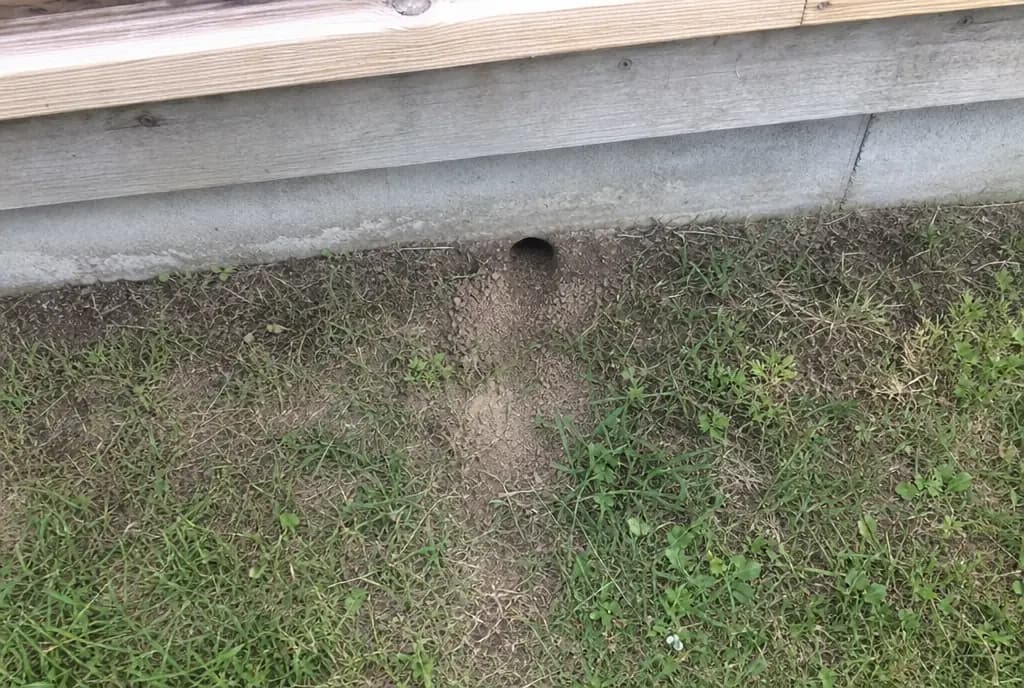
UC IPM says Norway rats burrow along building foundations, beneath rubbish or woodpiles, and around gardens. Their nests are lined with leaves, shredded paper or cloth. They forage 100 to 500 feet from the nest at night, and a female can have 4 to 6 litters a year and wean 20 or more young.
Cornell says Norway rats need to drink standing water every day, from a puddle, a leak or condensation on a pipe. The University of Illinois adds that their burrows can undermine the structures they dig under, and that they chew insulation and wires.
Rats in winter
MSU Extension says rats exploit weak spots in a building especially in the fall and winter months, and that burrows along the outside wall are a sign they are trying to get in for warmth and food. Rats are creatures of habit: MSU says they stay close to walls and use the same path to food and water, so droppings pile up along that route.
Rats are shy of new things. MSU says they take time to approach a new object, which is why a trap or station can sit untouched for days at first.
Rats and health
The University of Illinois says Norway rats carry many pathogens, including Seoul virus, a form of hantavirus, and bacteria such as Leptospira. Treat rat droppings and nests the same careful way as mouse droppings.
Do not sweep or vacuum rat droppings
Sweeping and vacuuming put dust in the air. Wear gloves, air the space out, and soak droppings and nests with a disinfectant or bleach solution before you wipe them up. The steps are in our droppings guide. See a doctor about any fever or illness after cleaning up after rodents.
What to do about rats
- Take away food and water. Lids on garbage and compost, pet food inside at night, fallen fruit and bird seed cleaned up, and leaks fixed, per UC IPM.
- Clear the cover. Move woodpiles off the foundation and thin dense plantings so there is space between shrubs and the house.
- Find the gaps. Penn State says a rat fits through a hole about the size of a quarter. UC IPM says rats chew through plastic, foam, wood and caulk.
Burrows at the foundation, or noises in the basement?
Our exterminators confirm it is a rat, find the burrows and the paths, set locked, tamper-resistant bait stations where they run, and show you every gap. Rats are covered by Honorable Shield and Rodent Shield. Quotes are free.
One rat at the bird feeder in October is a warning. Burrows along the foundation, gnawed wires or droppings in the basement are when our rat and mouse control is worth a visit.
Common questions
What kind of rats live in Michigan?
In Southeast Michigan, the Norway rat, also called the brown rat. UC IPM says it lives throughout the lower 48 states. Cornell says roof rats are generally not found in New York, a state at our latitude.
How do I tell a Norway rat from a roof rat?
Pull the tail over the back. On a roof rat it reaches the snout or past it; on a Norway rat it reaches the middle of the skull, per UC IPM. Norway rats are also heavier, with a blunt muzzle and small ears.
How big is a Norway rat?
About 16 inches long with the tail, per Cornell, and 7 to 18 ounces, per UC IPM.
Is it a rat or a mouse?
Adult rats are much bigger. Compared with a young rat, a mouse has larger ears and eyes and a pointier nose, per Cornell. Droppings help too: mouse droppings are 1/8 to 1/4 inch, Norway rat droppings 3/4 to 1 inch.
Where do rats nest?
Norway rats burrow along foundations, under woodpiles and trash, and around gardens, per UC IPM. Indoors they stay in basements and on the ground floor.
Do rats come inside in winter?
Yes. MSU Extension says rats exploit weak spots in buildings especially in fall and winter, looking for warmth and food.
How small a hole can a rat get through?
About the size of a quarter, per Penn State. UC IPM recommends sealing any crack or opening larger than 1/4 inch, because that also keeps out mice.

About this page
Written by Nick Russler, owner of Honorable Pest Control in Ann Arbor, Michigan. The facts here come from the University of California, Cornell University, the University of Illinois, Michigan State University and Penn State, and the sighting counts from iNaturalist, all read on September 26, 2026. We do not diagnose or treat illness; see a doctor about any symptoms. If something here is out of date or wrong, tell us and we will fix it.
Sources
- University of California IPM, Rats
- Cornell University IPM, Mouse and Rat Biology and Behavior
- University of Illinois Extension, Norway Rat
- Michigan State University Extension, Preparing your barn for winter: Pest management series part two
- Penn State Extension, Is There a Mouse in the House? Eliminate Mice with IPM
- iNaturalist, research-grade rat and mouse (Muridae) observations in Washtenaw, Oakland, Wayne and Livingston counties (pulled September 21, 2026)

Ann Arbor, MI · Licensed and insured
Rats digging in at the foundation?
Tell us what you are seeing and where you live. We check we cover your street and give you the price first.
500+ Customer Reviews·Michigan pesticide business license #820457