
Wasps and hornets
Wasps in winter: why are they in your house?
That slow wasp on your window in January most likely came from somewhere inside your house. Here's where wasps in winter come from, which ones they are around Ann Arbor, whether one can still sting, and what to do.
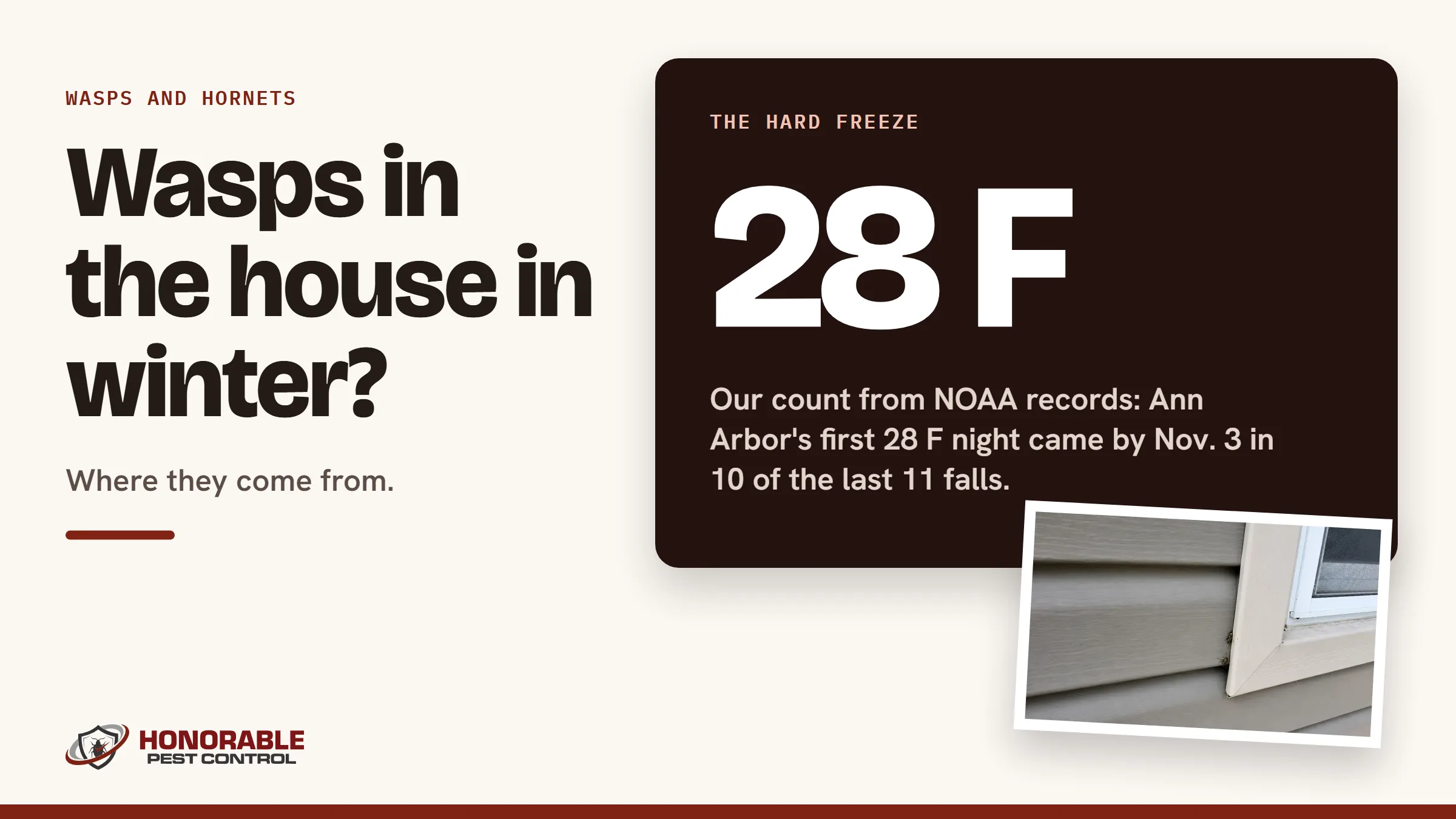
Summary
The short answer
A wasp in your house in winter usually came out of a hiding spot in the house. After the first frosts, a yellow jacket inside most likely came from a nest inside a wall. Later in winter, it's most likely a queen that woke up in a wall or the attic. It's often slow, but it can still sting if you press on it. Swat it, vacuum it or jar it outside, and skip the spray. Never plug a hole wasps are using, because that can push them into your rooms.
From MSU Extension, the University of Minnesota, Iowa State and NC State. All sources are listed at the end.
Where wasps in winter come from
There are two common sources, and the calendar tells you which.
| A nest in the wall | A queen waking up | |
|---|---|---|
| When | Late fall into early winter, after the first frosts | Warm days in winter, and again in spring |
| Which wasps | Yellow jacket workers | Paper wasp or yellow jacket queens |
| What you see | Yellow jackets coming out of a wall into your rooms | At a sunny window, sometimes several |
| When it ends | The workers die off with freezing weather. Warm walls can keep a very few going longer | The queens head out to start new nests in spring |
| What to do | Don't plug the hole outside. Have the nest found. | Swat it, vacuum it or catch it in a jar |
The wall nest. Iowa State Extension says yellow jackets in the house after frost are almost certainly coming from a nest in a wall. Once the food is gone and the yard turns cold, they explore the warm side of the wall and find a way into your rooms. Per MSU, the German yellow jacket commonly nests in wall voids, attics and crawlspaces.
The queens. Penn State says European paper wasp queens winter behind siding, in wall voids and in attics. They may winter in groups, says the University of Maryland. A 1969 University of Michigan study near Ann Arbor lists the space between a house's inner and outer walls among northern paper wasps' winter spots.
Not sure which wasp you have? Our guide to telling yellow jackets, paper wasps and hornets apart starts with the nest.
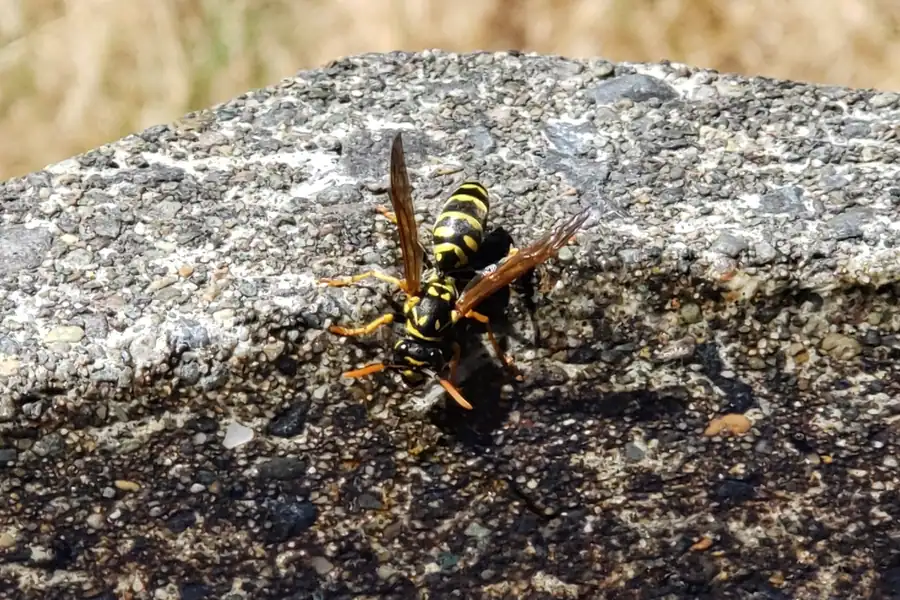
European paper wasp
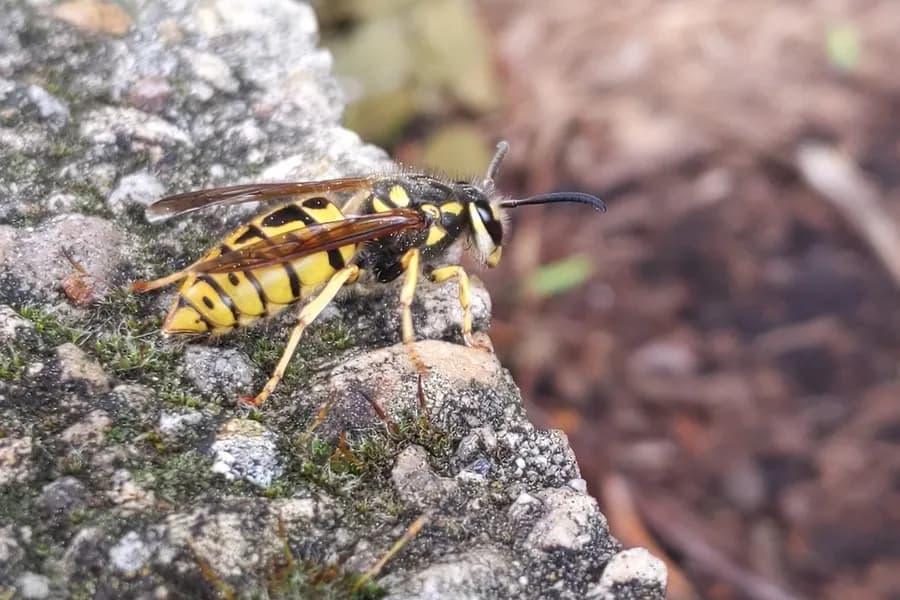
German yellow jacket
Do wasps hibernate in winter?
Only the new queens of social wasps make it through, resting in a sheltered spot until spring. MSU Extension says Michigan's social wasps leave their nests in fall, and the workers die from starvation and cold. According to MSU, yellow jacket workers are usually gone by Nov. 1. Paper wasp queens stop eating and live on stored fat. A 2023 study in Austria and Italy found warmer winters make them burn through it faster.
The University of Minnesota says a yellow jacket or paper wasp nest stays active until freezing temperatures, usually in the mid-to-upper 20s F, kill the old queen and the workers. In Ann Arbor, the first 28 F night came by Nov. 3 in 10 of the last 11 falls.
Ann Arbor's first hard freeze, the last 11 falls
First night at 28 F or colder at the Ann Arbor (University of Michigan) weather station. Our own count from NOAA daily records. The National Weather Service treats 28 F as a hard freeze, and its map puts the Ann Arbor area's median first 28 F night in late October (1981-2010 averages). Our 11-fall median is Oct. 26.
The old paper nest is generally not reused, and Cornell says it's rare for a queen to move back in. Here's what winter does to a bald-faced hornet nest.
Why they show up on warm days
A warm day can stir a sleeping wasp. NC State Extension says paper wasps resting in an attic, wall void or crawlspace may follow light through a gap at a baseboard, a wall fixture or a vent. Wasps beating against your window on a warm winter day pose no threat, NC State adds.
Not every buzzing bug at your window is a wasp. Cluster flies, boxelder bugs and Asian lady beetles also move into Michigan homes for the winter, MSU says. The western conifer seed bug buzzes like a bumble bee, but it doesn't bite or sting. Our guides to cluster flies in Michigan, Asian lady beetles and western conifer seed bugs cover each one.
Can a wasp in winter sting?
Yes. Wasps inside are often sluggish, Iowa State notes, but may be active enough to sting if it's warm enough. For paper wasps that wander in, NC State says there's no nest or young to defend, so your real risk is stepping on one or pressing against it. Penn State says stings in otherwise healthy adults should clear up without medical treatment, but you should get medical care if you're allergic to wasp stings or get stung many times.
If someone gets stung
Wash the spot with soap and water, then hold a cloth soaked in cold water or filled with ice on it for 10 to 20 minutes, says Mayo Clinic. Call 911 for signs of a serious allergic reaction, such as trouble breathing, swelling of the lips, face or throat, or fainting, even if it's just one or two signs. See a doctor if the swelling gets worse or the spot looks infected.
What to do with a wasp in the house
- Get it out. Per NC State, you may swat it, vacuum it up, or catch it in a jar and let it go outside.
- Skip the spray. Ohio State says spraying indoors usually does little or no good. The University of Minnesota adds that a spray at a wall nest can sometimes send yellow jackets looking for another exit, which often leads into your house.
- Don't panic over a few. Several queens inside in early spring most likely picked the same cozy spot. That's highly unlikely to mean an active nest, says a University of Maryland extension expert.
If they keep coming out of a wall
Don't plug the hole they use outside. MSU's warning: plugging the opening of a wall nest only forces the wasps to chew their way into your living area. Caulk it shut the next spring instead. Hidden nests in buildings are usually best left to a pest management professional, according to the University of Minnesota.
Call us at (734) 519-6671 and a technician will come look for where they're getting in and show you what we find. Here's how our wasp control service handles a live nest.
Keeping them out next fall
Queens tend to come back to the same places: a two-year nestbox study at Rochester, in Oakland County, found paper wasp queens strongly tied to where they came from, its summary says. Mississippi State Extension (2011) says to make your house bug-tight before insects move in. Sealing the outside once they're in your attic or walls can backfire. They can't get out in spring, and more end up in your rooms. The checklist starts with torn gable vent screens, then soffit and ridge vents, window screens, and gaps around windows, pipes and wires.
That sealing work, done in spring after they've left, is a job for you or a handyman. We don't seal or repair, but we find the gaps and show you where they are. Want them found before spring? Get a free quote with the form below.
Want a technician to find where they get in?
We look for the nest or the gaps, show you what we see, and treat a live nest with label-directed treatments. The quote is free.
Rather not call? Get your free quote right here.
What are we dealing with?
Tap everything you have seen. Most homes have more than one.
Takes about 30 seconds. Or just call (734) 519-6671.
No obligation. We confirm availability and explain the recommended next step.
Common questions
Where do wasps go in winter?
Only the new queens of yellow jackets, hornets and paper wasps live through it. The University of Minnesota says yellow jacket and paper wasp queens hide under loose tree bark, in old rotten stumps or inside buildings, like under siding. Penn State adds wall voids and attics for European paper wasps.
Is the old nest in my attic or eaves empty?
The colony that built it is gone, and Cornell says it's rare for a queen to move back in. But an old nest can occasionally shelter sleeping paper wasp queens: a 1980 study in Ontario counted more than 350 in two old nests on one building. MSU says nests that aren't a hazard can be left alone, and to wait until after the first freeze to take down a hanging nest in a low-traffic spot.
Can a wasp start a nest inside my house in winter?
According to Iowa State Extension, the yellow jackets coming out of your walls into the house won't start new colonies or reproduce during the winter. New nests start in spring: a 1969 University of Michigan study found northern paper wasp queens near Ann Arbor begin building in early May.
Will they come back next year?
They may. The 1969 University of Michigan study near Ann Arbor saw 18 marked northern paper wasp queens show up the next spring at the eaves where their parent nest had been. And researchers in Italy say paper wasps often winter in the same shelters year after year.
Why do I find dead wasps on the windowsill?
Queens that die while wandering a house likely ran out of energy or dried out, since there's no nectar or sap to eat indoors, says a University of Maryland extension expert.
What temperature wakes wasps up?
We couldn't find a tested number for wasps inside a house. NC State just says "any warm day." In a lab study of European paper wasp queens from winter shelters in Austria, they were generally active more often at 54 F than at 39 or 46 F.
Are wasps good for anything?
Yes. Per MSU Extension, many kinds of wasps eat garden pests, and nests that don't pose an immediate hazard can be left alone.
What about mud daubers?
Most wasps aren't social at all: the University of Minnesota says only about 1,000 of some 103,000 wasp species are. Mud daubers live alone. The Missouri Department of Conservation says they spend the winter as young wasps sealed in their mud nests, and they rarely sting unless you handle them roughly.
Sources
- Michigan State University Extension, Getting rid of wasp nests (2023)
- MSU Plant and Pest Diagnostics, Yellowjackets
- MSU Plant and Pest Diagnostics, Cluster fly
- MSU Plant and Pest Diagnostics, Boxelder bug
- MSU Plant and Pest Diagnostics, Multicolored Asian lady beetle
- MSU Plant and Pest Diagnostics, Western conifer seed bug
- University of Minnesota Extension, Wasps and bees (reviewed 2025)
- NC State Extension, Non-honey bee stinging insects in North Carolina (2024)
- Iowa State University Extension, Yellowjacket wasp
- Ohio State University Extension, Yellowjackets (HYG-2075)
- Penn State Extension, European paper wasp (2026)
- University of Maryland Extension, Social wasps
- Ask Extension, answer from the University of Maryland Home and Garden Information Center
- Cornell University NYS IPM Program, Wasps in winter? (2017)
- Mississippi State University Extension, Bug-Wise No. 9 (2011)
- Gamboa and others, Insectes Sociaux (2004), paper wasp study at Rochester, Michigan
- West-Eberhard, University of Michigan Museum of Zoology (1969), northern paper wasps near Ann Arbor
- Gibo, Journal of the New York Entomological Society (1980), paper wasps in Ontario
- Kovac and others, Insects (2023), paper wasps in winter
- Kovac and others, Journal of Insect Behavior (2026), paper wasp queens and temperature
- Dapporto and Palagi, Annales Zoologici Fennici (2006), paper wasp winter shelters
- University of Minnesota Extension, Wasps are a gardener's friend (reviewed 2025)
- Missouri Department of Conservation, Mud daubers
- Mayo Clinic, Insect bites and stings: First aid
- National Weather Service Detroit/Pontiac, First fall freeze
- NOAA NCEI, daily records, Ann Arbor University of Michigan station
- iNaturalist, research-grade records of European and northern paper wasps and German yellow jackets in Washtenaw, Oakland, Wayne and Livingston counties

Ann Arbor, MI · Licensed and insured
Ready to protect your home?
Tell us what you are seeing and where you live. We check we cover your street, say what we would do, and give you the price first. No surprise charges.
500+ Customer Reviews·Michigan pesticide business license #820457