
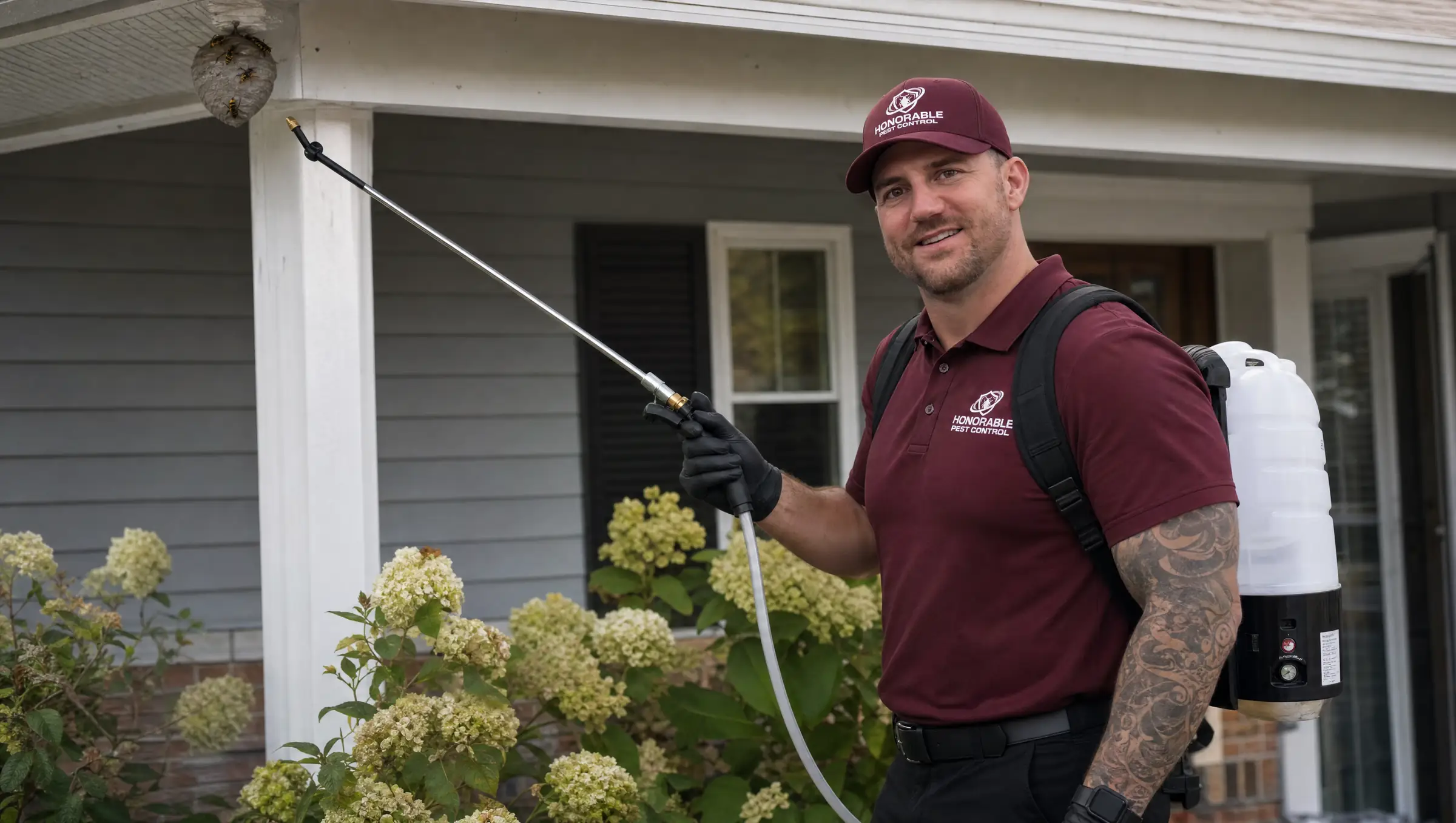
Wasps and hornets
Yellow jacket, paper wasp or bald-faced hornet? Read the nest
Read the nest. An open gray comb under the eaves is paper wasps. A line of wasps into a hole in the ground or a wall is yellow jackets. A closed gray paper football in a tree is bald-faced hornets. Here is how to tell them apart, which ones defend hard, and which nests you can simply leave for the frost.
 By Nick Russler, ownerLicensed and insured in MichiganPublished
The short answer
- Open comb, no cover
- Paper wasps
- Hole in the ground or a wall
- Yellow jackets
- Gray football in a tree
- Bald-faced hornets
- Biggest colonies
- Yellow jackets
- Nests reused
- Never
- Colonies end
- With the hard frosts
Michigan's three common social wasps each build a different nest, per Michigan State University. Paper wasps hang an open comb with no cover. Yellow jackets build a covered paper nest in an old rodent burrow or a wall. Bald-faced hornets hang a closed gray paper nest in a tree or under a roof peak. All three nests last one season: the workers die in the fall, and only new queens survive the winter. A nest that is out of the way can be left for the frost.
Prefer to listen? One minute 18.
The short version, read aloud. Read by a synthetic voice, not one of our technicians.
Every wasp colony starts in spring with a single queen, so nests are small in early summer. By August, MSU says, a yellow jacket colony can reach 1,000 to 2,000 wasps, and that is when most people find one, often with the lawn mower.
The first question is not how to kill it. It is which wasp built it, because the answer decides whether it needs treating at all.
Read the nest: five wasps side by side
| Nest | Where | Size | Colony | |
|---|---|---|---|---|
| Paper wasp | One open comb, no cover | Under eaves, rails, overhangs | 1/2 to 1 in, slender | Under a dozen to about 100 |
| Yellow jacket | Covered paper nest | Old rodent burrows, walls, attics | 3/8 to 5/8 in | 1,000 to 5,000 at peak |
| Bald-faced hornet | Closed gray paper ball | Trees, roof peaks | About 7/8 in, black and white | Hundreds to thousands |
| European hornet | Hidden paper nest | Trees, rotting wood, walls | Workers 0.6 to 0.8 in | Social colony |
| Cicada killer | A burrow, no paper | Bare, sunny, sandy soil | Largest wasp in Michigan | None; solitary |
Sizes and nests are from MSU and the University of Minnesota. For yellow jackets, MSU puts the August peak at 1,000 to 2,000 wasps, and UMN says a nest can reach about 5,000.
Paper wasps: the open umbrella
Paper wasps are slender, with long legs that dangle below them when they fly. UMN says they build a single comb with no protective cover, which is why they are sometimes called umbrella wasps, under any horizontal surface: eaves, deck rails, beams, the inside of a shed.
They are the easiest to deal with. The colony is small, often fewer than a dozen wasps and at most about 100, per UMN, and because the comb is open, MSU says the wasps and brood are exposed. A small paper wasp nest in a spot nobody uses can simply be left.
Yellow jackets: the hole in the lawn
Yellow jackets are bright yellow and black, hard and shiny, with few hairs. They do not dig. MSU says the queens take over holes abandoned by rodents, such as chipmunks, and they also nest in wall voids, attics and landscape timbers.
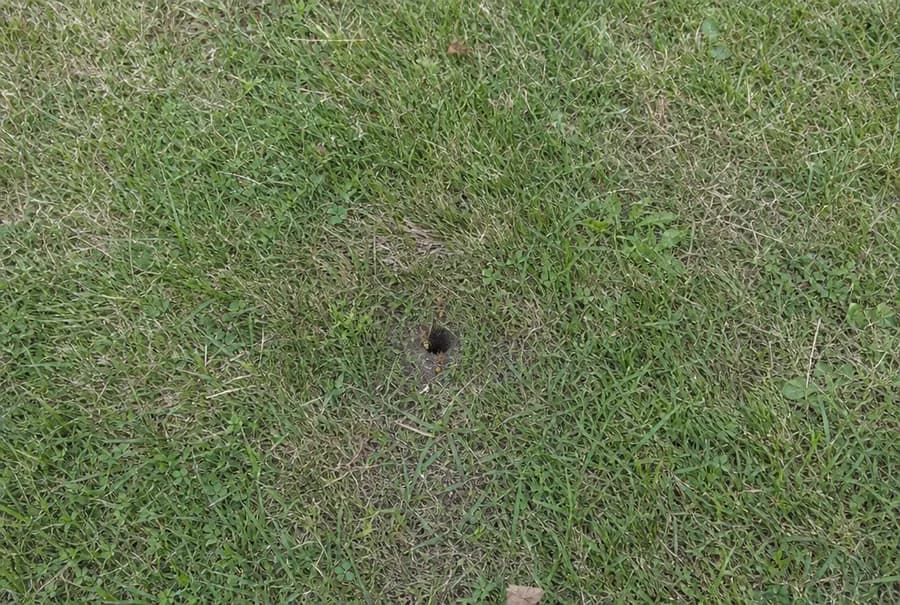
Yellow jackets: one busy hole
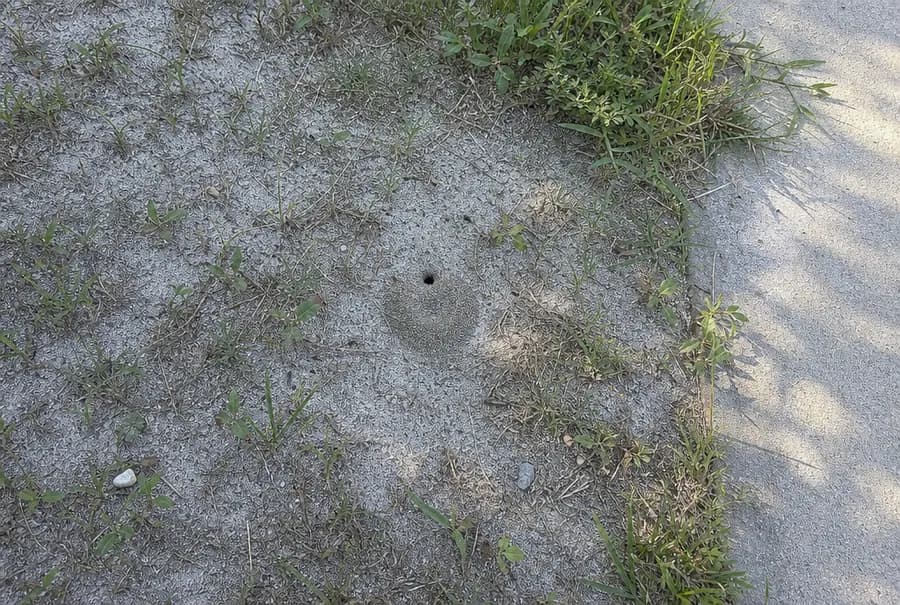
Cicada killer: a burrow with a soil mound
They are the ones that defend hard. MSU says the vibration from a mower or trimmer sets them off, and that late in the season, when the colony is raising next year's queens, the workers become very defensive near the nest. UMN adds that some yellow jackets turn into aggressive scavengers around food and drinks in late summer and fall.
Bald-faced hornets: the gray football
The bald-faced hornet is black with white or cream markings on the face and the tip of the abdomen, about 7/8 of an inch long, per UMN. It is not a true hornet: UMN groups it with the yellow jackets, and it builds the same kind of covered paper nest, only out in the open, hanging in a tree or under the eaves.
MSU calls them usually aggressive when the nest is disturbed. A football-sized nest high in a tree at the back of the yard is often best left alone. The same nest beside a door or a deck is a different story.
European hornets and cicada killers: big, and not the same
European hornets are one of Michigan's largest social wasps. MSU says queens reach 1.25 to 1.5 inches, and the orange brown around the eyes and on the thorax sets them apart from every black and yellow or black and white wasp. They are found in the southernmost part of the Lower Peninsula, they nest hidden in trees, rotting wood and sometimes walls, and unlike most wasps, they fly at night. They can and will sting when threatened.
Cicada killers are the largest wasp in Michigan, and they are solitary. MSU says each female digs a burrow in bare, sunny, sandy soil with a U-shaped mound of soil at the entrance, and stocks it with paralyzed cicadas. They do not readily sting, and with no colony to defend they usually ignore people. They appear in mid-June to early July. MSU notes they rarely move into thick, healthy turf, so a thicker lawn is the long-term fix.
When a nest needs treating, and when it does not
MSU's advice is to decide by location. A nest that does not pose an immediate hazard can be left: wasps leave the nest in the fall and never reuse it, and after a couple of hard frosts they are no longer a problem. A nest near a door, a deck, a play area or a path you mow is the one to deal with.
Wasp nests that don't pose an immediate hazard can be left alone.
Michigan State University Extension
Do not seal a wasp hole in a wall, and keep clear if you are allergic
MSU warns that plugging the outside opening of a nest in a wall forces the wasps to chew their way into the house. Leave the hole open until the nest is dead. The same goes for a ground nest: do not cover it with soil or a rock.
If you are allergic to stings, UMN says not to take on a nest yourself. The CDC says a severe allergic reaction to a sting needs emergency care, and people with a history of one should carry an EpiPen.
MSU says the covered nests of yellow jackets and bald-faced hornets are more challenging and best left to pest control professionals, and nests inside walls are the hardest of all, because a spray from outside rarely reaches the nest.
You can make your yard less inviting in spring. Yellow jacket queens look for old rodent burrows, so MSU suggests checking for them and filling them in during spring and early summer.
A nest by the door or in the wall?
Our exterminators identify the wasp first, treat the nest with a product labeled for that wasp and that spot, then take the dead nest down where they can reach it. Wasps are covered by Honorable Shield. Quotes are free.
If the nest is out of the way, we will tell you to leave it for the frost. If it is where people walk, our wasp and hornet control deals with it, and a honey bee colony goes to a specialist instead. Not sure it is a wasp at all? See how to tell a carpenter bee from a bumble bee.
Common questions
What is the difference between a yellow jacket and a wasp?
Yellow jackets are wasps. Compared with a slender paper wasp, a yellow jacket is smaller, bright yellow and black, hard and shiny, and builds a covered nest in the ground or a wall instead of an open comb.
What is the difference between a wasp and a hornet?
In Michigan, the bald-faced hornet is not a true hornet; UMN groups it with the yellow jackets. The European hornet is a true hornet, larger and marked with orange brown.
Are bald-faced hornets aggressive?
Around the nest, yes. MSU says they are usually aggressive and sting when the nest is disturbed. A nest high in a tree away from people can often be left alone.
Do wasps reuse their nests?
No. MSU says old nests are never reused, though a good site may be picked again the next year. The workers die in the fall and only new queens survive the winter.
When do wasp nests die off in Michigan?
In the fall. MSU says after a couple of hard frosts the wasps are no longer a problem. UMN says freezing temperatures in the mid to upper 20s kill the workers.
Are cicada killers dangerous?
MSU says they do not readily sting, and you can stand among their burrows as long as you do not try to catch one. They are solitary, with no colony to defend.
Should I plug a wasp hole in my siding?
No, not while the nest is alive. MSU warns that plugging it forces the wasps to chew their way into the house. Treat the nest first, then seal the hole.

About this page
Written by Nick Russler, owner of Honorable Pest Control in Ann Arbor, Michigan. The facts here come from Michigan State University Extension, the University of Minnesota Extension and the CDC, all read on September 26, 2026. If something here is out of date or wrong, tell us and we will fix it.
Sources
- Michigan State University Extension, Getting rid of wasp nests
- Michigan State University Extension, Bee, wasp or hornet nest: Which one is it?
- Michigan State University Extension, European hornet, a large wasp active in spring
- Michigan State University Extension, Cicada killer wasps are no cause for concern
- University of Minnesota Extension, Wasps and bees
- CDC, National Institute for Occupational Safety and Health, Insects and Scorpions at Work

Ann Arbor, MI · Licensed and insured
Wasps where you walk?
Tell us where the nest is and where you live. We check we cover your street and give you the price first.
500+ Customer Reviews·Michigan pesticide business license #820457