

Stink bugs and boxelder bugs
Why are stink bugs and boxelder bugs all over my house?
Because your south wall is the warmest place on the street, and both bugs are looking for somewhere to spend the winter. Neither one bites, breeds indoors or damages the house. Here is how to tell them apart, when they arrive in Southeast Michigan, what keeps them out, and the one thing that does not work.
 By Nick Russler, ownerLicensed and insured in MichiganPublished
The short answer
- Stink bug
- Brown shield, about 5/8 in
- Boxelder bug
- Black and red, about 1/2 in
- When they gather
- Mid-September to October
- Which walls
- South and west
- Bite, breed indoors, damage
- No, no and no
- What works
- Sealing gaps early
Both are true bugs that spend the winter as adults, and in fall they fly to the warmest walls they can find and crawl into any gap. In Michigan the brown marmorated stink bug starts gathering once the day drops below 12.5 hours of light, which in Ann Arbor is September 15. Boxelder bugs follow, mostly in October. They are a nuisance, not a danger: MSU Extension says stink bugs do not bite, do not breed in homes and do not damage the structure. The fix is to close the gaps before they arrive, and to vacuum the ones that get in.
Prefer to listen? One minute.
The short version, read aloud. Read by a synthetic voice, not one of our technicians.
It usually starts on a warm afternoon in late September. One side of the house is suddenly covered in bugs, a few more are on the window screens, and by January there is one walking across the living room ceiling. It looks like an infestation. It is not quite that.
In most Southeast Michigan yards it is one of two insects, and they behave the same way for the same reason. Once you know which one you have and what it is after, the fix gets simple.
Stink bug or boxelder bug?
The two are easy to tell apart once they are side by side. The brown marmorated stink bug is a flat, shield-shaped bug about 17 mm long, a little over 5/8 of an inch, mottled brown, with light bands on its antennae and a black and white pattern along the edge of its body, according to Penn State Extension and the State of Michigan. It is an invasive insect from eastern Asia, first found in Michigan in 2011 and now established across the state.
The boxelder bug is narrower and darker: about half an inch long, black with orange or red markings, and three red stripes just behind the head, per the University of Minnesota Extension. It is a native insect. Its young are small and bright red, and only the adults survive the winter.
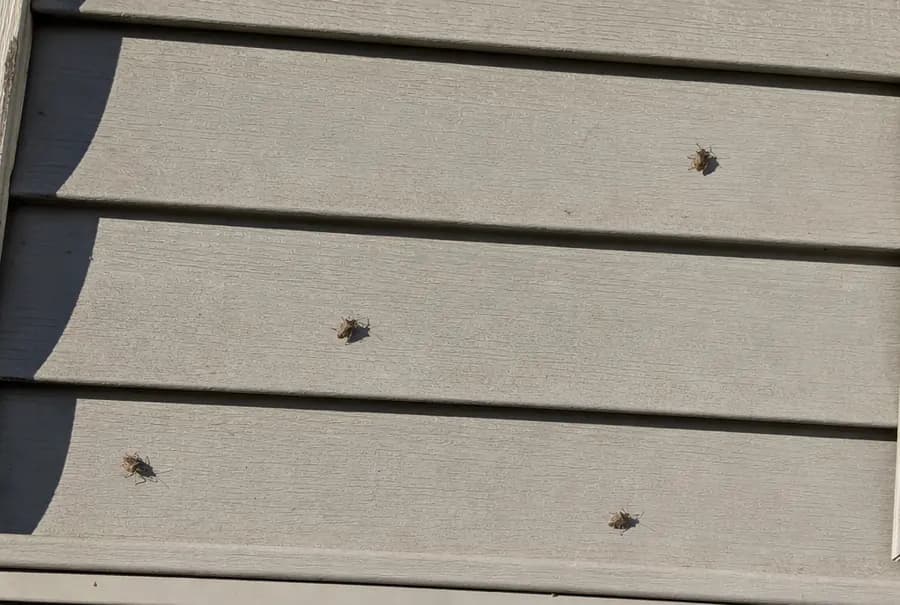
Stink bugs: brown, shield-shaped, spread out
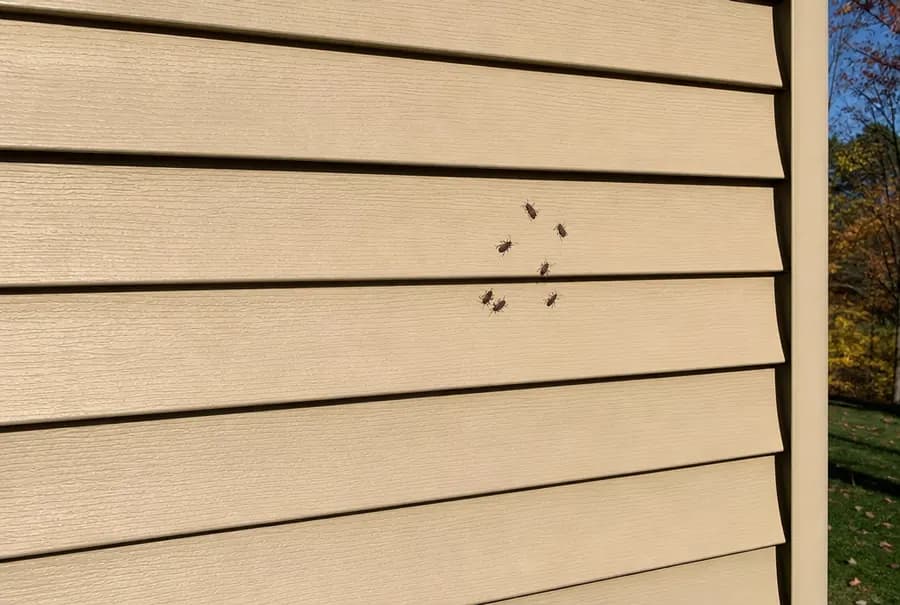
Boxelder bugs: black and red, in clusters
Two other fall visitors get mixed up with these. MSU Extension lists the western conifer seed bug, which looks like a stink bug but has an oval body and flattened, leaf-like back legs, and the multicolored Asian lady beetle, an orange beetle that can bite and can stain fabric.
| Bug | How to spot it | Where it comes from | Bites? |
|---|---|---|---|
| Brown marmorated stink bug | Brown shield shape, banded antennae, long thin back legs | Gardens, fruit trees, crops | No |
| Boxelder bug | Black with red edges, narrow oval, red stripes behind the head | Boxelder trees and related maples | No |
| Western conifer seed bug | Brown oval body, flat leaf-like back legs | Conifer seeds | No |
| Multicolored Asian lady beetle | Round orange beetle with black spots | Fields and gardens, eating aphids | Yes, a nip |
Why they pick your house
None of them want your food or your wood. They are looking for a winter bed. As the days shorten they go into a resting state and stop breeding and feeding. Out in the woods they would spend the winter under loose bark. A house is the same thing, only bigger and warmer.
MSU Extension puts it plainly: they gather on south and west walls, because those get the afternoon sun, and they crawl upward until they find a crack. The spot they want stays between 40 and 50 degrees: warm enough to rest, cool enough that they do not burn through their stored energy. Wall voids, attics and the space behind siding are just right.
That is also why cutting down a boxelder tree rarely helps. MSU Extension notes that where there is one boxelder tree there are dozens, and these bugs can fly several miles.
When they arrive in Southeast Michigan
Stink bugs follow the light, not the thermometer. MSU Extension found they begin to gather on buildings once there are fewer than 12.5 hours of daylight, around the second or third week of September. We checked that against the sunrise and sunset table for Ann Arbor: the day drops below 12.5 hours on September 15.
Hours of daylight in Ann Arbor, 2026
Stink bugs start gathering below 12.5 hours (highlighted). Day length from timeanddate.com; the 12.5-hour line from MSU Extension.
Boxelder bugs gather on tree trunks and walls through the cycle of warm days and cold nights that follows. MSU Extension says that can start in late September but is most likely in October. So the calendar for a Michigan house looks like this:
| When | What is happening | What to do |
|---|---|---|
| Late August | Nothing yet | Walk the south and west walls and seal gaps |
| Mid-September | Stink bugs start gathering | Keep windows shut on warm afternoons |
| October | Boxelder bugs peak | Wash them off the wall into soapy water |
| November to February | Resting inside walls and attics | Vacuum any that wander out |
| Late April to May | Heading back outside | Open a window and let them go |
What actually keeps them out
Sealing the gaps, before mid-September. Every extension service says the same thing, and MSU Extension says it best:
Caulking, sealing and closing cracks will do more to limit numbers than any pesticide.
Michigan State University Extension
- Look where the sun hits. Check the south and west walls first: gaps around window and door trim, where pipes and cables go in, around vents and the dryer duct, and under the soffit.
- Caulk wood siding, screen the rest. Caulk works on wood. On vinyl it will not seal completely, because vinyl panels are hung loose so they can expand and shrink. Use mesh or screen over vents and larger openings.
- Check the window air conditioner. The gap around a window unit is one of the easiest ways in. Pull it or seal around it before the season.
- Seal the inside too. If the outside cannot be closed up, sealing around outlets, switch plates, light fixtures and ducts at least keeps them in the walls and out of the rooms.
- Knock them off. A strong jet from the hose sends them off the wall; a bucket of soapy water finishes them.
What about spraying the outside of the house? It helps less than people expect. An insecticide on the siding only kills the bugs that touch it, and MSU Extension says a single application is not an effective long-term strategy, because more fly in on the next warm day. It earns its place on a house where hundreds gather every year, and the University of Minnesota says it works best timed to the fall move and combined with sealing.
What to do once they are inside
Do not squish them. A crushed stink bug releases the smell it is named for, and a smashed boxelder bug leaves a red stain. Instead:
- Vacuum them, then empty the canister or bag outside straight away. A shop vacuum handles large numbers.
- Pick up strays with a tissue, or knock them into a cup of soapy water.
- Try a light trap. Stink bugs fly toward light. MSU Extension suggests a lamp shining into a foil pan of water with a little unscented dish soap.
Skip the indoor spray and the bug bomb. MSU Extension does not recommend insecticides indoors for overwintering bugs: it only kills the ones it touches and does not stop the rest in the walls. Penn State says spraying into cracks will not stop them coming out either.
The bug on the ceiling in January is not a new arrival. On a warm winter day the heat of the house wakes up a few that are already in the walls, and they wander out toward the light. They will not lay eggs indoors, so there is no second generation to worry about.
Hundreds on the wall every fall?
We treat the sunny walls they gather on at the start of the season, show you every gap they are using, and clear the ones already inside. Stink bugs and boxelder bugs are both on the Honorable Shield covered list. Quotes are free.
When to call us, and when not to
A dozen bugs on the siding and a few on the windows is normal for a Michigan fall. Vacuum them and seal what you can. You do not need us for that.
It is worth a call when the wall is covered every year, when they keep getting into the living space, or when the gaps are up high where you cannot reach them. Our stink bug control and boxelder bug control visits start with finding how they get in, because that is what decides whether next year is better.
Common questions
Do stink bugs or boxelder bugs bite?
No. MSU Extension says stink bugs do not bite people or pets, and boxelder bugs are harmless too. Like other true bugs they have a piercing mouthpart, so handle a pile of them with a tissue rather than bare hands.
Will they lay eggs in my house?
No. Neither one breeds indoors. The adults rest through the winter and head back outside in spring to lay eggs on plants.
Why do I see them in the middle of winter?
A warm day wakes a few of the ones already resting in the walls, and they wander out toward light. They are not new arrivals, and picking them up is all it takes.
Should I cut down my boxelder tree?
It rarely helps. Boxelder bugs also feed on related maples, there are usually more boxelder trees nearby, and the bugs can fly several miles.
Do stink bugs hurt my garden?
They can. Of the three common fall invaders, MSU Extension names the brown marmorated stink bug as the only garden and farm pest. Penn State lists apples, peaches and many vegetables among its foods.
Why does it smell when I vacuum them?
Stink bugs release their smell when disturbed or crushed. Empty the vacuum outside right away so the smell does not linger.
Is it a stink bug or a western conifer seed bug?
Look at the back legs. A western conifer seed bug has flat, leaf-shaped back legs and an oval body. A stink bug has thin legs and a wide shield shape.

About this page
Written by Nick Russler, owner of Honorable Pest Control in Ann Arbor, Michigan. Every fact on this page comes from Michigan State University Extension, the State of Michigan, Penn State Extension or the University of Minnesota Extension, and the day lengths come from timeanddate.com's table for Ann Arbor. All were read on September 26, 2026. If something here is out of date or wrong, tell us and we will fix it.
Sources
- Michigan State University Extension, Managing brown marmorated stink bugs in homes (2024)
- Michigan State University Extension, Why are all these bugs appearing on the side or inside of my home? (2019)
- Michigan State University Extension, Boxelder bugs complete their fall stampede
- State of Michigan, Invasive Species: Brown Marmorated Stink Bug
- Penn State Extension, Brown Marmorated Stink Bug (updated 2026)
- University of Minnesota Extension, Boxelder bugs (reviewed 2023)
- timeanddate.com, Sunrise and sunset times in Ann Arbor, 2026

Ann Arbor, MI · Licensed and insured
Covered in bugs every fall?
Tell us what is on your walls and where you live. We check we cover your street and give you the price first.
500+ Customer Reviews·Michigan pesticide business license #820457