
Cluster flies
Why are there so many slow flies on my windows this fall?
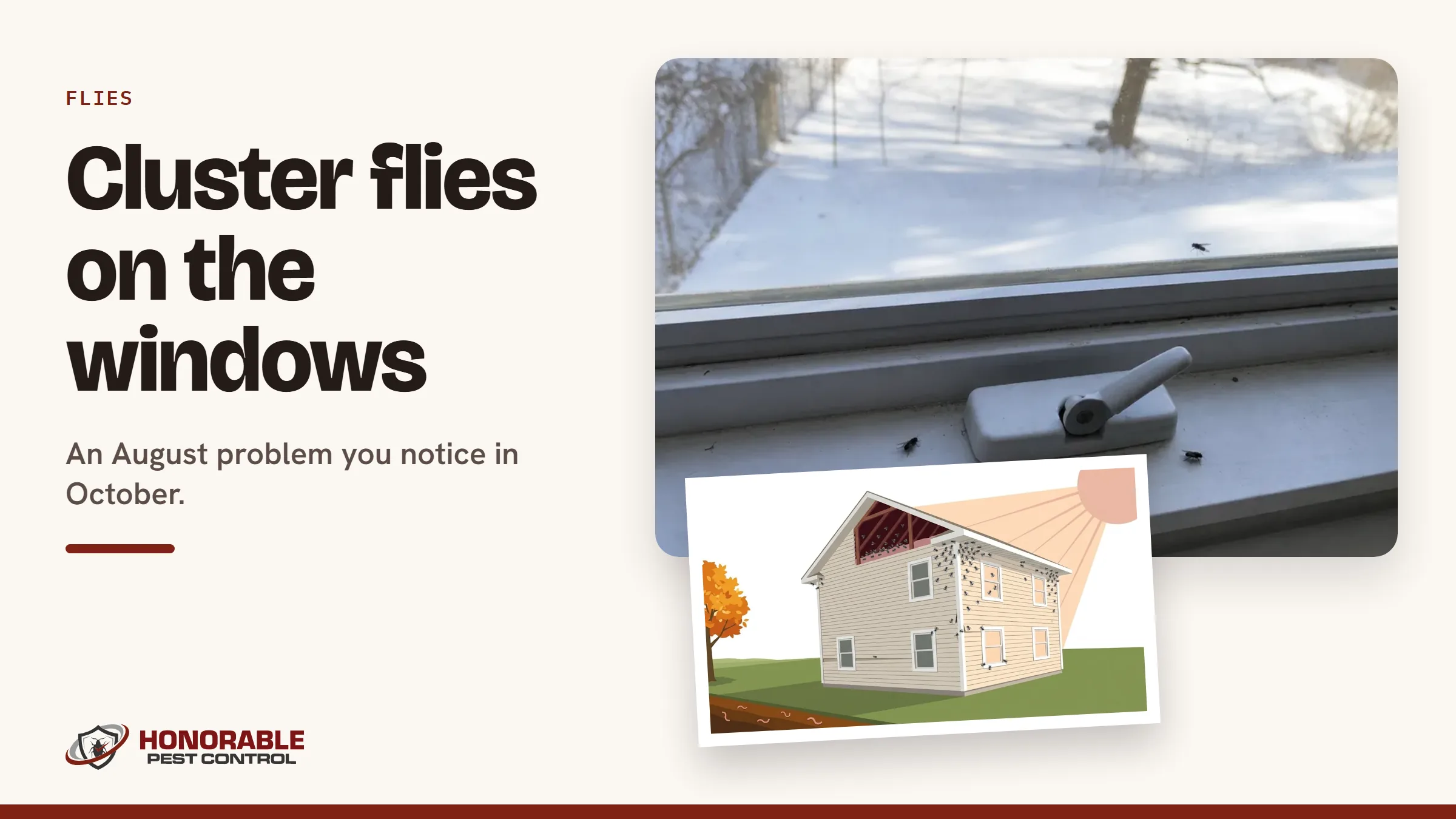
If the slow flies on your windows in fall are a little bigger than a house fly, with golden hairs on the thorax, they are cluster flies. They grew up in the lawn and moved into your walls. Here is why your house gets them, why they wake in January, and what helps now versus next August.
 By Nick Russler, ownerLicensed and insured in MichiganPublished
Summary
The short answer
Slow gray flies with golden hairs on the thorax are cluster flies. They grow up inside earthworms in lawns and fields. They move into walls and attics in late summer and early fall. Sun on the wall or furnace heat wakes them, even in January. They do not breed indoors and are not a sign of a dirty house. Prevention for next year happens by mid-August: close the gaps or time an outside treatment.
If they have golden hairs on the thorax, they are cluster flies, spending the winter in your walls and attic. Once they are in the walls, it is practically impossible to kill enough of them to make a difference, MSU Extension says, so vacuum the ones that come out and plan for next August.
Prefer to listen? 58 seconds.
The short version, read aloud. Read by a synthetic voice, not one of our technicians.
What are cluster flies?
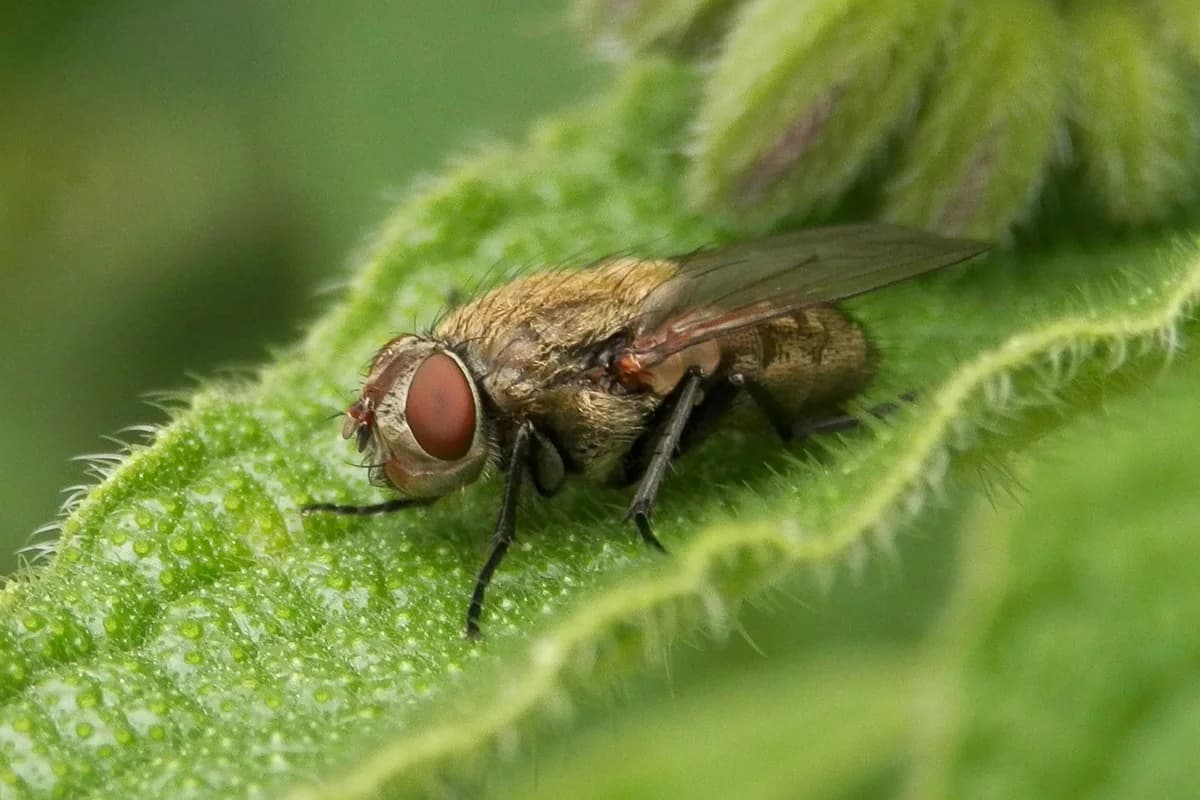
Cluster flies (Pollenia species) look like a slightly larger house fly, dull gray with golden-yellow hairs on the thorax, Penn State Extension says. They are sluggish flyers, and at rest their wing tips overlap like a pair of scissors, the Connecticut Agricultural Experiment Station says; a house fly's do not. Minnesota Extension puts them at 3/8 to 1/2 inch long.
Where they come from: earthworms, not your kitchen
Cluster flies grow up outdoors, inside earthworms. Females lay eggs in soil cracks, and the newly hatched maggots burrow into passing earthworms to feed, MSU Extension says. There are up to four generations a year in Michigan, and only the last one looks for winter shelter.
Cluster flies are not associated with garbage or manure, Maryland Extension says, and Health Canada says they do not breed, feed or lay eggs inside homes. Having them show up has more to do with bad luck and a healthy earthworm population outdoors than with housekeeping, MSU says.
Why your house, and why every year
Open, sunny houses draw them, and typically the same buildings become winter sites year after year, the Connecticut station says. In Connecticut, it adds, buildings on open hilltops draw more, those surrounded by large trees rarely have them, and the flies prefer light-colored buildings. Health Canada says there tend to be more in houses surrounded by large lawns or backing onto open parks.
Minnesota Extension says they like sunny spots high on the south and west sides. As the air cools in late afternoon they crawl up into gaps under the eaves and siding, the Connecticut station says, and a crack the thickness of a credit card is enough, MSU adds. Kentucky's extension says window screens do not stop them.
Cluster flies are one of several insects that move into homes in late summer and early fall, MSU says; see our guides to Asian lady beetles and to stink bugs and boxelder bugs.
Why they show up on the windows in January
They moved in months ago and wake when they warm up. The Connecticut station says that can happen in winter if surrounding temperatures rise above 54 F, and then they fly to sunny windows and lights. Sun on the south and west walls warms them, MSU says, and so does the furnace, the University of Connecticut adds.
In Ann Arbor, the air alone rarely gets that warm in midwinter. Counting ten winters of NOAA daily highs, 2016-17 to 2025-26, we found an average of 5.6 days at 54 F or warmer across December, January and February, and 0.7 in January. So most midwinter window flies were likely warmed by a sunny south or west wall, or by the furnace.
Days with a high of 54 F or warmer in Ann Arbor
Average days per month with a high of 54 F or warmer at the Ann Arbor University of Michigan weather station, over the ten winters 2016-17 to 2025-26. Our count from NOAA daily records; the 54 F mark is from the Connecticut Agricultural Experiment Station. This is air temperature at the station, so a sunny south or west wall, or the furnace, can warm the flies on more days than this.
What helps now, and what does not
Until next summer, keep them in the walls and remove the ones that get out. Purdue Extension says vacuuming and light traps reduce the numbers indoors but do not eliminate them.
- Vacuum them. MSU calls it a pretty effective way to remove the sluggish flies. Manitoba Agriculture, writing about prairie farms, suggests darkening the room and drawing them to one bright window first.
- Close the inside gaps. Sealing around outlets, switches, light fixtures and window and baseboard trim helps keep the flies trapped in the walls, MSU says.
- Clean up the dead ones. Flies that die in the wall voids may draw larder beetles, which then move through the house, Health Canada says. Large numbers of dead flies can attract carpet beetles and rodents, the Connecticut station says, and the University of Connecticut says to remove dead insects.
Skip the bug bomb and the wall dust
Indoor fogs and sprays cannot reach the flies in the wall voids, the Connecticut station says. Penn State adds that dusting the voids can backfire: carpet beetles may feed on the dead flies, then on woolens and stored dry goods.
Every fix, rated:
| What | When | Does it help? | Who says so |
|---|---|---|---|
| Vacuum the live ones | Whenever they come out | Yes, for the ones you can see | MSU, Manitoba |
| Seal outlets, switches, inside trim and window pulley holes | Fall and winter | Yes: helps keep them in the walls | MSU, Kentucky |
| Light traps | Once they are inside | Some: fewer flies, not none | Purdue |
| Flypaper, bug zappers, sticky traps | Once they are inside | Little: they are not usually active flyers indoors | Connecticut station |
| Foggers and indoor sprays | Once they are inside | Limited: cannot reach the wall voids | Connecticut station, Penn State |
| Killing earthworms or treating the lawn | Any time | No: not shown to reduce the flies | MSU, Purdue, Health Canada |
| Spraying the house in spring | Spring | No: will not reduce next fall's flies | Minnesota |
| Closing outside gaps, screening soffit vents | Summer, before they gather | Yes, the best way to keep them out, though caulk alone will not solve it | Penn State, Health Canada, Minnesota |
| Outside treatment of the south and west walls | By August 15 in Michigan | Some relief; in sunlight it may not kill flies much beyond several days or a week | MSU, Penn State |
Your August plan: do it yourself or call?
The work that cuts next year's flies happens in summer. Penn State Extension calls exclusion the best method: seal cracks around windows, doors, siding, pipes, chimneys and the fascia. Health Canada adds: screen the soffit vents. Minnesota Extension warns that caulking alone will not solve the problem.
If sealing every gap is not practical, Penn State, writing for Pennsylvania, says a licensed operator's treatment just before the flies gather may offer some relief, though in sunlight it may not kill flies much beyond several days or a week. MSU, writing for Michigan, sets the date: by August 15, when the flies begin to gather on outside walls.
A vacuum handles a few flies on a sill. Call when they come back in numbers every year or you cannot find the gaps. MSU warns that professional work can be expensive and you may still see some flies.
Flies are not on the Honorable Shield plan, so our fly control is quoted per job. We treat the outside where cluster flies gather, timed for late summer, and show you the gaps we find so you can get them sealed. We do not seal, caulk or repair.
Cluster flies back on the south wall every fall?
Tell us what you are seeing. We time the outside treatment for late summer and show you the gaps we find, and quotes are free.
Common questions
Will cluster flies go away on their own?
Partly. On warm days they crawl out trying to get back outside, Penn State says, but in early spring hundreds may die in homes before finding the way out, a 2022 paper in The Canadian Entomologist notes. Treating the house in spring will not reduce next fall's flies, Minnesota Extension says.
Do cluster flies bite or spread disease?
They do not bite and are not known to transmit diseases, MSU says. The dead ones are the concern: piles of them around windows can lead to allergy problems, a peer-reviewed identification guide notes, and they can feed carpet and larder beetles.
Should I kill the earthworms in my lawn?
No. Treating yards to kill earthworms has not been shown to reduce the flies entering homes, MSU says, and Purdue says lawn treatments fail because the flies travel considerable distances. Health Canada advises against it too, since earthworms build fertile soil and aerate lawns.
What happens if I swat one?
Crushed, they leave a greasy spot on upholstery, carpet and paint and give off an odor like buckwheat honey, Manitoba Agriculture says, writing about prairie farms. Live ones occasionally leave small dark spots of excrement on windows and walls, Penn State says. Vacuum them instead of swatting.

About this page
Written by Nick Russler, owner of Honorable Pest Control in Ann Arbor, Michigan. The facts here come from Michigan State University Extension; Penn State, Purdue, and the Universities of Minnesota, Connecticut, Maryland and Kentucky; the Connecticut Agricultural Experiment Station; Health Canada and Manitoba Agriculture; The Canadian Entomologist and the Canadian Journal of Arthropod Identification; and NOAA, all read on October 11, 2026. The Ann Arbor day counts are our own tally of NOAA's daily records. We do not diagnose allergies; see a doctor about any symptoms. If something here is out of date or wrong, tell us and we will fix it.
Sources
- Michigan State University Extension, Cluster Fly (Pollenia rudis)
- Michigan State University Extension, Cluster flies: A fall invader that lives up to its name (2012)
- Penn State Extension, Cluster Flies (updated 2026)
- Purdue University Extension Entomology, Nuisance Flies: Cluster and Face Flies, E-235 (2018)
- University of Minnesota Extension, Flies (reviewed 2024)
- University of Connecticut Home and Garden Education Center, Cluster Flies
- University of Maryland Extension, Cluster Flies (updated 2024)
- University of Kentucky Entomology, Cluster Flies, Face Flies, and Blow Flies in Homes, ENTFACT-624 (revised 2026)
- Connecticut Agricultural Experiment Station, Cluster Fly (Pollenia rudis)
- Health Canada, Clustering flies
- Manitoba Agriculture, Mosquito and Fly Prevention and Control on Manitoba Farms (2002)
- Vezsenyi, Langer, Samkari and Beresford, The history and current state of cluster flies in North America, The Canadian Entomologist (2022)
- Jewiss-Gaines, Marshall and Whitworth, Cluster flies (Calliphoridae: Polleniinae: Pollenia) of North America, Canadian Journal of Arthropod Identification No. 19 (2012)
- NOAA National Centers for Environmental Information, daily maximum temperatures, Ann Arbor U of Mich station USC00200230 (2016 to 2026)

Ann Arbor, MI · Licensed and insured
Slow flies on the windows every fall?
Tell us what you are seeing and where you live. We check we cover your street and give you the price first.
500+ Customer Reviews·Michigan pesticide business license #820457