
Western conifer seed bugs
Western conifer seed bugs in Michigan, the big fall bug that isn't a kissing bug
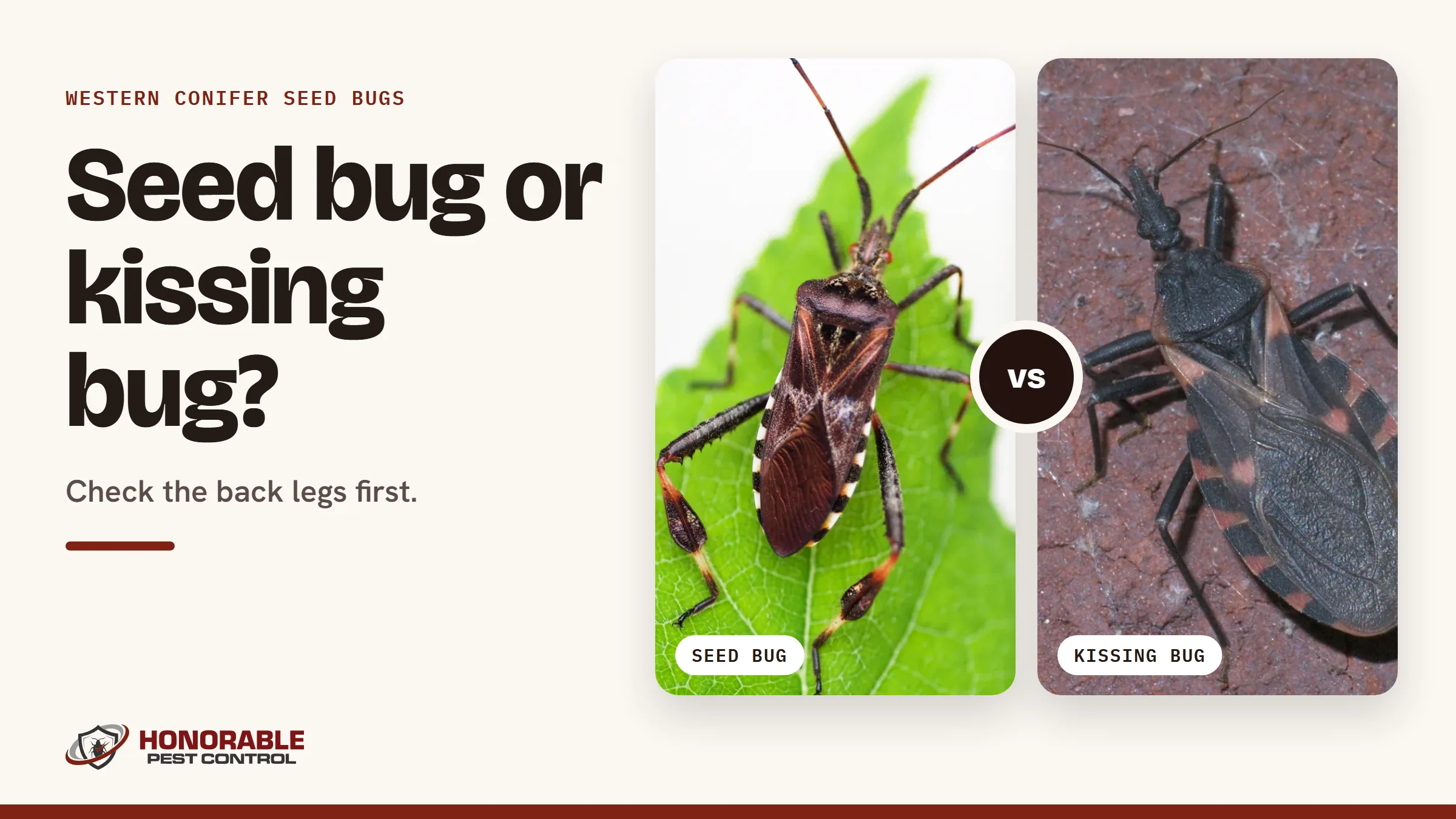
If that big brown bug on your window this fall has flat, leaf-like flares on its back legs, it's a western conifer seed bug, not a kissing bug. Here's how to tell the two apart, what the CDC and MSU say about kissing bugs in Michigan, and how to keep seed bugs out.
 By Nick Russler, ownerLicensed and insured in MichiganPublished
Summary
The short answer
If its back legs have flat, leaf-like flares, it's a western conifer seed bug, about 3/4 inch long. It eats seeds from pine cones and other conifers. It comes inside in fall to spend the winter, and it can't breed in your house. It doesn't bite or sting, MSU says. Kissing bugs haven't been reported in Michigan. The quick tell: a kissing bug has a thin, cone-shaped head and thin legs.
Check the back legs. Flat, leaf-like flares mean a western conifer seed bug, not a kissing bug. Got a few inside? Vacuum them up. Next September is when the outside of the house matters.
Prefer to listen? 35 seconds.
The short version, read aloud. Read by a synthetic voice, not one of our technicians.
In August 2026, a Detroit homeowner snapped a photo of a big bug, and Google said "kissing bug." So they asked MSU Extension. The answer: a seed bug, and harmless. If you're in the same spot, don't panic. Here's how to tell.
What is this big bug on my window?
Check the back legs first. Flat, leaf-like flares mean a western conifer seed bug. It's brown on top and about 3/4 inch long, MSU says. The flare sits partway down each back leg. The Montreal Insectarium calls it a leaf-footed bug. You may also see a thin white zigzag across the middle of the wings. Penn State says it can be darker, or not there at all.
When it flies, you'll hear it. MSU says the loud buzz sounds like a bumble bee. Outside, MSU says, it feeds mainly on the seeds and young cones of conifers.
Western conifer seed bug or kissing bug: how do you tell?
Look at the head and the back legs. A kissing bug has a thinner head, Minnesota Extension says, and its legs are thin, with no leaf-like flares. Ohio State points to the cone-like shape at the front of its head. The seed bug's head is wider, and you can't miss those flat flares.
If you mixed them up, you're not alone. Minnesota says they're a similar color, size and shape. In Chile, researchers got 74 bugs sent in as kissing bugs in 2018 and early 2019, and 63 of them were western conifer seed bugs. That's 85%.
Look-alikes
Western conifer seed bug or kissing bug?
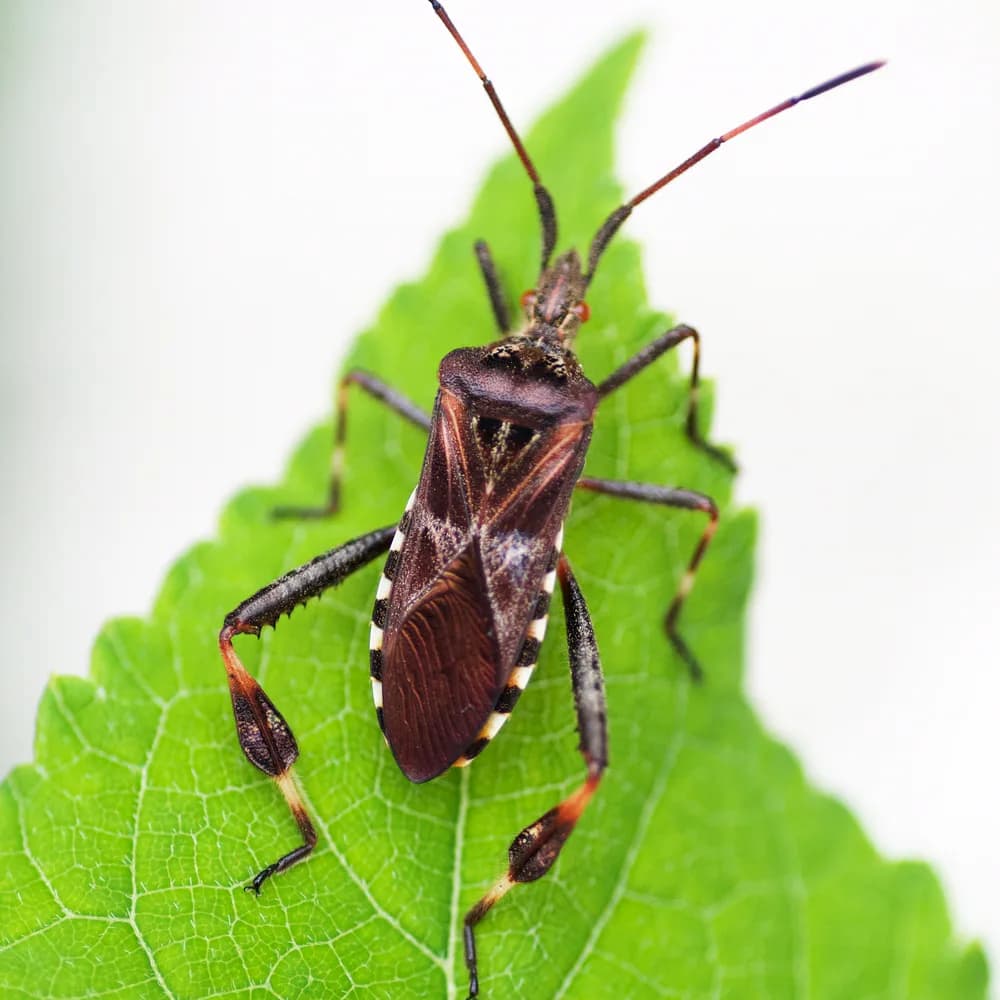
Western conifer seed bugLeptoglossus occidentalis
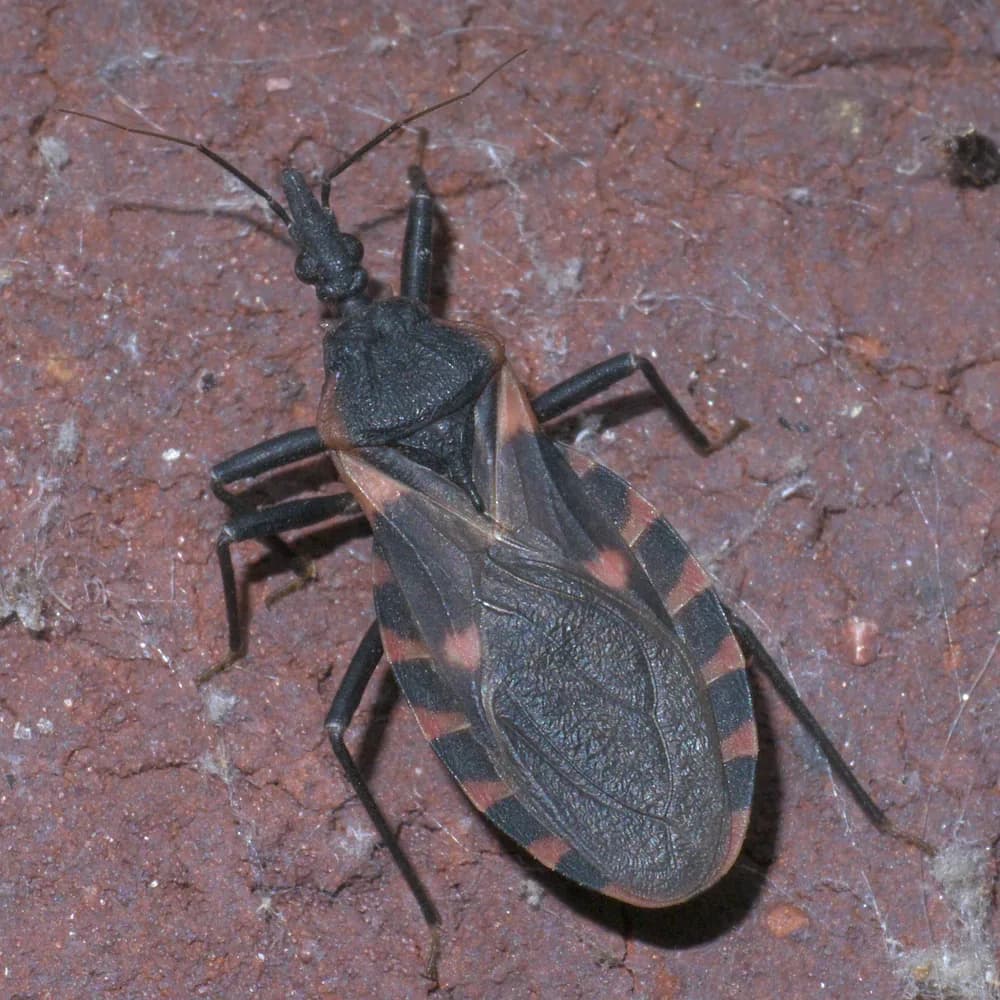
Kissing bugEastern bloodsucking conenose
| Look at | Western conifer seed bug | Kissing bug |
|---|---|---|
| Head | Wider | Thinner, with a cone shape at the front |
| Back legs | A broad, flat, leaf-like flare on each | Thin, with no leaf-like flares |
| Wings and edge | A thin white zigzag across the wings; it can be faint or missing (barely there on this one) | Orange or red stripes around the edge of the body |
| Food | Seeds and young cones of conifers, like pines | Blood, from animals or people |
Are there kissing bugs in Michigan?
They haven't been reported here. MSU said in August 2026 that kissing bugs aren't found in Michigan and occur naturally in the southern US. The CDC's map of states that have reported them leaves Michigan out. Ohio, Indiana and Illinois are on it. Texas A&M says kissing bugs are found in 29 states, and are probably rare in Indiana and Illinois, where they've only been found a few times.
Ohio does have its own kissing bug. Ohio State has had reports mostly from counties in the south of the state, and it says there's been no reported case of Chagas disease caught in Ohio. You may have seen a 2019 headline saying a kissing bug was "confirmed in Michigan." The CDC's map doesn't back that up.
We checked iNaturalist, too, where people post bug photos and others confirm them. It has zero confirmed kissing bug sightings from Michigan, against 5,155 across the US, as of October 13, 2026. That's not proof, but it lines up.
Which fall bug is it?
Not sure which bug you've got? Two questions usually sort it out.
Which one is it?
Which fall bug is it?
Two questions. Look at the back legs first.
See every answer
- seed bug Western conifer seed bug
- It eats pine seeds, doesn't bite or sting, and can't breed in your house. Vacuum it up. How to keep them out
- kissing bug Probably not, but get it checked
- Kissing bugs haven't been reported in Michigan. Don't touch it with bare hands. Use a glove or a plastic bag, keep it in a closed bag or jar, and ask MSU Extension. Ask Extension
- stink bug Brown marmorated stink bug
- A flat, shield-shaped bug that wants your walls for the winter, too. Crush one and you'll know how it got its name. Stink bugs and boxelder bugs
- boxelder bug Boxelder bug
- Black with orange or red markings, and three red stripes behind the head. A smashed one leaves a red stain. Stink bugs and boxelder bugs
- lady beetle Asian lady beetle
- The orange fall beetle that gathers on sunny walls. Crushed ones can stain. Asian lady beetles
Why are western conifer seed bugs in my house?
They want a place to spend the winter. Out West, MSU says, they hide under pine bark, in dead Douglas firs, even in hawk and rodent nests. When it turns cold, they may come into buildings, too. Minnesota says the search starts as the weather cools in September.
They like the sunny sides of your house. They get in through cracks around your windows, doors and siding. The same sunny walls draw Asian lady beetles and cluster flies. If you see one in January or March, it came in last fall, Minnesota says.
Our own count shows the timing: September and October bring far more sightings than any other month.
When people in Southeast Michigan spot western conifer seed bugs
Research-grade iNaturalist sightings by month in Washtenaw, Wayne, Oakland, Livingston, Monroe, Jackson and Lenawee counties, all years, 566 in all. Our count, pulled October 13, 2026. Sightings follow when people are looking, so this shows timing, not how many bugs there are.
Are western conifer seed bugs harmful?
Not to you or your house. MSU says it doesn't bite or sting. The Montreal Insectarium says it doesn't harm people or animals and doesn't carry disease. It can't breed indoors, because it needs its host plant to lay eggs on. It doesn't cause damage, but it may give off a bad smell if you bother it.
Here's the honest part. Penn State says they don't generally bite people. Researchers in Chile say one can give a painful bite, but it doesn't spread disease.
How do you keep them out, and when should you call?
Inside, vacuum them. Outside, the work happens in September. Here's what helps:
- Vacuum the ones inside. MSU says a vacuum works pretty well on these slow bugs.
- Fix the easy gaps. Penn State lists loose screens, windows and doors, gaps around frames and soffits, and unscreened chimneys and vents. That's a job for you or a contractor.
- Know the limit. Caulk may work on older homes with clapboard siding, MSU says, but no amount of it will keep them out of a house with vinyl siding.
- Time the outside. MSU says treating the outside walls in September, especially the south and west sides, when the first bugs gather, can help cut how many get in.
Minnesota Extension goes further. Since only a few usually get in there, it says spraying the outside isn't practical or needed. Honestly, if you see a handful each fall, vacuum them and move on.
Call us if they come back in numbers every fall, or you can't tell where they're getting in. We treat the outside walls where they gather, timed for September, and walk you around the gaps we find so you can get them fixed. We don't seal or caulk. See our stink bug control page.
Seed bugs back on the sunny wall every fall?
Tell us what you're seeing. We time the outside treatment for September and show you the gaps we find, and quotes are free.
Common questions
Do western conifer seed bugs bite?
Not really. MSU says they don't bite or sting, and Penn State says they don't generally bite people. Researchers in Chile say one can give a painful bite, but it doesn't spread disease.
Will they lay eggs in my house?
No. They can't breed indoors, because they need their host plant to lay eggs on, the Montreal Insectarium says. The ones you see in winter or spring came in the fall before, Minnesota Extension says.
Where did western conifer seed bugs come from?
The West. They spread east and were first found in Michigan in the fall of 1987, MSU says. Trade has since carried them as far as Europe, Japan and Chile, Penn State says.
What if I think I found a real kissing bug?
Don't touch it with bare hands. Texas A&M says to catch it with a glove or a small plastic bag and keep it in a closed bag or container. Then ask MSU Extension through Ask Extension, the way the Detroit homeowner did. If you're worried about a bite, Texas A&M says to call your healthcare provider.

About this page
Nick wrote this. The facts come from the sources below, checked on October 13, 2026. The sightings are our own count of iNaturalist posts, so they show when people spot the bugs, not how many there are. Look-alike photos: Daslexia and Robert Webster (xpda.com), CC BY-SA 4.0, via Wikimedia Commons, cropped, with our labels added. We're not doctors, so call yours about a bite that worries you. See something wrong? Tell us and we'll fix it.
Sources
- Michigan State University Extension, Plant & Pest Diagnostics, Western conifer seed bug
- Ask Extension, answered by MSU Extension, Is this a Kissing Bug? #941811 (August 2026)
- University of Minnesota Extension, Western conifer seed bug and hackberry psyllids (reviewed 2024)
- Penn State Extension, Western Conifer Seed Bug (updated 2026)
- Ohio State University Extension, Buckeye Yard & Garden onLine, The Ohio Kissing Bug Conundrum (2025)
- Texas A&M University Kissing Bug Community Science Program, Frequently Asked Questions
- Centers for Disease Control and Prevention, How Chagas Disease Spreads (reviewed 2026)
- Faundez, Carvajal and Villablanca, Alien Invasion: The Case of the Western Conifer-Seed Bug in Chile, Overreaction, and Misidentifications, Journal of Medical Entomology (2020)
- Montreal Insectarium, Espace pour la vie, Western conifer seed bug
- iNaturalist, research-grade observations in Washtenaw, Wayne, Oakland, Livingston, Monroe, Jackson and Lenawee counties (our count, pulled 2026-10-13)

Ann Arbor, MI · Licensed and insured
Big brown bugs on the windows every fall?
Tell us what you are seeing and where you live. We check we cover your street and give you the price first.
500+ Customer Reviews·Michigan pesticide business license #820457