
Asian lady beetles
Why are Asian lady beetles all over my house?
They are hunting for a winter shelter, and a sunny, light-colored wall with a gap in it looks like the best one on the street. Here is how to tell them from native ladybugs, when to seal, why caulk fails on vinyl siding, and how to clear them out without a bug bomb.
 By Nick Russler, ownerLicensed and insured in MichiganPublished

The short answer
- Best field clue
- M or W mark behind the head
- Big invasion months
- Usually September and October
- What sets off the swarm
- First warm days after a cold snap
- Walls they pick
- Sunny south and west
- Gap they need
- About 1/8 inch
- Breed indoors
- No
Asian lady beetles swarm Michigan houses in fall because they are hunting for a winter shelter, and a sunny wall with a gap in it looks like one. MSU Extension says they normally move to homes on the first few warm days after the first fall cold snap. They do not breed indoors or damage the house, but crushed beetles can stain, and some people become allergic to them. The big months are usually September and October, MSU says, so finish sealing before then, from the inside on a vinyl-sided house, and vacuum the ones that get in instead of spraying.
Prefer to listen? 51 seconds.
The short version, read aloud. Read by a synthetic voice, not one of our technicians.
Asian lady beetle or native ladybug?
The multicolored Asian lady beetle, Harmonia axyridis, comes from northeastern Asia and was first officially reported in Michigan in 1994.
MSU says they range from pumpkin-orange to mustard-yellow to black, and in Michigan most seem to be mustard-yellow. Adults are about 1/4 inch long, with no spots or up to about 19.
The best clue is an M- or W-shaped mark on the white section behind the head, the pronotum. MSU says our familiar native ladybugs lack it. On dark beetles it can be filled in to a solid black patch, and it can look thick, thin or broken.
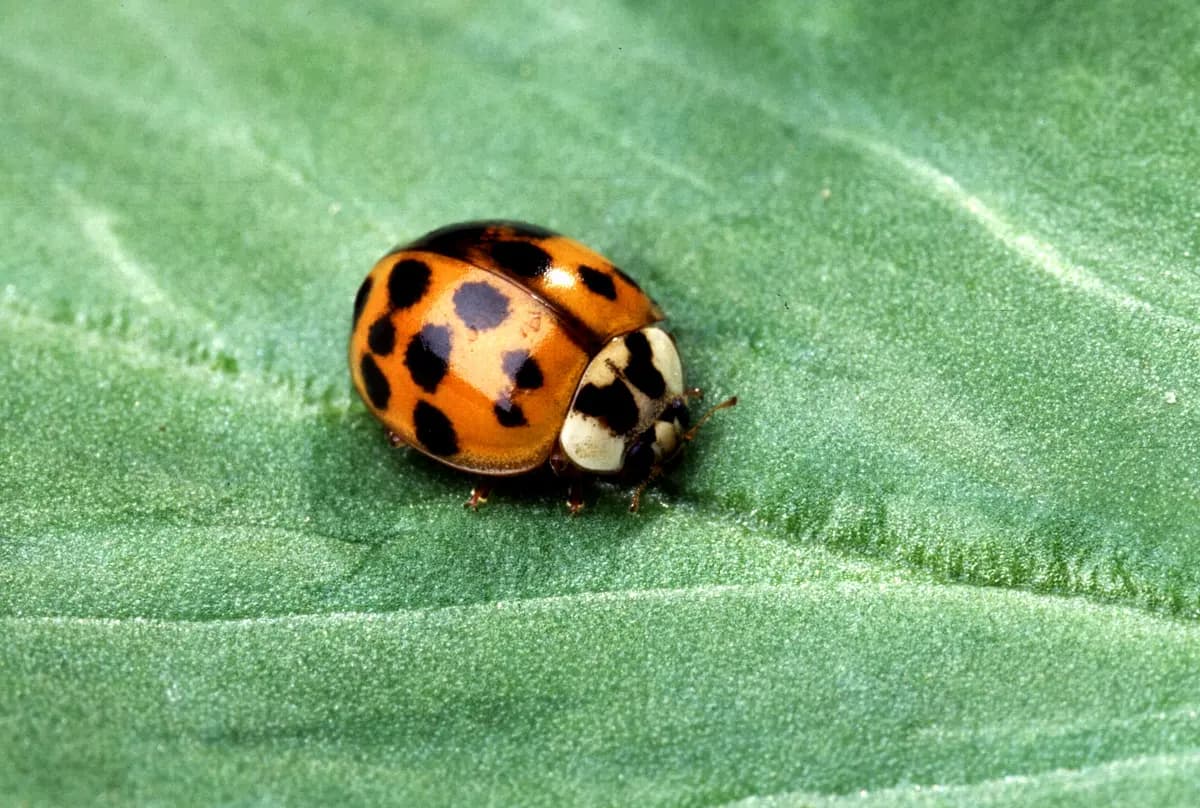
Ohio State says native lady beetles usually winter in sheltered spots outdoors, while this one often winters in and around buildings. Stink bugs and boxelder bugs do the same.
Why your house, and why the sunny side
In Asia they winter in cliff-face cavities, MSU says, and here the outside of a building is the stand-in.
MSU Extension says to check the sunny south and west walls first; fall invaders like these seem to enjoy heat reflected off light siding and big windows. Homes near woods or fields are especially prone, Kentucky's extension adds.
Dark-colored houses are reported to generally have fewer problems, MSU says, though Kentucky finds light-dark contrast, like dark shutters on a pale wall, matters more than color.
They are not coming in to get warm; Ohio State calls that a common misconception. They want cool, steady shelter, and ones that end up in heated rooms starve, which is one reason dead beetles pile up indoors.
When they come in Michigan
The trigger is the weather, not a date. MSU says they normally start moving to homes on the first few warm days after the first fall cold snap. Research in Ohio, Ohio State says, puts it at the first day over 64 F after a sharp drop in temperature, usually to near freezing.
| When | What the beetles are doing | What to do |
|---|---|---|
| Late spring and summer | Outdoors, eating aphids | Best time to seal gaps |
| Before September | Still outdoors; the big months are usually September and October | Finish sealing and screening |
| Late September to early October | First beetles land on the house | The window for an exterior treatment |
| First warm days after the first cold snap | Swarming on the sunny south and west walls | Watch the sunny side; vacuum strays |
| Winter | Resting in walls and attics; a few wake on calm, sunny days | Vacuum any that wander out |
| Late winter and early spring | Waking as the siding nears 50 F; gathering at sunny windows | Vacuum; these got in last fall |
From MSU Extension, Ohio State and the University of Kentucky.
Sealing, and the vinyl siding problem
MSU says they get in through soffit vents, gaps around windows and other cracks on the outside, then reach the rooms through outlets, switches, heating vents and ceiling fixtures. Ohio State and Minnesota say a gap of about 1/8 inch is enough.
No amount of caulk will keep the beetles out of homes with vinyl siding.
Howard Russell, Michigan State University Extension
The reason, MSU explains: vinyl siding and soffits are hung loosely so the panels can expand and contract. Caulk may still work on older wood clapboard. What helps on any house:
- Seal the inside of the wall. MSU says caulking around outlets, switches, light fixtures and inside trim helps keep the beetles trapped in the walls.
- Screen the vents. Ohio State says to cover attic vents, and fans that vent into the attic, with insect screening, 20-mesh maximum.
Once they are inside: vacuum, do not bomb
Do not crush them: disturbed beetles leak a yellowish, smelly fluid from their leg joints that Ohio State says can permanently stain walls, drapes and carpet. Vacuum them instead:
- Put a stocking in the hose. A knee-high nylon stocking held in the hose with a rubber band catches the beetles, as MSU and Ohio State suggest.
- Tape or freeze the bag. Vacuuming does not automatically kill them, Minnesota says, so tape the bag shut and toss it, or freeze it, as Penn State advises.
- Hand it off if you are allergic. Penn State says the vacuum exhaust spreads their defensive compound, so allergic people may not be able to vacuum them.
MSU says long exposure has been reported to cause allergic reactions in some people, and dust from dead beetles in wall voids may trigger allergies or asthma.
Ladybug sensitization and allergy in one West Virginia allergy practice
Top bar: share of patients skin-tested for ladybug who were sensitized. Other bars: share of the practice's patients the study linked to ladybug allergy. From a 2007 study in Allergy and Asthma Proceedings. These are allergy-clinic patients in an area where the beetles are established, not the general public, and there is no Michigan figure.
Skip the bug bomb and the indoor spray
Ohio State says not to use any fogger or bug bomb: it misses the beetles in the walls, and the dead ones draw carpet beetles, larder beetles and ants.
MSU does not recommend indoor insecticide either: with the furnace running, it recirculates through a closed house.
Do it yourself, or call someone?
Most of this is a do-it-yourself job. A few beetles on the siding are normal for a Michigan fall, and you may not need anyone.
If sealing is hard, as on vinyl, Penn State says an exterior treatment by a licensed pest control operator may offer some relief. Sunlight breaks it down, so it may not last much beyond several days to a week or two, and MSU says it has to go on in late September or early October.
Not every MSU author is sold on it: one says sprays on foundations or siding are usually not very effective, because the beetles only briefly touch them on the way in.
MSU adds that pest control companies are usually reluctant to treat living areas, mainly because they cannot guarantee the beetles will stay gone.
It is worth a call when hundreds gather on the sunny side, or when you cannot find where they are getting in. On Honorable Shield we treat the outside where they gather and show you the gaps we find so you can get them sealed. We do not caulk or repair. Stink bugs and boxelder bugs are on the same covered list.
Lady beetles covering the south wall?
Tell us what you are seeing. Asian lady beetles are on the Honorable Shield covered list, and quotes are free.
Common questions
Do Asian lady beetles bite?
They can pinch, usually without breaking the skin. MSU says some bite and most do not, and the prick is often the spurs on their legs. They carry no disease, have no toxin in their mouthparts, and the pain is usually short-lived.
Are Asian lady beetles dangerous to pets?
Do not assume they are harmless. Penn State Extension says pets that eat the beetles may get chemical burns inside the mouth. If your dog or cat has been eating them, call your vet.
Why are there more of them in spring?
There are not more, and they are not breeding. MSU says they do not breed or reproduce indoors; Purdue says they have only concentrated and shifted indoors, and MSU says they wake as the days lengthen and the siding nears 50 F.
Did the DNR release them in Michigan?
No. MSU says that, to its knowledge, no intentional releases ever happened in Michigan, and that despite the rumors it was not released by the DNR, MSU or chemical companies. It was first found in Ontario in 1992 and first officially reported in Michigan in 1994.

About this page
Written by Nick Russler, owner of Honorable Pest Control in Ann Arbor, Michigan. The facts here come from Michigan State University Extension, Ohio State, the University of Kentucky, Penn State, the University of Minnesota, Purdue and a study in Allergy and Asthma Proceedings, all read on September 29, 2026. We do not diagnose or treat allergies; see a doctor about any symptoms. If something here is out of date or wrong, tell us and we will fix it.
Sources
- Michigan State University Extension, Lady Beetle FAQs
- Michigan State University Extension, Multicolored Asian Lady Beetle
- Michigan State University Extension, They're back: Multicolored Asian ladybeetles out and about (2010)
- Michigan State University Extension, Five fall insect invaders (2011)
- Michigan State University Extension, Fall invading insects (2009)
- Michigan State University Extension, Why are there lady bugs on my windowsill? (2015)
- Michigan State University Extension, Multi-colored Asian lady beetles are moving from fields to homes (2014)
- Ohio State University Extension, Multicolored Asian Lady Beetle, fact sheet ENT-44 (2014)
- University of Kentucky Entomology, ENTFACT-416 (revised 2026)
- Penn State Extension, Multicolored Asian Lady Beetle (updated 2026)
- University of Minnesota Extension, Multicolored Asian lady beetles (reviewed 2021)
- Purdue University Extension Entomology, publication E-214 (2017)
- David W. Goetz, Allergy and Asthma Proceedings 28(1):50-57 (2007), via PubMed
Ann Arbor, MI · Licensed and insured
Lady beetles on the house every fall?
Tell us what is on your walls and where you live. We check we cover your street and give you the price first.
500+ Customer Reviews·Michigan pesticide business license #820457