

Carpenter ants
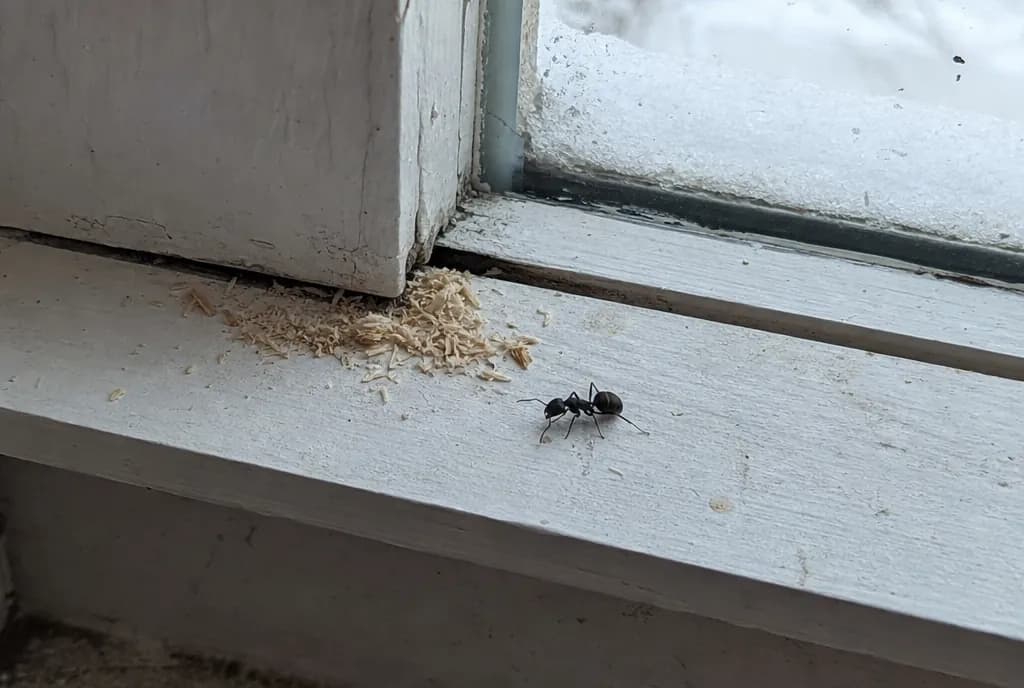
What do carpenter ants look like, and is that sawdust a problem?
Big, black or red and black, 3/8 to 1/2 an inch long, with one bump at the waist and a smoothly rounded back. They do not eat wood; they dig nests in wood that is already wet. Here is how to recognize them, what the sawdust means, how to tell a flying ant from a termite, and the one sign that means the colony is inside the house.
 By Nick Russler, ownerLicensed and insured in MichiganPublished
The short answer
- Worker size
- 3/8 to 1/2 in
- Color
- Black, or red and black
- Waist
- One node
- Eats wood
- No, digs in it
- Nests in
- Wet or rotting wood
- Nest inside if seen in
- Winter
Carpenter ants are among the biggest ants in Michigan. Workers are 3/8 to 1/2 an inch, black or red and black, with a single node at the waist and a smoothly rounded thorax, per the University of Minnesota. They do not eat wood. They chew out nests in wood that is wet and already softening, and push out coarse sawdust. The telling sign, says Michigan State University: seeing them indoors in winter, when they cannot be active outside, strongly suggests a colony inside the house.
Prefer to listen? One minute 3.
The short version, read aloud. Read by a synthetic voice, not one of our technicians.
Big black ants on the kitchen floor in March, a winged one on the window, a little pile of sawdust under the sill. Every spring someone in Southeast Michigan finds all three and assumes the house is being eaten.
It is not, and MSU is emphatic on that. But carpenter ants are a sign worth reading, because they only move into wood that has a water problem.
What carpenter ants look like
- Size: workers are usually 3/8 to 1/2 an inch long, and a queen can be up to an inch, per UMN.
- Color: black, or red and black.
- Shape: a single node, or bump, at the narrow waist, and a back that is evenly rounded when you look from the side.
- Antennae: bent at an elbow, like every ant.
The black carpenter ant is one of the largest and most common ants in Michigan. MSU's diagnostician once nominated it, half seriously, as the unofficial state insect, because nearly everyone in the state has met one.
Do carpenter ants eat wood?
No. That is the most common mix-up, and MSU puts it plainly: unlike termites, carpenter ants only nest in wood, they do not eat it. The wood they choose is wet and well on its way to rotting. MSU adds that no house in Michigan has collapsed because of carpenter ants.
When they nest indoors, they are a symptom of a water problem.
Michigan State University Extension
Indoors, MSU lists the usual spots: wet areas around windows and doors, showers and bathtubs, dishwashers, leaky pipes and drains, and under leaking shingles or roof vents. They also turn up in hollow-core doors and in foam insulation.
Are they nesting in the house, or just visiting?
MSU's first question is always the same: do you see them indoors during the winter?
| What you see | What it usually means |
|---|---|
| Ants indoors in winter | A colony is very likely nesting inside the building |
| Ants indoors in summer | Not necessarily a nest; they may be coming in from outside |
| Winged ants indoors in summer | Not by itself a sign of a nest; swarmers wander in and most die |
| Winged ants indoors in winter | A colony in the house, thriving, and there at least two years |
Carpenter ants are most active at night, so the best time to watch where they travel is after dark.
What the sawdust means
Carpenter ants keep a tidy nest. MSU says they push wood shavings, food debris and dead ants out, and it collects below the nest, often in basements, along the tops of foundation walls and in spider webs. That pile of coarse sawdust, called frass, is one of the best clues to where the nest is.
Sawdust is not always ants. MSU tells of a homeowner whose shavings came from an electrician who drilled through the joists and did not sweep up. Look above the pile for fresh holes before you worry.
Flying ant or termite?
In spring both show up as winged insects near windows, and they are easy to tell apart once you know the three differences, per the University of Maryland and UMN:
| Flying ant | Termite swarmer | |
|---|---|---|
| Waist | Pinched, narrow | Straight, no waist |
| Antennae | Bent at an elbow | Straight |
| Wings | Front pair longer than the back pair | Both pairs about the same length |
If it turns out to be a termite, that is a job for a termite specialist. We do not treat termites, and we will tell you so rather than sell you an ant treatment for it.
What to do about carpenter ants
- Find the nest. MSU says the best control is to find the nest and treat it directly. Start in the room where you see the most ants, watch where they go at night, and look for frass.
- Fix the water. Whatever made the wood wet will draw the next colony. MSU's advice is to make the repairs that keep the area dry once the nest is treated.
- Check the likely spots. Window and door frames, around the tub and dishwasher, under the sink, and anywhere the roof has leaked.
Seeing big black ants in the house?
Our exterminators name the ant, find the nest and treat that, then show you the moisture that drew them. Ants are covered by Honorable Shield. Quotes are free.
A few big ants in the kitchen in July may just be foragers from outside. Ants indoors in winter, or frass under the sills, are when our ant control visit earns its keep.
Common questions
How big are carpenter ants?
Workers are usually 3/8 to 1/2 an inch long, and a queen can be up to an inch, per the University of Minnesota. They are among the largest ants in Michigan.
Do carpenter ants eat wood?
No. MSU says they only nest in wood and do not eat it. They chew out galleries in wood that is wet and softening, and push the sawdust out.
Can carpenter ants destroy a house?
MSU says no house in Michigan has collapsed because of carpenter ants. The water problem that drew them is usually the bigger issue, and it is worth fixing.
Why do I see carpenter ants in winter?
Because they are likely living inside. MSU says ants indoors in winter, when they cannot be active outside, strongly suggest a colony in the building.
Are winged ants a sign of carpenter ants in my house?
In summer, not on their own; swarmers wander in and most die. In winter, MSU says winged ants mean a thriving colony that has been in the house at least two years.
How do I tell a flying ant from a termite?
A flying ant has a pinched waist, elbowed antennae and front wings longer than the back ones. A termite has no waist, straight antennae and wings of about equal length.
When are carpenter ants most active?
At night, per MSU. That is the best time to follow them back toward the nest.

About this page
Written by Nick Russler, owner of Honorable Pest Control in Ann Arbor, Michigan. The facts here come from Michigan State University Extension, the University of Minnesota Extension and the University of Maryland Extension, all read on September 26, 2026. If something here is out of date or wrong, tell us and we will fix it.

Ann Arbor, MI · Licensed and insured
Big black ants in the kitchen?
Tell us where you see them and where you live. We check we cover your street and give you the price first.
500+ Customer Reviews·Michigan pesticide business license #820457