
Moles, voles and chipmunks
Moles in Michigan: the two kinds and what they do to a yard
Moles in Michigan come in two kinds. The eastern mole is by far the most common one in suburban yards, and the star-nosed mole mostly sticks to damp ground near water. Here's how to tell them apart, where each turns up around here, and whether you need to worry.
 By Nick Russler, ownerLicensed and insured in MichiganPublished
Summary
The short answer
Southern Michigan has two moles, MSU says: the eastern mole and the star-nosed mole. The eastern mole is by far the most common one in suburban yards. The star-nosed mole lives mostly in damp soil near ponds and wetlands. Moles eat mostly earthworms and insects. MSU calls them beneficial, but says home remedies like gum and glass in the tunnels can be dangerous to you or your pets.
Southern Michigan has two moles, and the one in a typical suburban yard is most likely the eastern mole. Ridges in your lawn and not sure what's making them? Call us at (734) 519-6671.
Prefer to listen? One minute 1.
The short version, read aloud. Read by a synthetic voice, not one of our technicians.
Fresh ridges winding across your yard this fall? Moles in your yard? If you're on a suburban lot, they're most likely eastern moles hunting for worms and insects. Below: a card of the two moles in Michigan, a map of where people found each one near us, and straight answers on danger and basements.
Which two moles live in Michigan?
The eastern mole and the star-nosed mole. MSU Extension says southern Michigan has these two, and the eastern mole is by far the most common one in suburban yards. So if you live on a regular neighborhood lot, that's probably your mole.
Which mole is it?
Eastern mole vs star-nosed mole
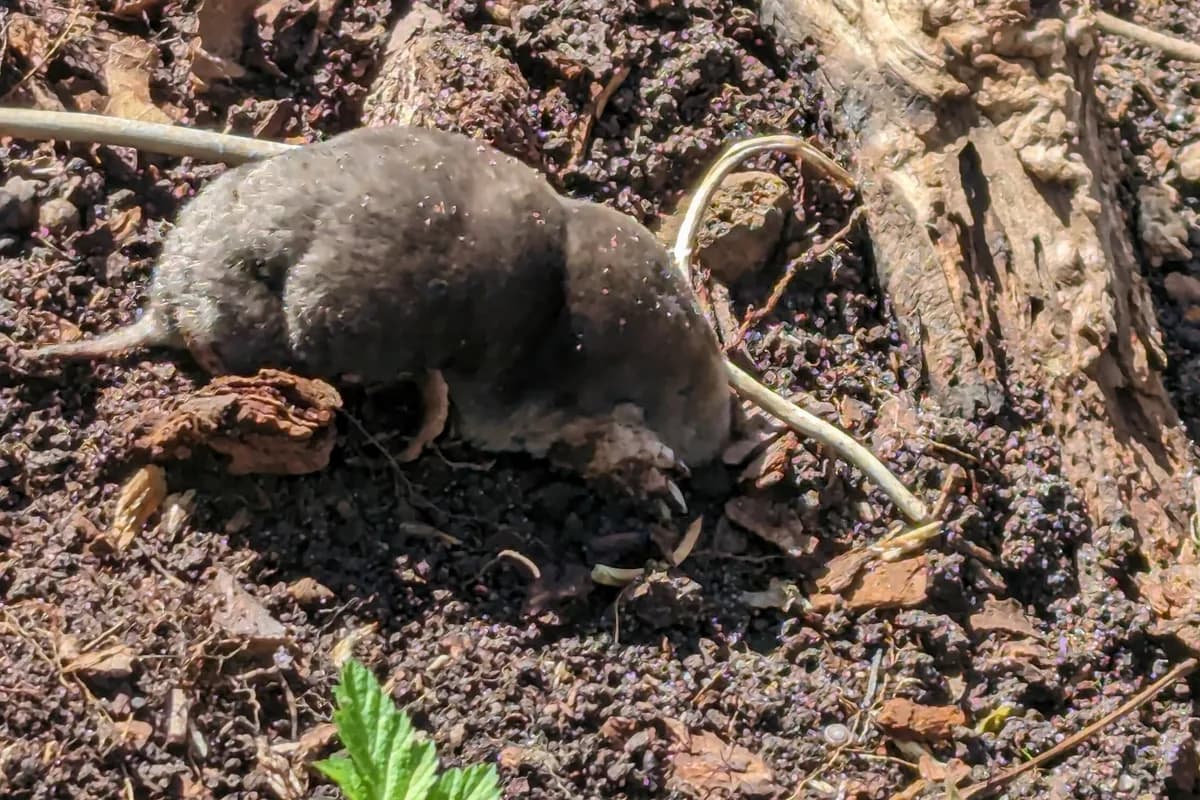
Eastern moleThe lawn mole
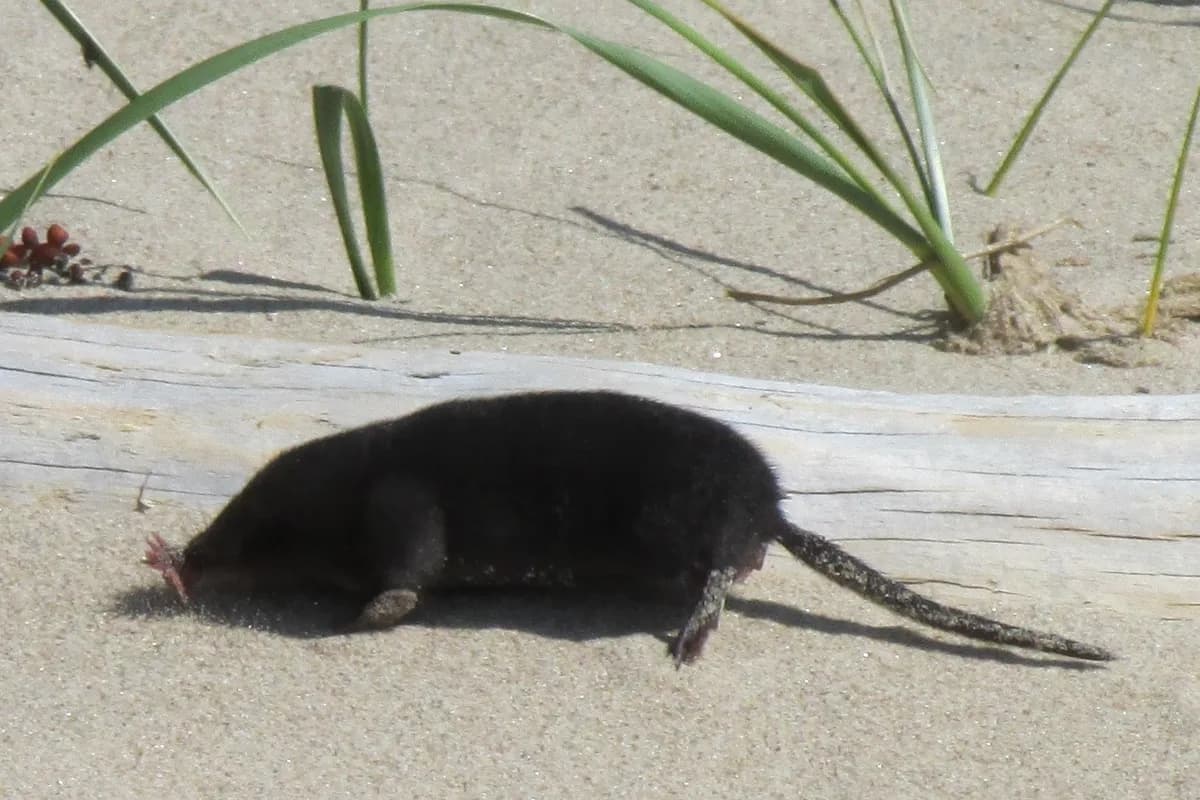
Star-nosed moleThe wetland mole
| Look at | Eastern mole | Star-nosed mole |
|---|---|---|
| Nose | Pointed snout | A ring of 22 pink, fleshy feelers |
| Front feet | Big, shovel-like, with large claws | Shovel-like too, with large claws |
| Tail | Short, almost naked | Longer, covered in coarse hair |
| Fur | Short and velvety, usually gray to silvery-gray | Short, dense and coarser; dark brown to black on the back |
| Lives in | Lawns, gardens, fields and woods with loamy or slightly damp soil | Damp soil near ponds, marshes and other wetlands |
| Leaves behind | Long, winding ridges, and molehills from deeper tunnels | Mostly molehills; only now and then a raised ridge |
Both have tiny eyes, ear openings hidden in thick fur, and big claws on shovel-like front feet, MSU says. The eastern mole has a pointed snout and a short, almost naked tail. The star-nosed mole's fur is dark brown to black and coarser than other moles', and its tail is covered in coarse hair, ADW says.
That star is all about touch. A 2011 research review calls star-nosed moles touch specialists that explore with the 22 feelers ringing their nostrils.
Where do moles in Michigan live?
Eastern moles live in lawns and gardens. Star-nosed moles mostly stick to wet ground. ADW says eastern moles dig in forests, pastures, gardens and lawns like yours, as long as the soil is loamy or slightly damp. Despite the name Scalopus aquaticus, they usually avoid soggy ground by the water.
Star-nosed moles like it wet: marshes, wet meadows and the banks of streams, lakes and ponds, ADW says. Many of their tunnels open under the water. Every so often, one may push its tunnels into a lawn next to a wetland.
Our own count
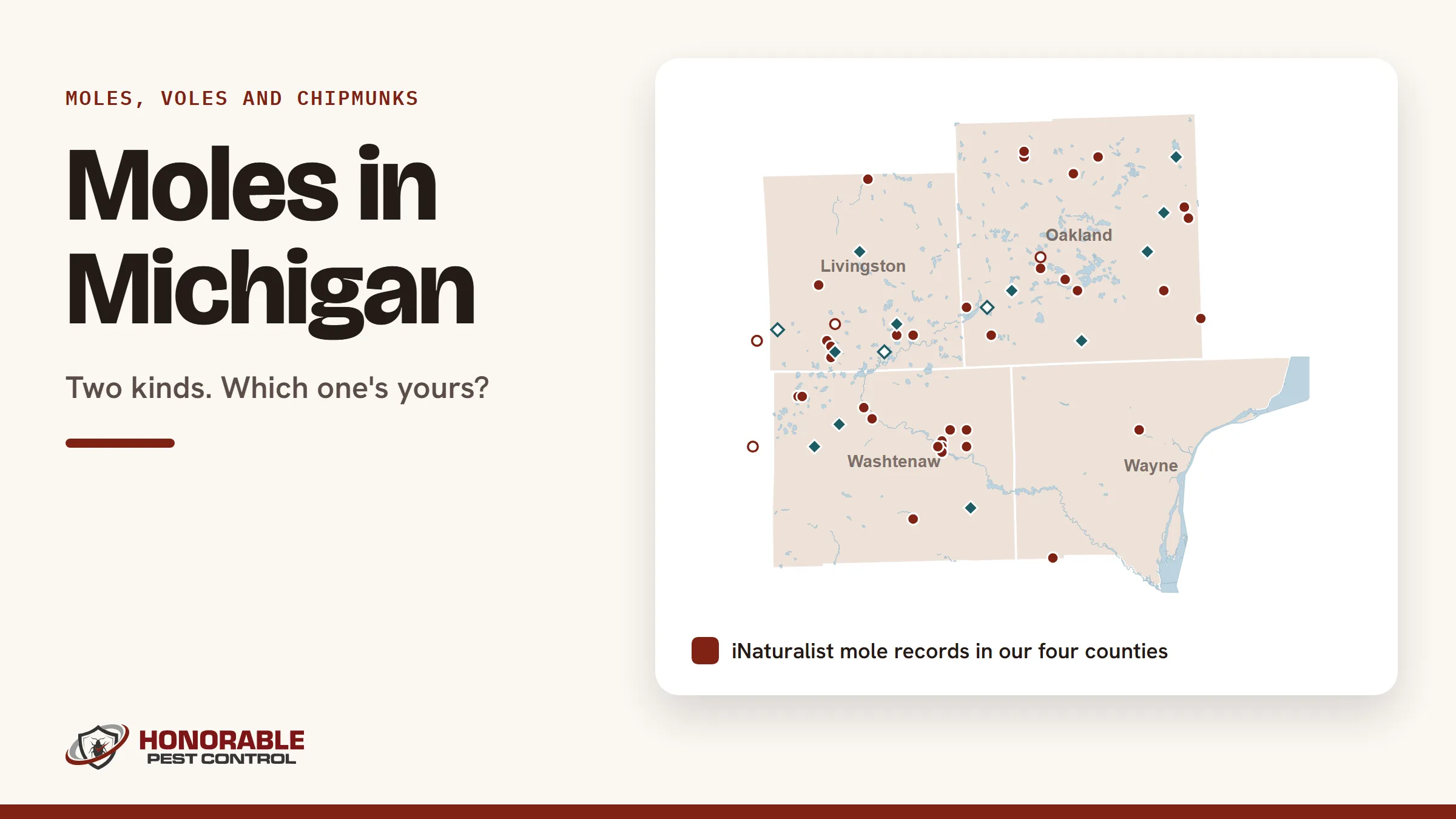
Where people have found moles in our four counties
- Eastern mole
- Star-nosed mole
- Open marker: spot hidden by iNaturalist
- Lakes, ponds and rivers
| County | Eastern mole | Star-nosed mole |
|---|---|---|
| Oakland | 16 | 8 |
| Washtenaw | 15 | 3 |
| Livingston | 9 | 5 |
| Wayne | 2 | 0 |
| All four | 42 | 16 |
To see where moles in Michigan turn up near you, we counted every research-grade iNaturalist record of both moles in our four counties. You can see 42 eastern mole records and 16 star-nosed mole records on the map, and Oakland County had the most of each. Most are marked dead, and ADW says eastern moles rarely come out of their burrows.
Most of the moles people found were dead
Research-grade iNaturalist records in Washtenaw, Livingston, Oakland and Wayne counties, all years, by the Alive or Dead tag, in our own count pulled November 1, 2026. One eastern record has no tag. These are moles someone happened to find and post, not a count of the moles in your county, and records follow where people look. Bar length shows each mole's share.
What do moles do to a yard in Michigan?
They dig up your yard looking for food. What do moles in Michigan eat? MSU says mostly earthworms and insects. In warm, damp weather, eastern moles feed just under the surface, and that pushes up the long, winding ridges. In dry weather and in winter, they dig deeper, sometimes over 2 feet down. The extra soil may get pushed up as molehills.
Here's the good news: it's probably not an army. MSU says the maze in your lawn was more likely made by only a few moles, and quite possibly just one. And killing grubs won't fix it: MSU's Kevin Frank says getting rid of grubs won't get rid of moles. Purdue says moles are most active near the surface in spring and fall, on damp days or after rain.
Stepped down a ridge while the homeowner watched from the doorwall, and the next morning they were out there in a lawn chair right next to it, waiting to see if it came back up.
Want to read the damage itself? Here's how to tell vole runways from mole ridges. New ridges every few days? Call us at (734) 519-6671 and we'll find the runways that are still in use.
Are moles dangerous?
Not to you, as far as the sources go. MSU calls moles beneficial animals. They eat a lot of insects that could become pests, and they loosen up the soil. And ICWDM says no diseases are known to pass from moles to people. The tunnels and mounds can trip you up, though.
The bigger risk is what people stuff down the holes. MSU says home remedies like chewing gum, razor blades, glass and hair don't work and can be dangerous to you or your pets. And MSU says it isn't legal to put down a grub insecticide to kill moles, because those products aren't labeled for moles.
Can moles get in the house or basement?
Honestly, we couldn't find a university source that covers moles getting into houses. ADW says eastern moles rarely come out of their burrows. As for your house, ICWDM says mole damage to structures tends to be limited to brick patios and pools, where digging can loosen things.
So what's that small gray animal the cat left by the door? MSU says cats more often catch shrews on the surface. And Purdue says several kinds of mice use mole runways. Something moving around inside? Read our post on the signs of mice in the house, or tell us what you're seeing and we'll come take a look.
Is it a mole or something else?
Long, winding ridges come from an eastern mole's shallow feeding tunnels, MSU says. Moles aren't rodents, Purdue says, but rodents do borrow their tunnels. ICWDM says most of the direct garden damage blamed on moles is done by rodents using mole tunnels to reach plants. Our guide to mole, vole and chipmunk lawn damage walks through the differences. If it turns out to be voles, that's vole control, a different job.
When should you call us about moles?
When the ridges keep spreading, or you'd rather not deal with traps. Our mole control visits find the runways that are still in use, set traps there, and come back to check them. It's its own add-on, not part of the Honorable Shield plan. Nothing stops a new mole from moving into good habitat later, so we'll tell you up front what the follow-up covers.
Already tried and still finding fresh ridges? Get a free quote with the form below, or call (734) 519-6671.
Want the live runways found?
We find the runways that are still in use, set traps there and come back to check them. Mole control is an add-on, not part of Honorable Shield. Quotes are free.
Rather not call? Get your free quote right here.
What are we dealing with?
Tap everything you have seen. Most homes have more than one.
Takes about 30 seconds. Or just call (734) 519-6671.
No obligation. We confirm availability and explain the recommended next step.
Common questions
What kind of moles live in Michigan?
Two. MSU says southern Michigan has the eastern mole and the star-nosed mole. The eastern mole is by far the most common one in suburban yards. The star-nosed mole lives mostly in damp soil near ponds, marshes and other wetlands, and sometimes even swims and feeds underwater.
Are moles dangerous?
Not to people, as far as the sources go. MSU calls moles beneficial, and ICWDM says no diseases are known to pass from moles to humans. Their tunnels and mounds can trip you, though. And MSU says home remedies like gum, glass and razor blades can be dangerous to you or your pets.
Can moles get in your house or basement?
We couldn't find a university source that covers it. ADW says eastern moles rarely come out of their burrows, and ICWDM says mole damage to structures tends to be limited to brick patios and pools. And if the cat brought in a small gray animal, MSU says cats more often catch shrews.
Why are there moles in my yard?
Food. MSU says moles eat mostly earthworms and insects, and they're drawn to well-watered, fertilized lawns. Don't let the mess fool you, either. MSU says the maze across a lawn was more likely made by only a few moles, and quite possibly just one.

About this page
Nick wrote this. The facts come from the sources below, checked on November 1, 2026. The map and county counts are our own count of iNaturalist records. Photos: Matthew Spoor (CC BY 4.0, via iNaturalist) and Marilyne Busque-Dubois (CC BY 4.0, via Wikimedia Commons). See something wrong? Tell us and we'll fix it.
Sources
- Michigan State University Extension, What to do about moles (2007, from MSU Museum wildlife specialist Jim Harding)
- Michigan State University Extension, The supreme pest of lawns: Moles (Kevin Frank, 2010)
- Michigan State University Extension, Common myths about moles in lawns (Kevin Frank, 2006)
- Animal Diversity Web, University of Michigan Museum of Zoology, Scalopus aquaticus (eastern mole)
- Animal Diversity Web, University of Michigan Museum of Zoology, Condylura cristata (star-nosed mole) (Sean Zera, 2004)
- Internet Center for Wildlife Damage Management, Mole Damage Identification
- Purdue University Cooperative Extension Service, ADM-10: Moles (Judy Loven, USDA-APHIS Wildlife Services, revised 2005)
- Government of Ontario, Species at Risk: Eastern mole
- Catania, The sense of touch in the star-nosed mole: from mechanoreceptors to the brain, Philosophical Transactions of the Royal Society B (2011)
- Our own count, pulled November 1, 2026: iNaturalist research-grade eastern mole and star-nosed mole observations in Washtenaw, Wayne, Oakland and Livingston counties

Ann Arbor, MI · Licensed and insured
Moles working the yard this fall?
Tell us what you're seeing and where you live. We'll check that we cover your street and give you the price first.
500+ Customer Reviews·Michigan pesticide business license #820457