
Chipmunks
Do chipmunks hibernate? Where chipmunks go in winter
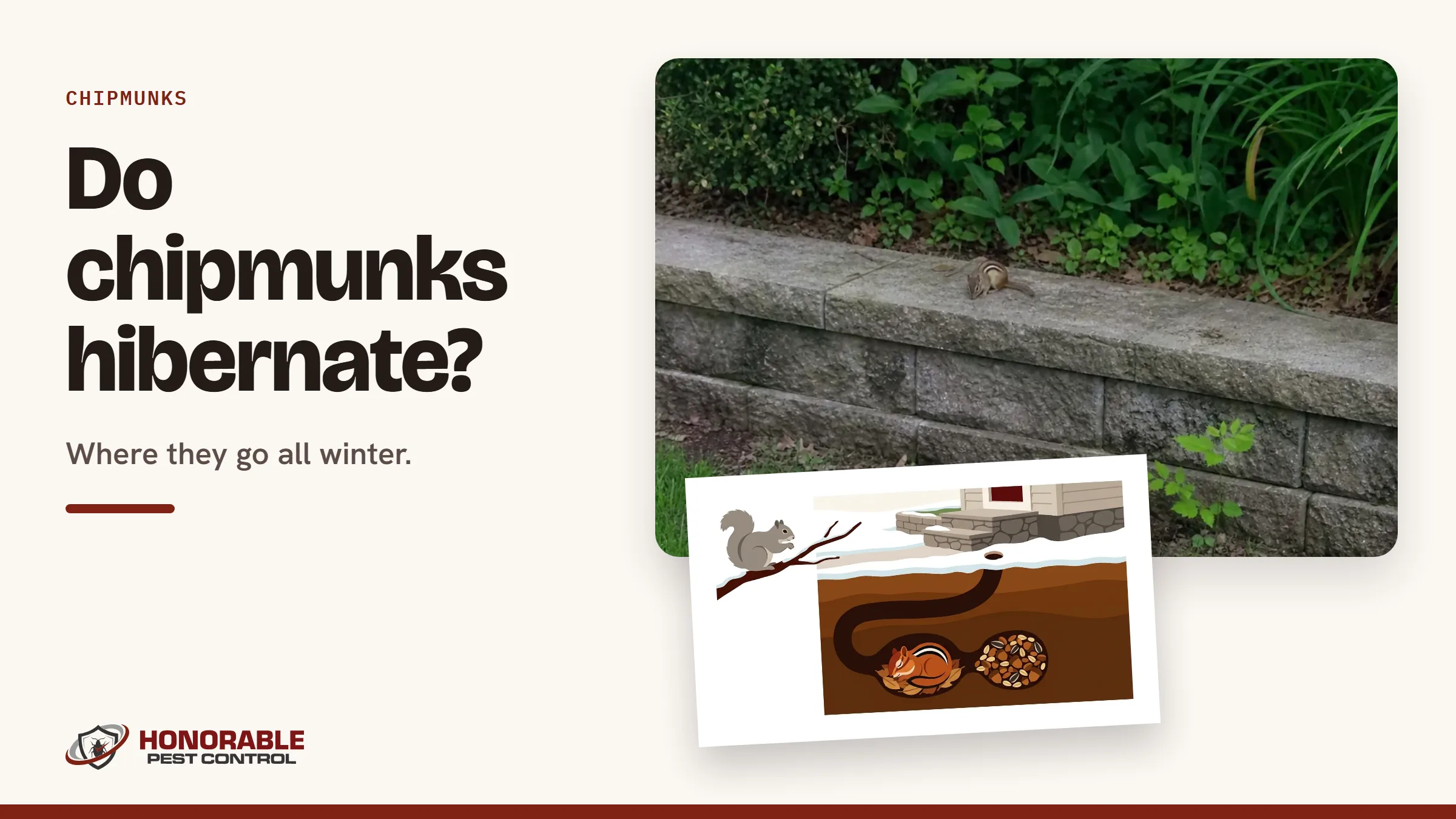
Not truly. Chipmunks go quiet underground from late fall to spring, but they are only dormant: they wake now and then to eat from a food store in the burrow, and some come out on warm, sunny winter days. Here is where they spend the winter, how to tell a chipmunk from a squirrel, and what the neat hole by your front step means.
 By Nick Russler, ownerLicensed and insured in MichiganPublished
The short answer
- True hibernator
- No; dormant only
- Winter food
- A store in the burrow
- Out on
- Some warm winter days
- Burrow entrance
- About 2 in, no dirt pile
- Main tunnel
- 20 to 30 ft
- Size
- 5 to 6 in, about 3 oz
Chipmunks do not truly hibernate the way woodchucks do. From late fall through winter they stay inactive underground and live on the seeds and nuts they stored in the burrow, per Penn State Extension, and some come out on warm, sunny winter days. Michigan State University puts chipmunks with black bears and skunks: dormant, and able to wake during the winter. The burrow starts at a clean hole about 2 inches across with no dirt around it, often beside steps, walls and foundations.
Prefer to listen? One minute 6.
The short version, read aloud. Read by a synthetic voice, not one of our technicians.
The eastern chipmunk is a common sight in Southeast Michigan yards. Nature watchers have logged 1,436 research-grade sightings in Washtenaw, Oakland, Wayne and Livingston counties on iNaturalist.
In October they are everywhere, cheeks full. By December they are gone. Here is where they went.
Where chipmunks go in winter
Penn State says chipmunks go inactive when the cold arrives in late fall and stay that way through the winter. They do not live off body fat like a true hibernator. They rely on the cache of food they stored in the burrow, and they collect it all year, climbing trees in the fall to gather nuts, fruits and seeds.
The best practice is to leave dormant animals alone.
Michigan State University Extension
MSU explains why: waking a dormant animal speeds up its metabolism, and it can burn through its stores and starve. Penn State says that in Pennsylvania, chipmunks come back above ground in late April to early May, though some show up in early March for a brief breeding season.
The groundhog is the one that really hibernates. The Michigan DNR says most woodchucks are still asleep on Groundhog Day.
Chipmunk vs squirrel: how to tell
| Eastern chipmunk | Red squirrel | Gray or fox squirrel | |
|---|---|---|---|
| Size | 5 to 6 in, about 3 oz | Small | Large |
| Stripes | Five dark and two tan down the back, and on the face | None | None |
| Tail | 3 to 4 in, hairy but not bushy | Short for a squirrel | Big and bushy |
| Lives | On the ground; dens underground | Mostly in trees | Mostly in trees |
| Call | A sharp chuck-chuck-chuck | A high-pitched chatter | - |
| In winter | Dormant underground | Active | Active |
Chipmunk and red squirrel details are from Penn State, which notes that people often confuse the two. The Michigan DNR says chipmunks, woodchucks and ground squirrels den underground and rarely spend time in trees, while fox, gray, red and flying squirrels live in trees. Our guide to Michigan's squirrels covers the tree squirrels.
The burrow: the clean hole by the step
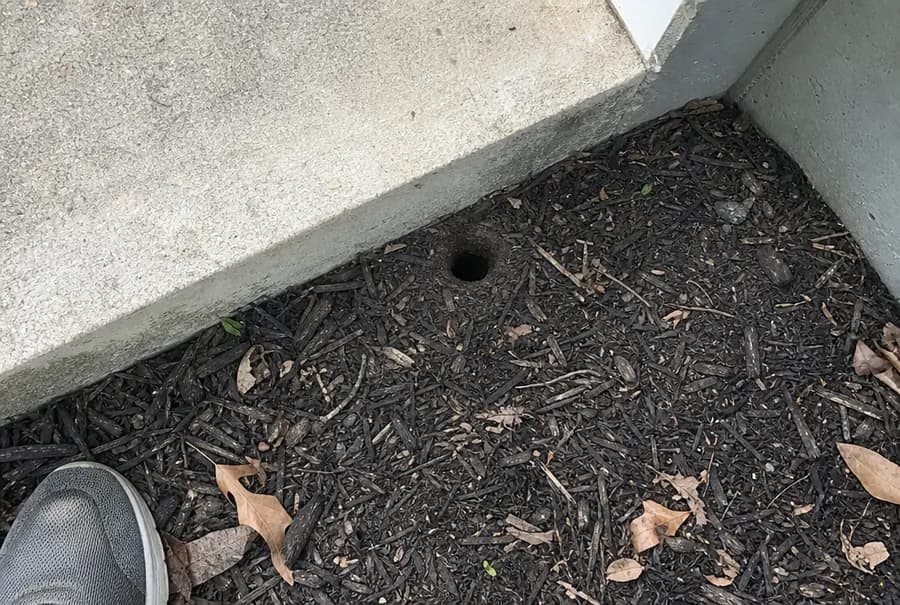
A burrow entrance by a front step
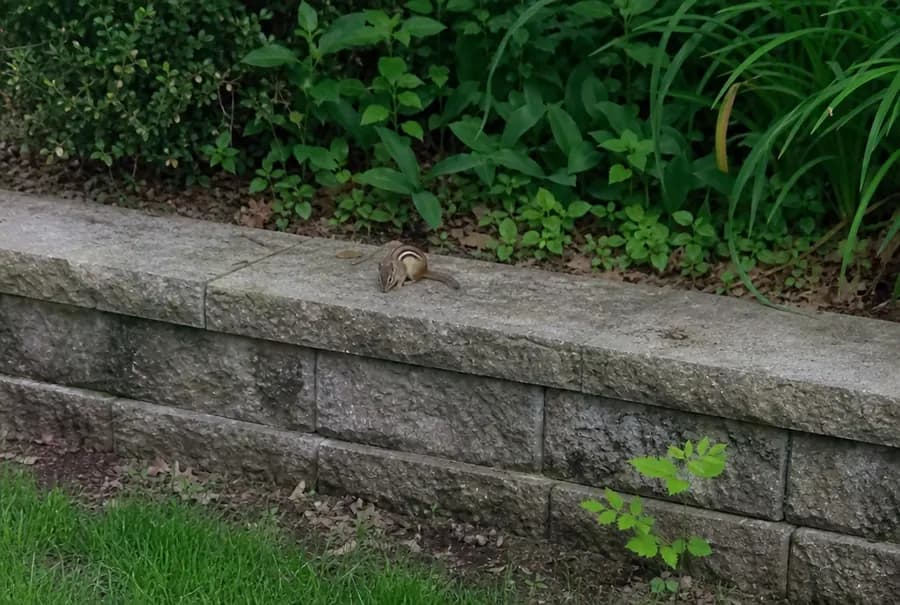
Retaining walls are a favorite
Penn State says the entrance is usually about 2 inches across, with no mound of dirt, because the chipmunk carries the soil away in its cheek pouches. Burrows are often hidden near stumps, wood piles, brush, basements and garages. The main tunnel usually runs 20 to 30 feet, with a nest chamber, one or two food chambers, side pockets and escape tunnels.
A clean hole with no dirt is the tell. A hole with a pile of soil is usually something else; see how to read lawn damage.
Do chipmunks cause damage?
One or two usually do not. Penn State says that in large numbers they can cause structural damage by burrowing under patios, stairs, retaining walls and foundations, and they eat flower bulbs, seeds and seedlings. A chipmunk defends only about 50 feet around its burrow, but home ranges overlap, so a yard can hold two to four per acre, or as many as ten where food and cover are good.
What to do about chipmunks
- Move the bird feeder. Penn State suggests 15 to 30 feet from the house, so spilled seed does not feed chipmunks at the foundation.
- Break up the cover. Do not let shrubs and ground cover run in an unbroken line from the woods to the foundation, and keep the grass short along the house.
- Store seed and pet food in rodent-proof containers.
- Know the rules. The Michigan DNR lists chipmunks with red squirrels and ground squirrels as open year-round, and the right method depends on Michigan DNR rules. We tell you what applies before we start.
Chipmunks under the steps or the patio?
Our exterminators find the burrows, tell you what Michigan rules allow, and show you what draws them to the foundation. Chipmunks are covered by Honorable Shield and Rodent Shield. Quotes are free.
A chipmunk on the woodpile is part of living in Michigan. Burrows against the foundation, under the steps or behind a retaining wall are when our squirrel and chipmunk control is worth a look.
Common questions
Do chipmunks hibernate?
Not truly. Penn State says they go inactive underground from late fall through winter and live on food stored in the burrow. MSU says they are dormant and can wake during the winter.
Where do chipmunks go in winter?
Into their burrows, which Penn State says usually have a 20 to 30 foot main tunnel, a nest chamber and one or two food storage chambers.
Do chipmunks come out in winter?
Some do, on warm, sunny winter days, per Penn State. Most stay underground until late April or early May.
What is the difference between a chipmunk and a squirrel?
A chipmunk is smaller, has black and tan stripes down its back and face, and lives on the ground. Tree squirrels have no stripes and spend most of their time in trees.
What does a chipmunk hole look like?
A clean, round hole about 2 inches across with no dirt around it, per Penn State. The chipmunk carries the soil away in its cheeks.
Can chipmunks damage my foundation?
In large numbers, Penn State says they can cause structural damage by burrowing under patios, stairs, retaining walls and foundations. A single burrow is a reason to look, not proof of damage.
Should I wake a chipmunk in winter?
No. MSU says disturbing a dormant animal speeds up its metabolism and can put it in danger of starving.

About this page
Written by Nick Russler, owner of Honorable Pest Control in Ann Arbor, Michigan. The facts here come from Penn State Extension, Michigan State University Extension and the Michigan Department of Natural Resources, and the sighting count from iNaturalist, all read on September 26, 2026. If something here is out of date or wrong, tell us and we will fix it.
Sources
- Penn State Extension, Chipmunks
- Michigan State University Extension, Exploring your world: Coping with cold through dormancy
- Michigan Department of Natural Resources, Squirrels
- Michigan Department of Natural Resources, Nuisance wildlife: Squirrels
- iNaturalist, research-grade eastern chipmunk observations in Washtenaw, Oakland, Wayne and Livingston counties (pulled September 21, 2026)

Ann Arbor, MI · Licensed and insured
Chipmunks by the foundation?
Tell us where the holes are and where you live. We check we cover your street and give you the price first.
500+ Customer Reviews·Michigan pesticide business license #820457