
Squirrels and chipmunks
Chipmunk vs squirrel: how to tell which one is getting in
A clean, round hole by your step points to a chipmunk. Noise in the attic or a gap at the roofline points to a squirrel. Here's how to tell the two apart by sight and by sign, and what Michigan's rules let you do.
 By Hayden Rhinehart, technician managerLicensed and insured in MichiganPublished
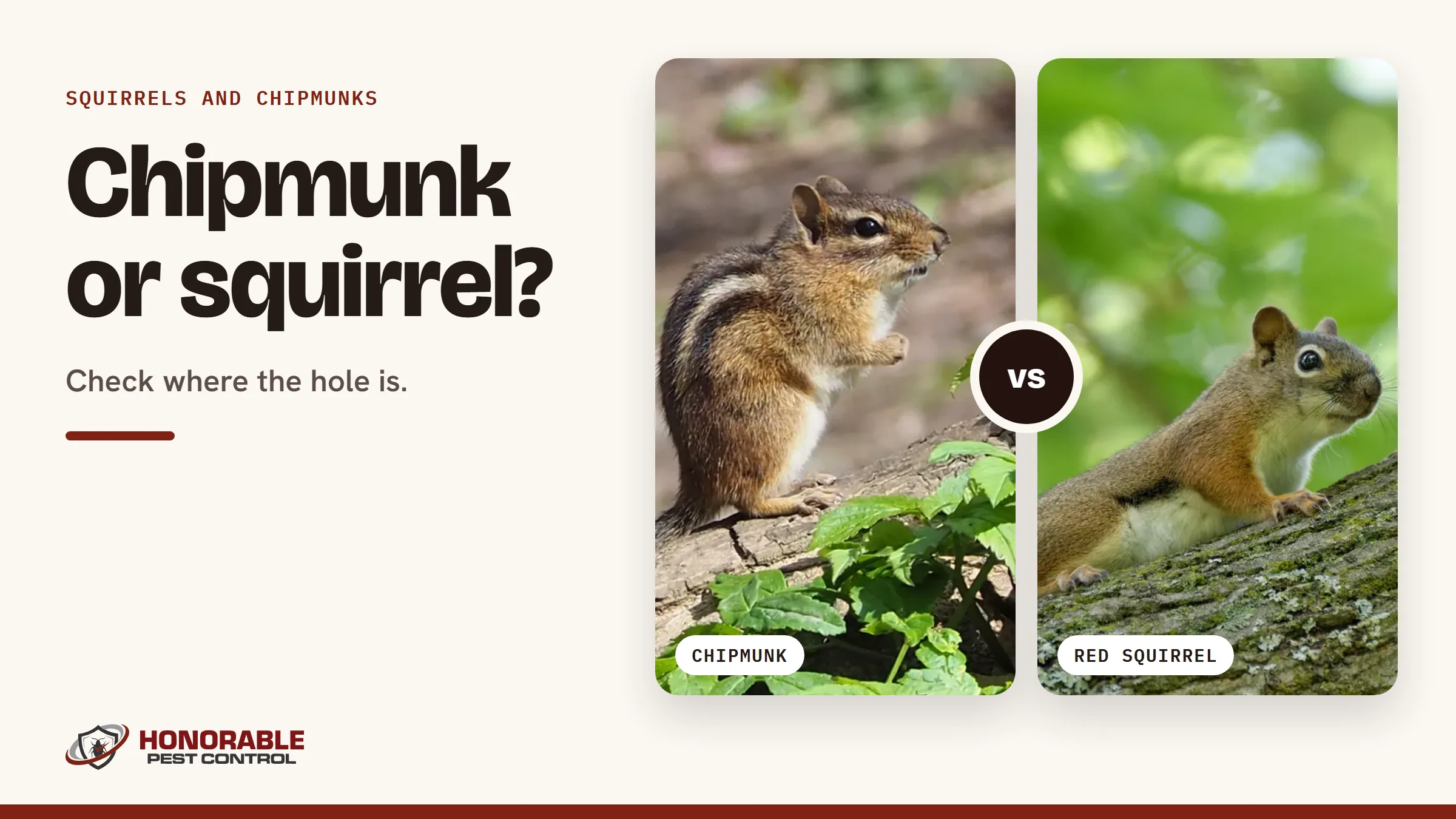
Summary
The short answer
A chipmunk has stripes on its face and back and a tail that isn't bushy. A red squirrel has no stripes down its back and a bushier tail. Chipmunks have dens underground, the DNR says. Their hole is usually about 2 inches across, with no obvious mound of dirt. Noise in your attic at night points to a flying squirrel, and by day to a gray or red squirrel. Chipmunks generally aren't a direct threat to you or your pets.
Low by the foundation, think chipmunk first, though a red squirrel can get in low too. Up high, think squirrel. Still not sure? Point a trail camera at the spot, the DNR says.
Prefer to listen? 47 seconds.
The short version, read aloud. Read by a synthetic voice, not one of our technicians.
To settle chipmunk vs squirrel, start with where you found the sign. Chipmunks usually get in around the foundation, Cornell says. Flying squirrels typically get in up high, and red squirrels go either way.
Chipmunk vs squirrel: how do you tell them apart?
Look at the face first. A chipmunk has light and dark stripes on its face, around the eyes, ADW says. You'll see stripes down its back, too: five blackish and two tan, ending at a reddish rump, Penn State says. The tail's hairy but not bushy. Startle one, and it holds that tail upright, ICWDM says.
Penn State says chipmunks sometimes get mixed up with red squirrels. So use your ears, too. A chipmunk gives a sharp "chuck-chuck-chuck." A red squirrel has a high-pitched chatter.
Look-alikes
Chipmunk or squirrel?
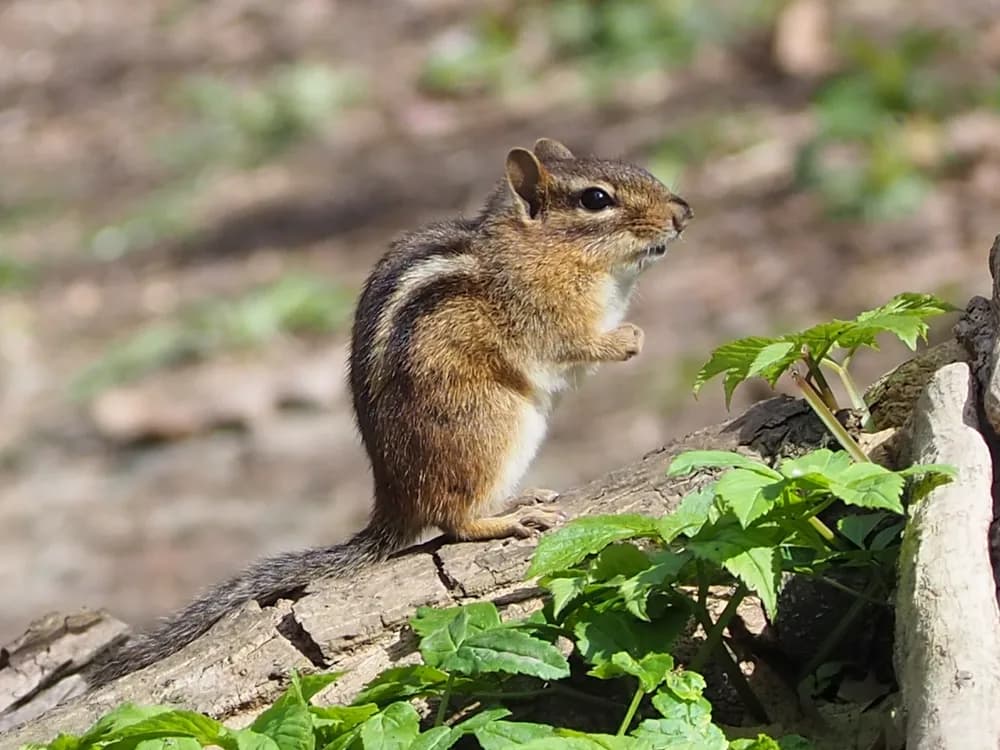
Eastern chipmunkTamias striatus
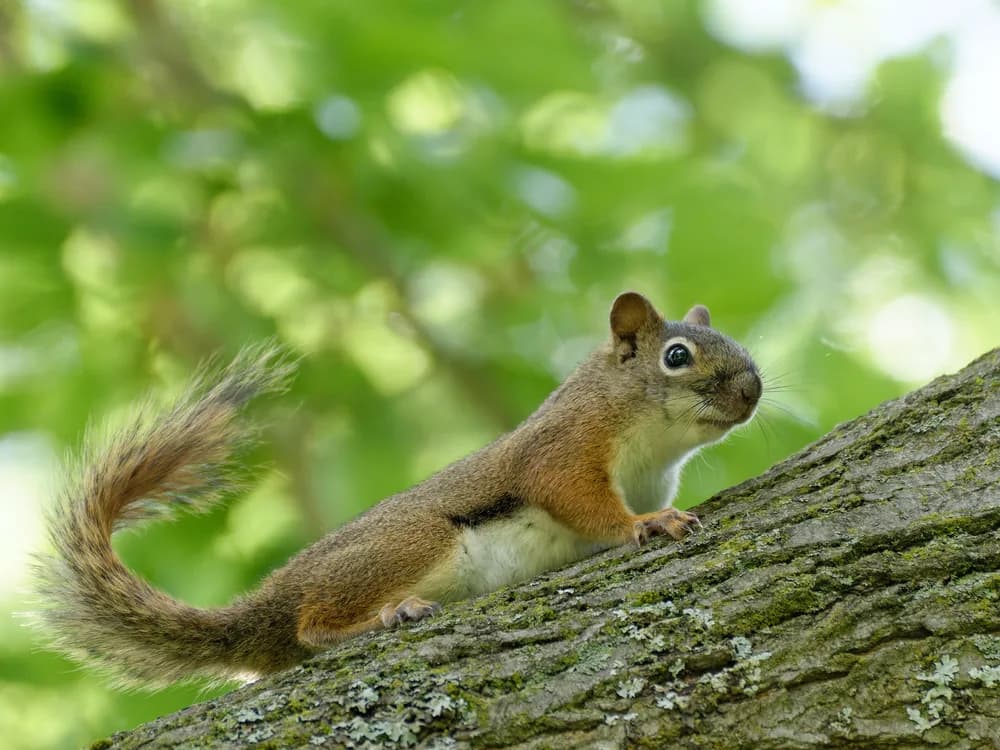
American red squirrelTamiasciurus hudsonicus
| Look at | Eastern chipmunk | American red squirrel |
|---|---|---|
| Face | Light and dark stripes around the eyes | A white ring around the eye, all year |
| Back and side | Five blackish and two tan stripes, ending at a reddish rump | No stripes down the back; a white belly, often with a dark line along the side |
| Tail | Hairy but not bushy, a bit flat; held upright when startled | Bushier than a chipmunk's |
| Where you see it | Mostly on the ground; it can climb, but it dens underground | Spends a great deal of time in trees |
| Size | 5 to 6 inches, plus a 3 to 4 inch tail (Penn State) | Larger: 10 to 15 inches, nose to tail tip (ICWDM) |
What types of squirrels live around here?
Michigan has nine kinds of squirrels, and chipmunks are among them. The DNR splits them in two. Fox, gray, red and flying squirrels nest in trees and spend most of their time up there. Chipmunks, woodchucks and ground squirrels have dens underground. They rarely spend time in trees.
In the southern Lower Peninsula, your flying squirrel is the southern one. Our squirrels in Michigan post covers each tree squirrel and how it gets into your attic.
Where do you find the signs, low or high?
Chipmunks usually leave their signs low. Squirrels mostly leave theirs up high. A chipmunk's hole is usually about 2 inches across, Penn State says. You won't see an obvious mound of dirt by it, because the chipmunk carries the dirt off in its cheek pouches. Cornell agrees. In large numbers, chipmunks can dig under your patio, stairs, retaining walls or foundation. They may eat your flower bulbs, too.
ICWDM says squirrels often travel power lines, and they gnaw on wires, get into buildings and build nests in attics. And up at your roofline, MSU says fascia boards can pop loose at the corners and leave small cracks, or soffits can get damaged. So check the whole roofline.
Which one is it? Start with the sign
Pick the sign you've actually got. Two or three taps and you'll have a best guess. Only hearing it? Our post on noises in the walls covers mice and rats, too.
Which one is it?
Chipmunk or squirrel? Sort it by the sign
Up to three questions. Start with what you found.
See every answer
- chipmunk Most likely a chipmunk
- A chipmunk's hole is usually about 2 inches across, with no obvious mound of dirt. It carries the dirt off in its cheek pouches, Penn State says. In large numbers, chipmunks can dig under patios, stairs and walls. Chipmunks and their burrows
- chipmunk Could be a chipmunk
- Chipmunks are active by day, ADW says, and they usually get in low, around the foundation, Cornell says. Red squirrels can get in low too. Look outside along the foundation for a clean, round hole about 2 inches across. Chipmunks and their burrows
- chipmunk Could be a chipmunk
- Penn State says chipmunks may eat flower bulbs, seeds and seedlings. Look for a clean, round hole nearby. Still not sure? The DNR suggests a trail camera aimed at the spot.
- flying squirrel Probably a southern flying squirrel
- Flying squirrels are entirely nocturnal, the DNR says. ICWDM says they use holes about the size of a quarter. They're protected in Michigan and can't be taken at any time. The CDC says to avoid contact with flying squirrels and their nests. Flying squirrels and Michigan's rules
- tree squirrel Probably a tree squirrel
- Gray and red squirrels are more active during the day, Cornell says. Chipmunks are out by day too, but they usually get in low, around the foundation. Noises in the walls and attic
- red squirrel Probably a red squirrel
- Red squirrels use holes about the size of a golf ball, ICWDM says. They store food in one place, and trash-bag-size piles of pine cones in attics or gutters aren't uncommon. Michigan's squirrels
- fox or gray squirrel Probably a fox or gray squirrel
- Fox and gray squirrels use holes about the size of a baseball, ICWDM says. Squirrels gnaw on wires, get into buildings and build nests in attics. Squirrel and chipmunk control
- squirrel nest A tree squirrel's nest
- Gray squirrels build a nest of leaves and twigs in a tree crotch, 30 to 45 feet up, ADW says. Chipmunks den underground. If nothing's getting into the house, you can leave it be.
Why don't you see chipmunks in winter?
Because they go quiet for the winter. Chipmunks don't have the fat stores to hibernate, ADW says. Instead, they go into periods of torpor. Our post on chipmunks in winter covers where they go.
Our own numbers fit that. We counted every checked sighting from our seven counties on iNaturalist, where you post an animal photo and others confirm it. Just 22 of 1,547 chipmunk sightings came in December, January or February. That's about 1.4%. For each squirrel, it's 17% to 24%.
What share of sightings come in December, January and February
Share of each animal's research-grade iNaturalist sightings that fall in the three winter months, in Washtenaw, Wayne, Oakland, Livingston, Monroe, Jackson and Lenawee counties, all years. Our count, pulled October 14, 2026. These are photos people chose to post, so they follow when people are outside looking, not how many animals there are. A near-zero winter share fits the chipmunk's winter torpor (do chipmunks hibernate?).
Are chipmunks dangerous?
Not directly. ICWDM says chipmunks generally don't pose a direct threat to you or your pets, and they usually run when you come close. They aren't significant carriers of diseases that hurt people, either. Squirrels may carry parasites and diseases, the DNR says, but passing them to you or your pets is uncommon.
Ticks are another story. A 2005 tick study in a part of New Jersey where Lyme disease is well established found chipmunks seemed to adapt well to managed yards. It concluded they apparently play an important role in the Lyme disease cycle in those neighborhoods.
Squirrels bring their own problems. They chew on electrical lines, and ICWDM says that can lead to fires. A red squirrel may bite you if you provoke it, ADW says. And the CDC says rare US cases of sylvatic typhus can happen when people are exposed to flying squirrels and their nests.
What can you do about them in Michigan?
It depends on which animal you've got. Here's what the Michigan DNR says:
- No catch and release. The DNR doesn't authorize or do live capture and release of squirrels, except for permitted research.
- Damage changes things. Where hunting or trapping is allowed, you as the property owner, or your designee, may lethally remove a squirrel other than a flying squirrel without a hunting or trapping license, but only if it's doing damage, or is physically present to imminently cause damage.
- Otherwise, killing one takes a license. If a squirrel isn't tied to damage, you need a hunting or trapping license to hunt or trap it, and only during the regulated season. That season is year-round for red squirrels, ground squirrels and chipmunks, and shorter for fox and gray squirrels.
- Chipmunks count as ground squirrels. The DNR's 2026 small game digest lists them that way.
- Flying squirrels are protected. They can't be taken at any time, the digest says.
The DNR also suggests noise, like a loud radio or banging pots and pans, to get a squirrel out of your attic. But MSU warns that radios and lights could cause a fire. So don't leave anything running up there.
Honestly, you don't need us for a chipmunk on the woodpile. Call us for noise overhead, a hole you can't explain, or burrows along your foundation. We'll confirm which animal it is, tell you what Michigan's rules allow for it, and show you every opening we find. We don't seal or repair. Squirrels and chipmunks are part of Honorable Shield. Our squirrel and chipmunk control page shows what a visit covers.
Chipmunks by the step or squirrels in the attic?
We confirm which animal it is, tell you what Michigan rules allow for that species, and show you every opening we find. Squirrels and chipmunks are covered by Honorable Shield and Rodent Shield. Quotes are free.
Common questions
Is a chipmunk a type of squirrel?
Yes. The Michigan DNR counts nine kinds of squirrels in the state, and chipmunks are among them. They're in the ground group: chipmunks, woodchucks and ground squirrels have dens underground and rarely spend time in trees. The DNR's small game digest lists chipmunks as ground squirrels, too.
Do chipmunks get into houses?
They can, though Cornell says they usually get in around the foundation. When chipmunks do get into a building, ICWDM says it's typically along the sill plate, through dryer vents, along the roof line or under siding. And MSU says chipmunks can possibly climb a rough brick or block chimney.
Is it a chipmunk or a squirrel in my walls?
Notice when you hear it. Flying squirrels are noisy at night, Cornell says, while gray and red squirrels are more active during the day. Chipmunks are out by day, too, but they usually get in low, around the foundation. Our post on noises in the walls covers mice and rats as well.
How big are Michigan's squirrels?
ICWDM puts fox squirrels at 18 to 27 inches from nose to tail tip and gray squirrels at 16 to 20 inches. Red squirrels are 10 to 15 inches, and southern flying squirrels 8 to 10. Penn State says a chipmunk is 5 to 6 inches long, plus a 3 to 4 inch tail.

About this page
Hayden wrote this. The facts come from the sources below, checked on October 14, 2026. The winter numbers are our own count of iNaturalist posts, so they show when people spot these animals, not how many there are. Look-alike photos: Kaldari (CC0, via Wikimedia Commons) and Donald Davesne (CC BY 4.0, via iNaturalist), cropped, with our labels added. See something wrong? Tell us and we'll fix it.
Sources
- Michigan Department of Natural Resources, Nuisance wildlife: Squirrels, and Michigan species: Squirrels
- Michigan Department of Natural Resources, 2026 Michigan Small Game Hunting Regulations Summary (PDF)
- Michigan State University Extension, When animals invade your attic (2016)
- Penn State Extension, Chipmunks
- Internet Center for Wildlife Damage Management, Tree Squirrel Damage Identification, with its tree squirrel and chipmunk pages
- Cornell University, New York State Integrated Pest Management Program, Wildlife IPM
- Animal Diversity Web, University of Michigan Museum of Zoology, species accounts for the eastern chipmunk, eastern gray squirrel, red squirrel and southern flying squirrel
- Centers for Disease Control and Prevention, About Epidemic Typhus
- iNaturalist, research-grade observations of the eastern chipmunk and four squirrels in Washtenaw, Wayne, Oakland, Livingston, Monroe, Jackson and Lenawee counties (our count, pulled 2026-10-14)
- Schulze, Jordan and Schulze, Host associations of Ixodes scapularis in residential and natural settings in a Lyme disease-endemic area in New Jersey, Journal of Medical Entomology (2005)

Ann Arbor, MI · Licensed and insured
Chipmunk holes or squirrels overhead?
Tell us what you're seeing, where it is, and where you live. We check we cover your street and give you the price first.
500+ Customer Reviews·Michigan pesticide business license #820457