

Bees
Carpenter bee or bumble bee? How to tell, and why it matters
Look at the abdomen. A carpenter bee's is bare, shiny and black on top. A bumble bee's is covered in yellow and black hair. The difference matters, because the carpenter bee is the one drilling round holes in your deck rail, and the bumble bee is a pollinator best left alone.
 By Nick Russler, ownerLicensed and insured in MichiganPublished
The short answer
- Carpenter bee abdomen
- Bare, shiny black
- Bumble bee abdomen
- Hairy, yellow and black
- Carpenter bee nests in
- Bare softwood
- Bumble bee nests in
- The ground, mostly
- Entrance hole
- About 1/2 in, round
- Male carpenter bees
- Cannot sting
The two look alike in size and color, but the top of a carpenter bee's abdomen is bare and shiny, and a bumble bee's is covered in black and yellow hair, per Michigan State University. Carpenter bees drill a round hole about 1/2 an inch across into bare wood to raise their young. Bumble bees nest in the ground, often in an old rodent nest. The big bee hovering at your face by the eaves is almost always a male carpenter bee, and the males cannot sting.
Prefer to listen? One minute 1.
The short version, read aloud. Read by a synthetic voice, not one of our technicians.
Every April and May, big bees start hovering around porches and eaves in Southeast Michigan, and a neat round hole shows up in the deck rail. Most people call them bumble bees.
They are usually carpenter bees, and the difference decides what, if anything, you should do.
Carpenter bee, bumble bee and honey bee, side by side
| Carpenter bee | Bumble bee | Honey bee | |
|---|---|---|---|
| Top of abdomen | Mostly bare, shiny black | Covered in hair, much of it yellow | Golden brown, thin black stripes |
| Size | About bumble bee size | 1/2 to 1 in | About 1/2 in |
| Nest | Tunnels in bare wood | Underground, often an old rodent nest | Mostly beekeepers' hives; sometimes a hollow tree or a wall |
| Colony | None; each female nests alone | One season, dies in fall | Lives for years |
| What we do | Treat the galleries | Leave it where you can | Never kill; call a specialist |
Sizes and nests are from Penn State Extension and the University of Minnesota. Penn State's rule of thumb is simple: if a number of large bees are hovering near the eaves or drilling in wood, you have carpenter bees.
Where each one nests
Carpenter bees nest in wood, but they do not eat it. The female drills a nearly perfectly round hole about 1/2 an inch across, usually against the grain. About an inch in, she turns and tunnels along the grain, and she lays her eggs in 6 to 8 sealed chambers, each stocked with pollen, per Penn State. They prefer wood more than two inches thick, and they go after unpainted wood: doors, window sills, eaves, railings and lawn furniture.
In Ann Arbor, MSU's diagnostician reported whole neighborhoods losing cedar fascia and soffit boards to them. Carpenter bees drill any soft wood, MSU says, but they love cedar and redwood, the same woods builders use for trim because they resist rot.
So round it "appears to have been drilled by your sharpest drill bit."
Michigan State University Extension
Bumble bees nest in the ground far more than in wood. UMN says their colonies are often in deserted rodent nests, compost piles and under things on the ground. A few species nest higher, in tree or wall cavities, or even a birdhouse.
The hole, the sawdust and the stain
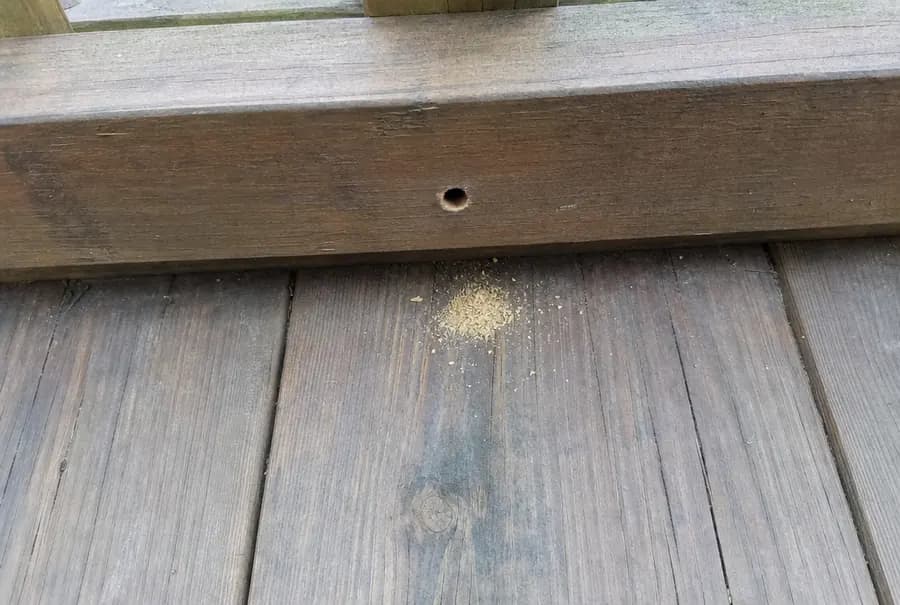
Fresh sawdust below a new hole
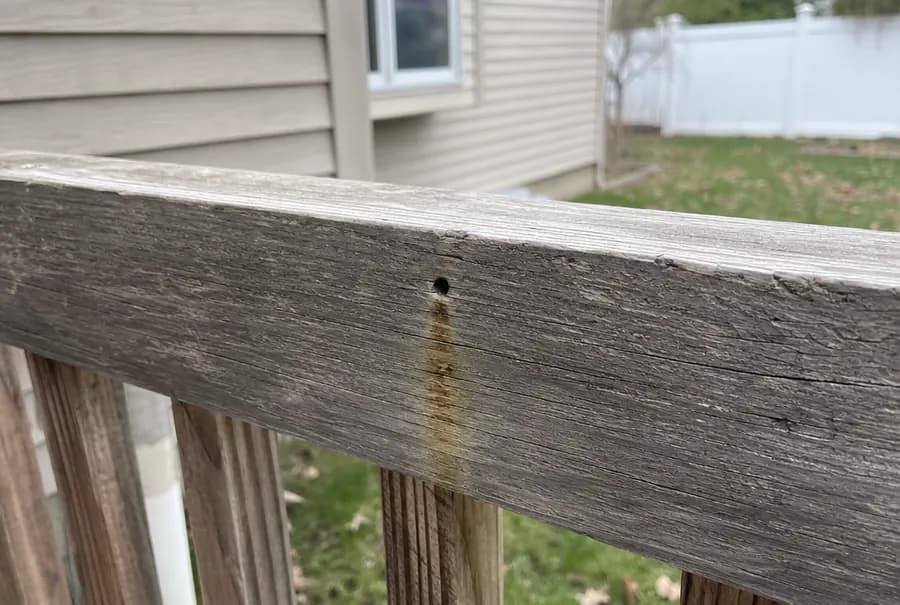
The stain below an older hole
Look for three things together: a clean round hole, a little pile of coarse sawdust under it, and a yellowish stain running down the wood. Penn State says the bees commonly defecate on the surface right below the opening, and that is the stain.
One bee in one season does little harm. The trouble is that the next year's bees come back to the same tunnels and extend them, and Penn State says that over the years this can cause considerable structural damage.
Do carpenter bees or bumble bees sting?
- Male carpenter bees cannot sting. They are the ones you notice: they hover near the nest, chase other insects, and dart at people who move quickly, per Penn State.
- Female carpenter bees can sting, but seldom do. Penn State says she has to be extremely provoked, as in handled.
- Bumble bees are not aggressive unless you reach into the nest or step on it, UMN says. Like wasps, they can sting more than once.
Bees nesting in the ground
A steady stream of fuzzy bees going in and out of a hole in the lawn or a flower bed is most likely a bumble bee nest. UMN's advice: if you can avoid the spot, leave it alone. The colony dies in the fall. Some common species are done by early August, and the rest by September. A small fence around the entrance prevents accidents.
UMN also points out that about one in three bumble bee species is in decline, and the rusty patched bumble bee is listed as endangered under the Endangered Species Act.
If the insects at the hole are slick, yellow and black, and angry in late summer, they are not bees. That is a yellow jacket nest, and it is a different job. See how to tell yellow jackets, paper wasps and hornets apart.
Honey bees: we call a specialist
We never kill honey bees. If what you have is honey bees, in a wall or in a swarm on a branch, we call in a specialist who can move them.
A swarm looks alarming but, UMN says, is not dangerous under most circumstances. It is a colony looking for a new home, and it usually moves on by itself within an hour to a few days. Stay back and keep others away from it. Honey bee colonies inside buildings are less common, UMN says, and the first step is to have the bee identified.
Bees going in and out of a gap in the siding can be honey bees, yellow jackets or bumble bees. Do not spray or seal the gap until you know which. UMN warns that sealing a live yellow jacket nest can send the wasps into the house.
What to do about carpenter bees
- Treat the holes, not the whole house. MSU and Penn State both say the treatment goes into the gallery openings. Penn State notes that working in eaves and soffits is why many homeowners hire a licensed company for it.
- Do not plug the holes right away. Penn State says the bees need to pass through the treated entrance, and so do any young bees still inside. Fill the holes in the fall.
- Fill, then paint. Once the galleries are dead, fill them with wood putty or dowels and paint or varnish the wood.
Round holes in the deck rail?
Our exterminators confirm which bee it is, treat active carpenter bee galleries with EPA-registered products applied to the label, and tell you which boards to paint. If it is honey bees, we call a specialist. Quotes are free.
Which wood to paint
Carpenter bees want bare, weathered softwood. MSU says painting or otherwise sealing the wood is reported to discourage them. Penn State recommends paint or varnish, and notes that stained wood is not usually protected. The boards to watch are the ones they already use: end grain on deck rails, fascia, soffits and porch ceilings. The bees come back to familiar wood each spring, which is why our carpenter bee treatment starts with the old holes.
Common questions
How can I tell a carpenter bee from a bumble bee?
Look at the top of the abdomen. A carpenter bee's is mostly bare and shiny black. A bumble bee's is covered in hair, much of it yellow, per MSU and Penn State.
Do carpenter bees sting?
The males cannot sting, and they are the ones that hover at your face. Females can, but Penn State says they seldom do unless they are handled.
Do carpenter bees eat wood?
No. They tunnel into it to raise their young and push the sawdust out. Penn State says they prefer unpainted wood more than two inches thick.
How big is a carpenter bee hole?
About 1/2 an inch across and nearly perfectly round. About an inch in, the tunnel turns and runs along the grain, per Penn State.
What are the bees nesting in the ground in my yard?
Fuzzy bees in and out of a hole are usually bumble bees. UMN suggests leaving the nest alone if you can; the colony dies in the fall. Slick, yellow and black insects are yellow jackets.
Do you kill honey bees?
No. We never kill honey bees. If that is what you have, we call in a specialist who can move them.
Does paint keep carpenter bees away?
It helps. MSU says painting or sealing the wood is reported to discourage them, and Penn State notes that stained wood is not usually protected.

About this page
Written by Nick Russler, owner of Honorable Pest Control in Ann Arbor, Michigan. The facts here come from Michigan State University Extension, Penn State Extension and the University of Minnesota Extension, all read on September 26, 2026. If something here is out of date or wrong, tell us and we will fix it.

Ann Arbor, MI · Licensed and insured
Bees drilling the deck?
Tell us where the holes are and where you live. We check we cover your street and give you the price first.
500+ Customer Reviews·Michigan pesticide business license #820457