
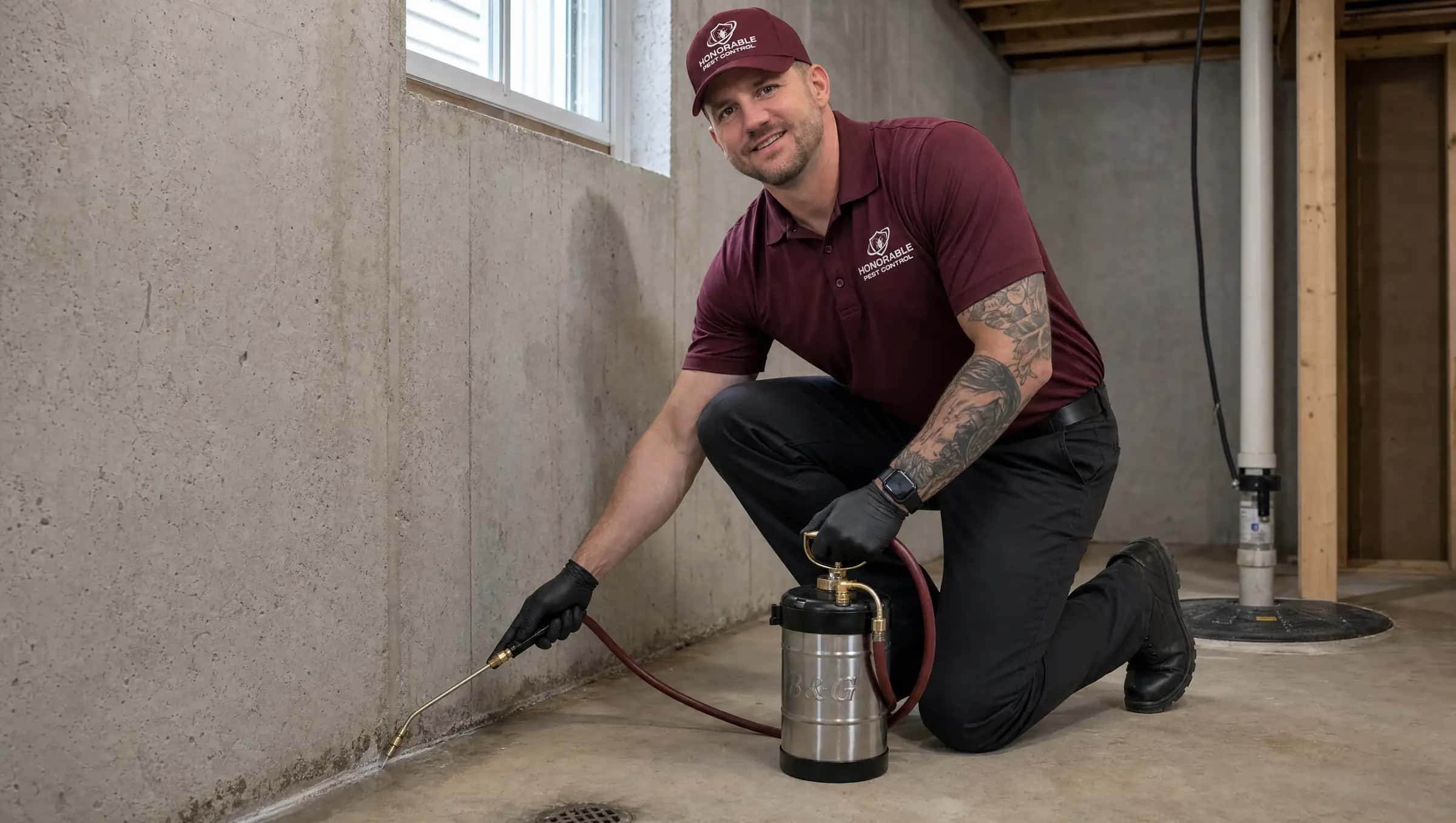
Centipedes
House centipedes: are they dangerous?
No. Michigan State University calls the house centipede harmless, and even beneficial: it hunts spiders and insects. It can bite if you grab it, but that is rare. What it does tell you is that the house is damp and there is something for it to eat. Here is what you are looking at, why it is in the bathroom, and what makes them go away.
 By Nick Russler, ownerLicensed and insured in MichiganPublished
The short answer
- Body length
- 1 to 1.5 in
- Legs
- 15 pairs, very long
- Dangerous
- No, per MSU
- Bites
- Rare, when handled
- Eats
- Spiders, silverfish, insects
- Means
- Damp, and prey to eat
A house centipede is a fast, long-legged hunter with a body about an inch to an inch and a half long. MSU's diagnostic lab says it should be considered harmless and even beneficial, since it eats spiders, insects and other small pests. It is the only centipede in Michigan that can breed indoors, and it likes damp basements and crawl spaces. Seeing them often means two things: moisture, and something for them to eat. Fix those and they leave.
Prefer to listen? 56 seconds.
The short version, read aloud. Read by a synthetic voice, not one of our technicians.
You turned on the bathroom light and something with far too many legs ran up the wall faster than anything that size should. Nobody forgets their first house centipede.
It is worth a closer look before you reach for a shoe, because this one is on your side. It is also telling you something about the house.
What you are looking at
The house centipede has a dirty yellow body with three dark stripes down its back and 15 pairs of long, banded legs. The body is only an inch to an inch and a half long, but with its legs and antennae it looks three to four inches long, per Penn State. The back legs of an adult female are nearly twice the length of its body.
It is not a native. Penn State says it came from the Mediterranean and is now found across the country. In Pennsylvania it cannot survive the winter outdoors but breeds readily in heated buildings, and MSU says it is the only centipede in Michigan that can breed indoors.
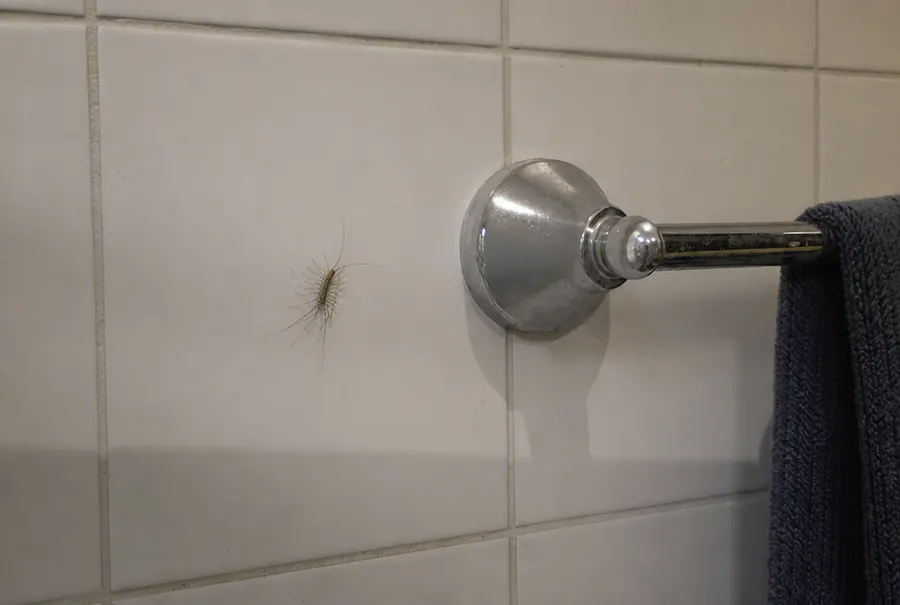
On the bathroom wall at night
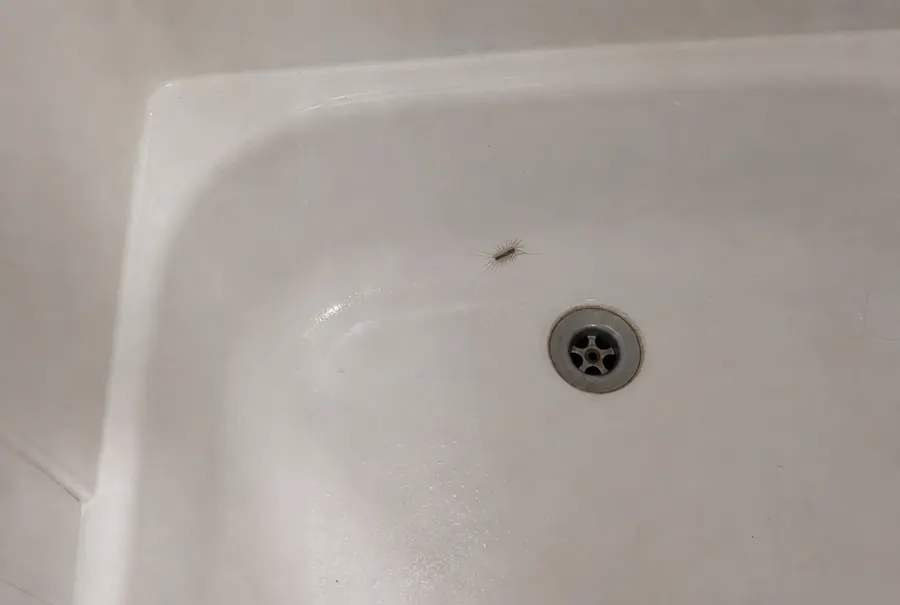
In the tub, where it slipped in
Is a house centipede dangerous?
No. MSU says it should be considered harmless and no cause for alarm, and Penn State says the same. There are only a few reports of one biting a person, usually when it was picked up or stepped on with bare feet. MSU compares the bite, at worst, to a bee sting. Clean it, put on an antiseptic, and ice it to bring down any swelling.
The house centipede should be considered a beneficial organism.
Michigan State University Plant & Pest Diagnostics
Why it is in your bathroom
Two reasons, and they are the same two every time.
- Moisture. House centipedes live in dark, damp places during the day, MSU and Penn State agree: basements, crawl spaces and floor drains.
- Food. They hunt at night. Penn State lists silverfish, firebrats, carpet beetle larvae, cockroaches and spiders among their prey. If you see centipedes often, some prey insect is plentiful, and that may be the bigger problem.
That is why killing the ones you see changes very little. A female can live several years and produce up to 150 young, per Penn State, and as long as the basement is damp and full of silverfish, more will come.
Where they hide in a Michigan house
Penn State lists the places centipedes spend the day. Most Michigan basements have at least one.
| Where | How they get in | What helps |
|---|---|---|
| Under the basement slab | Expansion cracks, the sump opening | Seal the cracks; screen and caulk the sump cover |
| Inside block walls | Uncapped blocks, missing mortar, pipe holes | Fill and seal the gaps |
| Floor drains | Drains with no water trap, dry sumps | Put a screen over the drain |
| Cardboard boxes on the floor | They hide under and inside | Store boxes off the slab, or in plastic bins |
| Crawl spaces | Any damp, cool corner | Dry it out |
What makes them go away
Penn State's order of attack is a good one: take away the food, then the hiding places, then the damp.
- Find out what they are eating. A few sticky traps along the basement walls show what else is living down there, which is often silverfish or spiders.
- Close the hiding places. Seal cracks in the slab and block walls, screen the sump and the floor drains, and get boxes off the floor.
- Dry it out. Run a dehumidifier, fix leaks and drips, and grade the soil so rain runs away from the foundation.
One centipede now and then in an older Michigan house is normal, and is eating things you would rather not have. Several a week is the house telling you about moisture.
Seeing them every night?
Our exterminators find the moisture, treat where centipedes hunt, and show you how to dry the house out, so they have no reason to stay. Centipedes are covered by Honorable Shield. Quotes are free.
A treatment helps most when it goes with fixing the damp. That is how our centipede control visits work: the moisture and the prey first, then the places they hide.
Common questions
Are house centipedes dangerous?
No. Michigan State University says house centipedes should be considered harmless and no cause for alarm, and even beneficial, because they eat spiders and insects.
Do house centipedes bite?
Rarely. MSU says there are only a few reports of bites, usually when one is handled or stepped on barefoot. At worst it can hurt about as much as a bee sting.
Should I kill house centipedes?
You can, but it will not solve much. They are eating other pests, and more will follow as long as the house is damp and there is prey. Fix the moisture and the food supply first.
How many legs does a house centipede have?
An adult has 15 pairs, 30 legs in all, per Penn State. Young ones hatch with only four pairs and add more as they grow.
Why do I only see them at night?
They hide in dark, damp places during the day and come out at night to hunt, per Penn State.
Can house centipedes live in the walls?
They can shelter inside concrete block walls, entering through uncapped blocks, missing mortar and gaps around pipes. Sealing those gaps helps.
Do they come up through the drain?
They can use floor drains with no water trap, especially ones connected to a dry sump. Penn State suggests a screen over the drain.

About this page
Written by Nick Russler, owner of Honorable Pest Control in Ann Arbor, Michigan. The facts here come from Michigan State University's Plant & Pest Diagnostics lab and Penn State Extension, both read on September 26, 2026. If something here is out of date or wrong, tell us and we will fix it.

Ann Arbor, MI · Licensed and insured
Centipedes in the bathroom again?
Tell us where you see them and where you live. We check we cover your street and give you the price first.
500+ Customer Reviews·Michigan pesticide business license #820457