
Pill bugs
Pill bugs in the house: what roly polies tell you about moisture
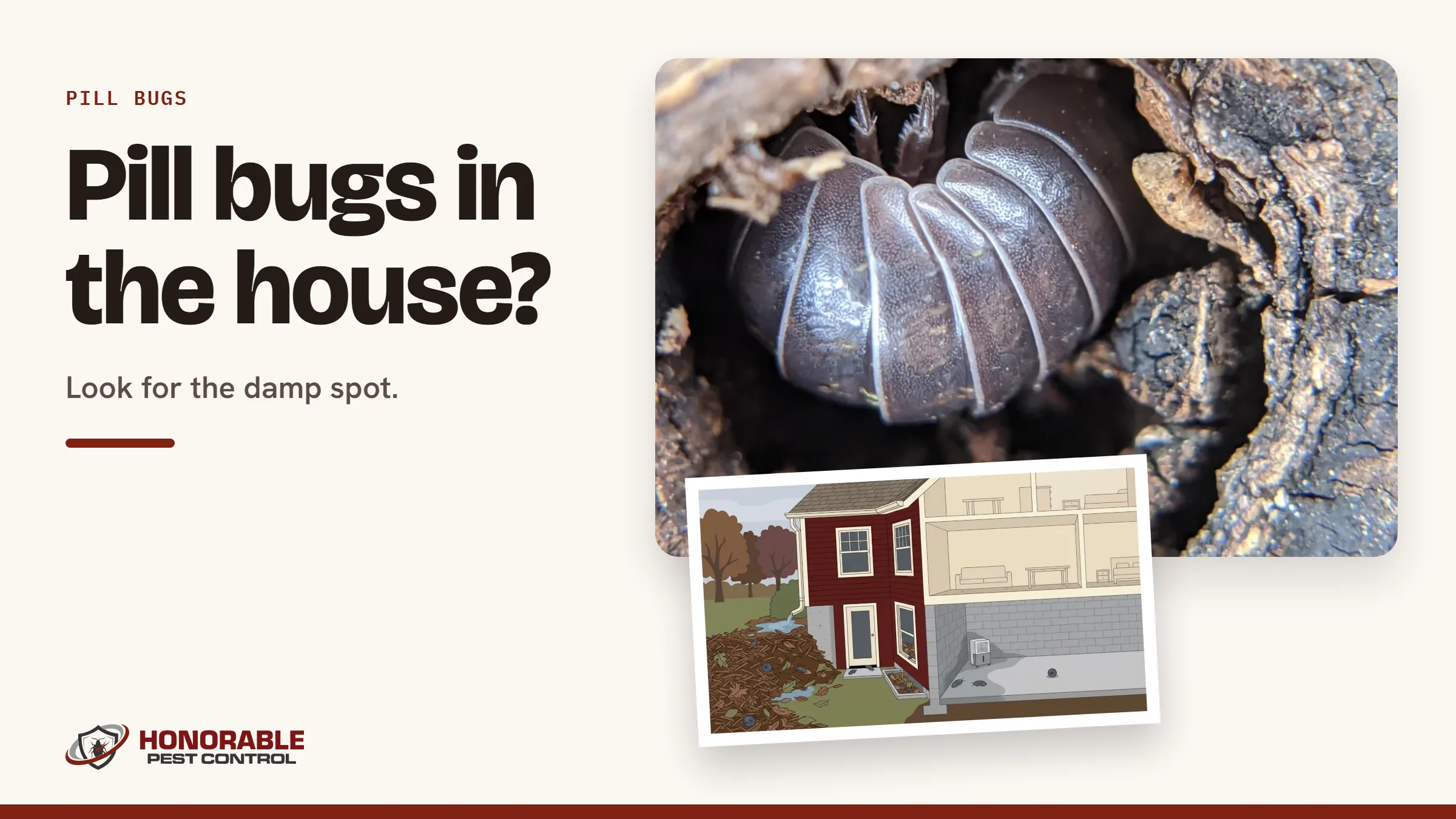
Pill bugs in the house or basement? Those little gray roly polies are harmless, but they're often telling you something: the ground by your foundation is staying damp. Here's how to read them, a checklist of the fixes you can do, and what we treat.
 By Hayden Rhinehart, technician managerLicensed and insured in MichiganPublished
Summary
The short answer
A roly poly is a harmless land crustacean, not an insect. It needs damp to survive, so wet mulch, leaves and soil by the foundation keep it close. Most that wander inside dry out within a few days. Keep finding them inside? UKY says that may point to a moisture problem or a gap at a door or window. Much of the fix is outside: pull leaves and mulch back from the foundation and keep water draining away.
Pill bugs in the house often point to wet ground right outside, so the fix starts with drying it out. Print the checklist below and do the outside jobs before the first snow.
Prefer to listen? 56 seconds.
The short version, read aloud. Read by a synthetic voice, not one of our technicians.
Found pill bugs in the house or basement this fall? Don't panic. Roly polies are harmless, and they can't last long in a dry room. But MU says seeing them inside is a good sign there are lots more in the soil outside. So your job is finding where it's wet.
Why are there pill bugs in my house?
Often because the ground by your house is damp, and there's a way in down low. UKY says their need for moisture may drive them into basements, crawl spaces and ground-level floors when they're looking for water.
MSU entomologist David Smitley says they can be a big nuisance around homes, hiding in moist shrub beds and leaf litter. MSU also says they thrive in flower beds with mulch on top. Sound like the bed along your foundation?
One homeowner met me at the front door with a coffee mug full of roly polies they'd swept up that morning. They followed me around the whole yard with it, like I might forget why I came.
Sweeping up millipedes too? Read about the millipedes that come in from the same damp ground.
Your pill bug checklist: what can you fix yourself?
A lot of it. They live in the damp stuff along your foundation, so most fixes dry out that strip or check the low gaps.
Printable checklist
Pill bug moisture checklist
Work from the outside in. Tick each one when it's done.
This weekend
Before the first snow
Inside, any time
Download the printable checklistPDF, one page
That's your side. Our side is the foundation itself, where the mulch meets the house.
When should you do the outside jobs? We counted ten falls of NOAA snow records for Ann Arbor. The first day with an inch or more of new snow came in November every time, between Nov 9 and Nov 26. So plan to finish the outside half of this list by early November.
When the first inch of snow came in Ann Arbor
The first day each fall with 1 inch or more of new snow at the Ann Arbor U of Mich weather station, 2016 to 2025, counted by Honorable on October 25, 2026, from NOAA's daily snowfall records. Bars start at Nov 1; the earliest and latest falls are marked. All ten came in November. It's one gauge, read once a day, so a date can be off by a day, and your yard may differ. At Detroit Metro Airport, the first inch came about a week later on average, and 2 of the 10 were in December. It counts snow, not pill bugs.
Is a roly poly bug an insect?
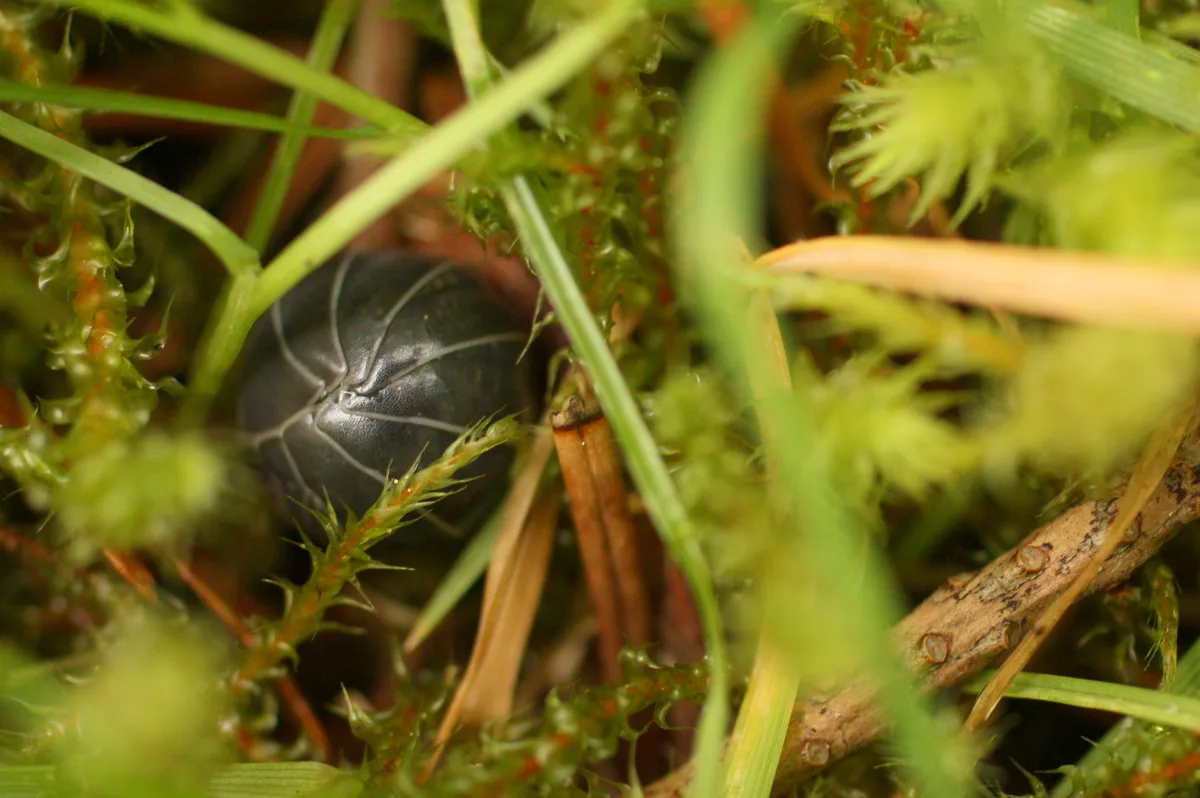
No. A pill bug isn't an insect at all. UKY says they're isopods, a kind of crustacean that can live on land. A Carnegie Museum of Natural History educator writes that woodlice, the group pill bugs belong to, are crustaceans that prefer damp soil and wetter places, like cool, humid basements.
So a dry room in your house is a dead end for them. MU says they don't have a waxy outer coat, and they can't close off their breathing system, so dry air dries them out.
And when you touch one and it rolls into a ball? UKY says that's for defense, and to hold in water. In a 2008 lab study, rolled-up ones lost water about 35 percent more slowly in dry air. The authors say rolling up may help them save water.
Pill bugs in the basement: how are they getting in?
Through small gaps down low. MU says they get into your basement and first floor through cracks in the foundation and walls. Cracks by a porch slab or in a basement wall make handy hiding spots, too.
UW-Madison says to keep them out, seal around door and window frames, especially along the foundation, where they often crawl up under the siding. That's a job for you or a contractor. We don't seal, but we'll point out the gaps we find.
Can't tell where they're getting in? Tell us what you're seeing and we'll come take a look. Spotting springtails or silverfish down there too? Here are the other tiny bugs of a damp basement.
Dead pill bugs or live ones: what are they telling you?
Dead ones likely just wandered in and dried out. Live ones are the clue. Nebraska Game and Parks says pill bugs that get into your home can't survive more than a few days unless they find humid conditions.
Try this simple check. Sweep up every one you see, then look again in a few days. Only dead ones? Your fixes are mostly outside. New live ones? Something nearby may be damp enough to keep them alive, or they're still getting in. Look for seepage along a wall, a corner where the air never moves, or a gap under the door.
Sweeping up live ones every few days? Call us at (734) 519-6671 and we'll help you find the wet spot.
Are pill bugs dangerous, or just a sign of damp?
They're not dangerous. UKY says they're completely harmless to people and pets, and they won't bite or sting. Purdue says they cause little or no real damage.
Outside, they can nibble your garden. They eat fungi and rotting stuff, UKY says, and tender plants only now and then. That can hurt seedlings and other young plants.
So yes, they're mostly a sign of damp, and the wet spot is what you need to fix.
What will we treat, and what's on you?
We treat the foundation and the damp spots they come from, and show you what to dry out. The water side is yours. Here's what a pillbug control visit involves.
Here's why we split it: UKY says a treatment along your foundation in spring or fall can limit how many get in. But outdoor treatments are unlikely to fix a problem that keeps coming back unless the moisture gets fixed, UKY says. And spraying inside? Purdue says general spraying indoors is seldom recommended.
On a plan? Roly polies are part of the Honorable Shield plan. Want a second set of eyes on your foundation? Get a free quote with the form below, or call (734) 519-6671.
Still finding live roly polies?
We treat the foundation and the damp spots pill bugs come from, and we show you what to dry out. Pill bugs are covered by Honorable Shield. Quotes are free.
Rather not call? Get your free quote right here.
What are we dealing with?
Tap everything you have seen. Most homes have more than one.
Takes about 30 seconds. Or just call (734) 519-6671.
No obligation. We confirm availability and explain the recommended next step.
Common questions
What do pill bugs look like?
Small, oval and dark gray, rounded on top and flat underneath. MU says they're dark gray to black and roll into a tight ball when you bother them. UKY says they show no tail parts, just antennae, and rarely get longer than 3/4 of an inch.
When do pill bugs come out?
Mostly at night. UKY says they're largely nocturnal. As for the season, MSU says they build up outdoors in cool, wet weather, and UMN says sowbugs, the pill bug's close cousin, crawl into homes mostly in late summer and fall.
Can pill bugs live in a basement through the winter?
Not in a dry one. UKY says that without high moisture, it's almost impossible for them to survive indoors. But Purdue lists damp basements with dirt floors among their likely homes. So if you find live ones in the middle of winter, look for the wet spot.
How do I get rid of pill bugs in the house?
Sweep or vacuum them up, or pick them up and put them outside. UKY says indoor sprays are typically of little use, since they usually die anyway from the lack of moisture. Then work through the checklist above, and call us if live ones keep turning up.

About this page
Hayden wrote this. The facts come from the sources below, checked on October 25, 2026. The snow dates are our own count of NOAA records for one gauge in Ann Arbor. Photos: Leslie Seaton (CC BY 2.0, via Wikimedia Commons) and, on the cover, Adam Kranz (CC0, via iNaturalist), cropped. See something wrong? Tell us and we'll fix it.
Sources
- Michigan State University Extension, Slog of wet weather brings on garden pests (Rebecca Finneran, 2011)
- University of Kentucky Entomology, ENTFACT-439: Sowbugs and Pillbugs (aka Rolly-Pollies) (Katz, DeVries and Larson, 2023)
- University of Missouri Extension, G7362: Sowbugs and pillbugs (revised October 2024)
- University of Wisconsin-Madison Extension, Wisconsin Horticulture: Sowbugs (Phil Pellitteri, revised 2010)
- Purdue Extension Entomology, E-55: Millipedes, Sowbugs, Pillbugs (Bennett and Gibb, 2016)
- University of Minnesota Extension, Sowbugs, millipedes and centipedes (reviewed 2024)
- Smigel and Gibbs, Conglobation in the pill bug, Armadillidium vulgare, as a water conservation mechanism, Journal of Insect Science (2008)
- Our own count, pulled October 25, 2026: NOAA daily snowfall via ACIS (NOAA Regional Climate Centers), Ann Arbor U of Mich (USC00200230, linked) and Detroit Metro Airport (USW00094847), 2016 to 2025
- Nebraska Game and Parks Commission, NEBRASKAland Magazine: Pillbugs (Julie Geiser, 2023)
- Carnegie Museum of Natural History, The Great Roly-Poly (Aaron Young, 2020)
Ann Arbor, MI · Licensed and insured
Pill bugs coming in from the mulch?
Tell us what you're finding and where you live. We'll check that we cover your street and give you the price first.
500+ Customer Reviews·Michigan pesticide business license #820457