
Millipedes
Millipedes in house after fall rain? Why they come in
Millipedes in house and basement after a fall rain? They're harmless, and most dry out and die soon after they get in. Here's why rain and fall can bring them in, and what keeps them outside.
 By Nick Russler, ownerLicensed and insured in MichiganPublished
Summary
The short answer
Soggy soil forces them up and out, Ohio State says, and some end up in your basement. They come in mostly in late summer and fall, and a dry spell can set them moving too. They don't bite or sting, and they don't hurt your house, food or clothes. They don't breed in your dry rooms, and most dry out and die soon after getting in. You don't need a spray inside, just a broom or a vacuum. If you keep finding live ones, there's too much moisture inside.
They're harmless, and most of the fix is outside, along your foundation. Rake the wet leaves and mulch back from the house.
Prefer to listen? 48 seconds.
The short version, read aloud. Read by a synthetic voice, not one of our technicians.
It rained, and now there are millipedes in the house. Maybe they're curled up on the basement floor. MSU Extension says millipedes live mostly outdoors, in soil and rotting plants, and in fall they can gather in big numbers in garages and on driveways. So what gets millipedes in Michigan moving?
Why are there millipedes in my house after it rains?
Because soaked soil can push them out. Ohio State says waterlogged soil forces millipedes up and out, toward higher ground. UMN says too much rain may send them looking for drier spots, and some end up in your basement.
They don't have far to go. UMN says they live in damp, rotting leaves around foundations and get in through foundation cracks, around ground-level windows and under doors. Ohio State says mulch and ivy beds by the house may become a favorite spot.
They aren't looking for your house, though. SDSU calls the ones that get inside accidental. They can wander 50 feet or more, and some stumble in.
I once spent a good minute on my knees with a flashlight, sure I'd found a huge millipede behind their water heater. It was a curled-up black hair tie, and the homeowner still brings it up every time I come out.
Why do millipedes in Michigan show up in the fall?
Fall is when they're on the move anyway. UMN says that in fall, they look for protected places to spend the winter, and some end up inside. Ohio State says fall trips in rainy, cool weather may come from that urge.
We counted ten years of NOAA rain records for Detroit Metro Airport, 2016 to 2025. Fall isn't the wettest time there. July and August average more rain than September and October, with about twice as many days of an inch or more.
How much rain falls each month at Detroit Metro Airport
Average rain per month in inches, 2016 to 2025, from NOAA's monthly records for one rain gauge at Detroit Metro Airport. Counted by Honorable on October 15, 2026. July and August, the two wettest months, are marked. It counts rain, not millipedes, so it can't show that rain sends them indoors, and your yard may get more or less.
So fall rain isn't the whole story. UKY says big crowds can line up with heavy rain, but the exact cause is unclear. A 2015 research review called mass migrations "still an enigma."
Seeing spiders, too? Read about the spiders that show up in fall.
Why are there so many millipedes in the basement?
They crawl in from the damp soil and leaf litter outside, UMN says. SDSU says you'll most often find a basement millipede in a dark corner, hiding from the light. Here's what to do tonight:
- Vacuum or sweep them up. MSU Extension says a vacuum works best indoors.
- Dry the basement out. Ohio State says to air out basements and crawl spaces, and UMN suggests a dehumidifier for damp areas.
- Clear out the window wells. Scoop out the wet leaves.
- Close the gaps. UMN says to seal cracks around doors and windows by late summer. That's for you or a contractor. We don't seal, but we'll point out the gaps.
Another many-legged bug down there? See house centipedes or the other small bugs of a damp basement.
Sweeping up a new batch after every storm? Call us at (734) 519-6671 and we'll come see where they're getting in.
Are millipedes dangerous to have in the house?
For the most part, no. SDSU says millipedes don't bite or sting, and Ohio State says they don't damage your house, your stuff or your food.
There's one catch. Many kinds give off a smelly fluid when they're bothered. UKY says it can cause a skin reaction like a burn, and UC IPM says some can burn your eyes. So use a broom, not your bare hands. Touched one anyway? Ohio's wildlife division says to wash your hands with soap and water.
| What a millipede can and can't do | Answer | Who says so |
|---|---|---|
| Bite you or your pets | Not known to | MSU Extension, SDSU |
| Sting | No | SDSU |
| Damage your house, food or clothes | No | UMN, Ohio State |
| Breed in your dry rooms | No. SDSU says they can't reproduce indoors, though MSU notes they can develop in potted-plant soil | SDSU, MSU Extension |
| Give off a defensive fluid | Some can. It can irritate skin or burn the eyes, and crushed ones may stain rugs | UKY, UC IPM, Ohio State |
Will millipedes go away on their own?
The ones inside will. A millipede inside the house usually dries out, dies and curls up. Ohio's wildlife division says most millipedes don't have a waxy coat to hold in water. UKY says big groups that get into basements and garages usually turn up dead, in piles.
Outside, UKY says there's likely nothing to fix. In California, UC IPM says invasions are usually over within a few days. If yours keep coming back after every rain, fix the damp spot by your foundation.
Millipedes in house after every rain? What keeps them out
A drier strip of ground along your foundation. Ohio's wildlife division says to move millipede habitat away from the foundation:
- Rake out the leaves. UMN says to clear leaf litter from around the foundation. Ohio State suggests a strip about three feet wide, if practical, so the soil can dry.
- Cut back the mulch. UKY says that, or moving woodpiles, can often fix damp spots by the foundation.
- Keep water moving away. UKY says gutters and downspouts should carry water away from the house.
What about spraying? Ohio State says sprays, fogs and bug bombs don't keep millipedes out. And UMN says an outside treatment works less well while food and shelter stay by the foundation.
For a few after a storm, a vacuum and a drier yard usually do it. If they keep coming in by the dozens, even after you've raked, call us. We treat the ground where they cross and show you what keeps it wet. Our millipede control page shows what a visit involves, and millipedes are part of what Honorable Shield covers.
Tired of sweeping them up? Get a free quote with the form below, or call us at (734) 519-6671.
Millipedes back after every rain?
We treat the ground around your foundation where millipedes cross, and we show you what keeps it wet. Millipedes are covered by Honorable Shield. Quotes are free.
Rather not call? Get your free quote right here.
What are we dealing with?
Tap everything you have seen. Most homes have more than one.
Takes about 30 seconds. Or just call (734) 519-6671.
No obligation. We confirm availability and explain the recommended next step.
Common questions
When do millipedes come out in Michigan?
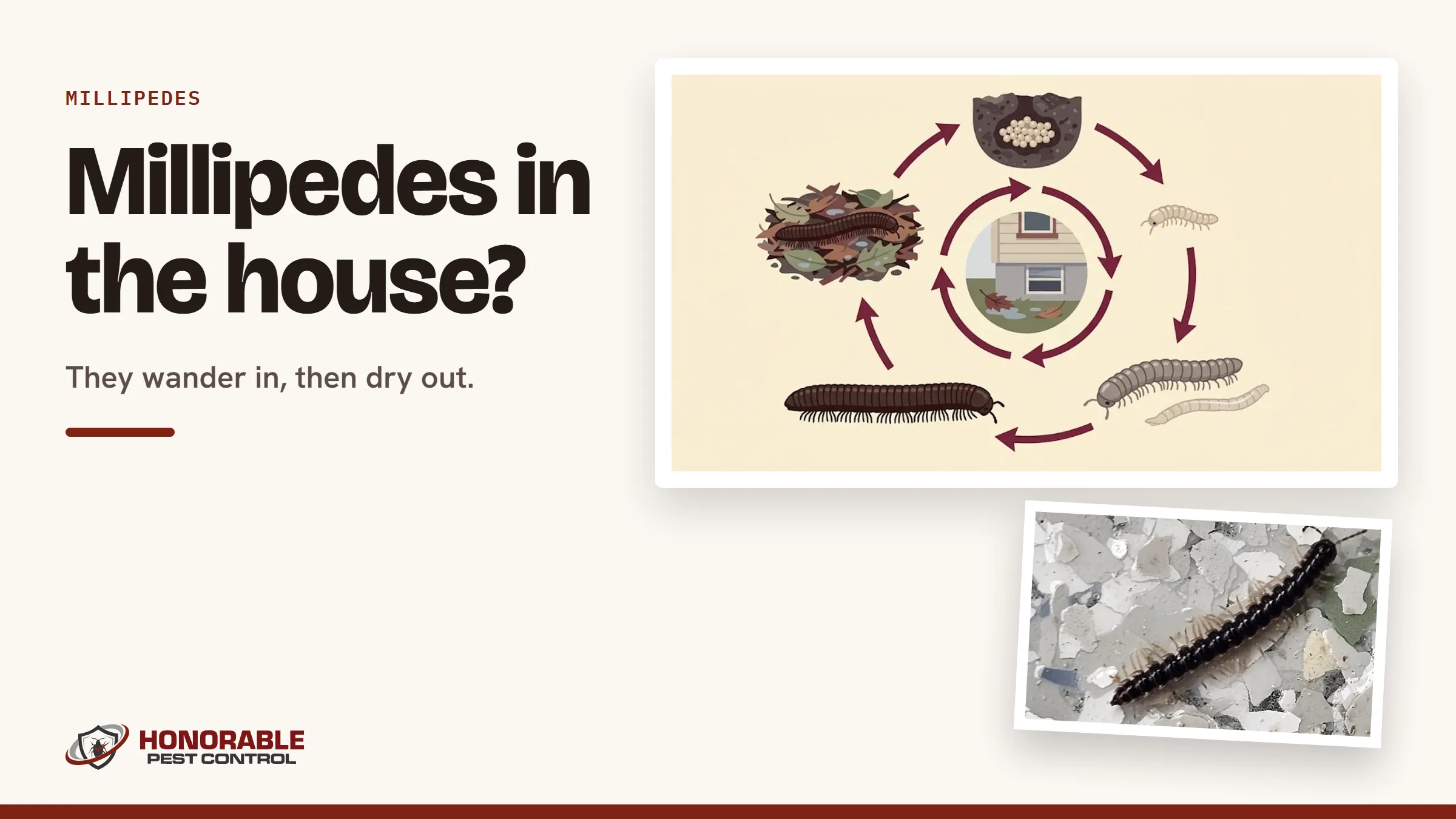
UMN says they crawl into homes mostly in late summer and fall, and now and then in spring and summer. MSU Extension says that in fall they can gather in big numbers in garages and on driveways. The life cycle wheel above shows where fall fits in their year.
Why are there millipedes in my house when it hasn't rained?
Dry weather can do it too. Ohio State says too much rain or even drought can drive them out of the soil. Dry falls happen here: at Detroit Metro Airport, all four falls from 2022 to 2025 got less September and October rain than the 10-year average. That's a rain count, not a millipede count.
What kills millipedes fast in the house?
You don't need a spray. Sweep or vacuum them up. UKY says most die soon after they get in anyway, because it's too dry inside. And Ohio State says bug bombs and fogs won't keep them out.
Do millipedes stay in the house all winter?
Most don't. UKY says most die soon after they get in, and UMN says they're rarely seen inside in winter. UMN adds that the ones found indoors in early spring are coming out of the cracks and crevices where they spent the winter.

About this page
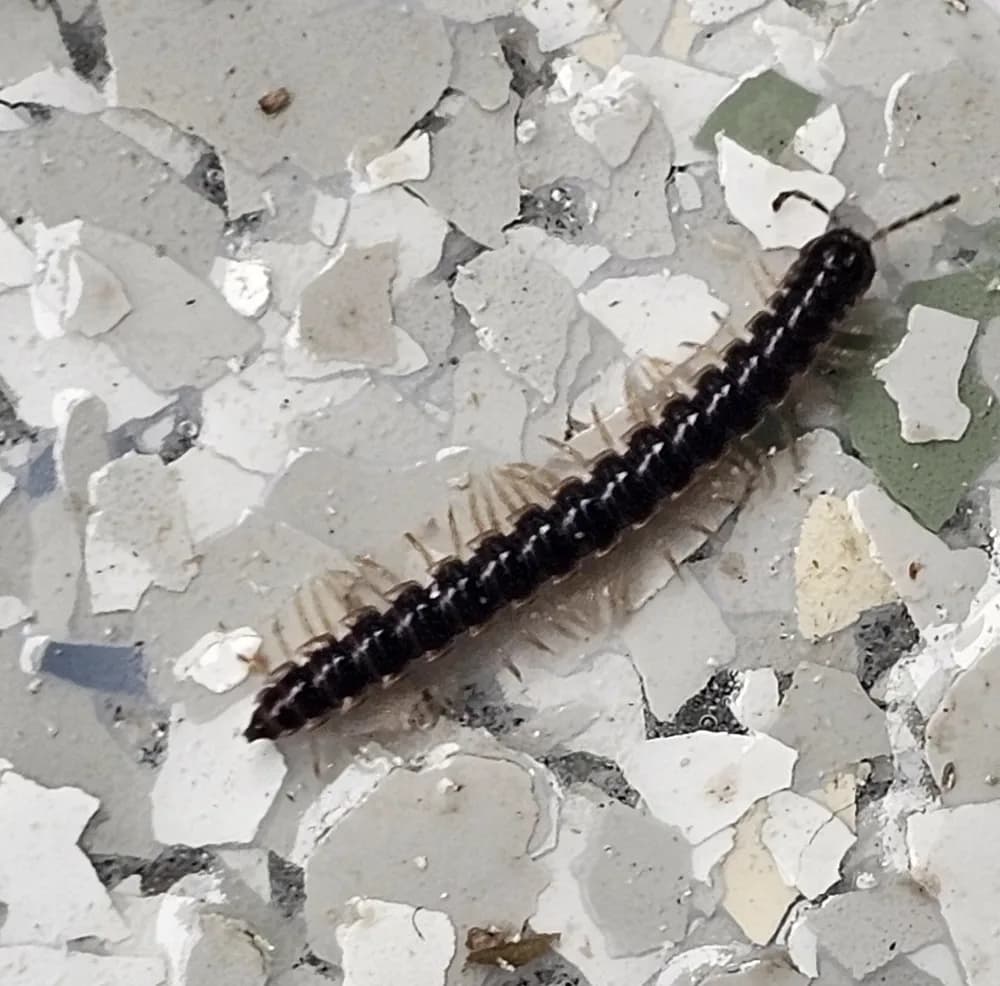
Nick wrote this. The facts come from the sources below, checked on October 15, 2026. The rain numbers are our own count of NOAA records for one gauge at Detroit Metro Airport. Photo: Russell Parsons (CC BY 4.0, via iNaturalist). See something wrong? Tell us and we'll fix it.
Sources
- Michigan State University Extension, MSU Plant & Pest Diagnostics, Millipedes (Class Diplopoda)
- University of Minnesota Extension, Sowbugs, millipedes and centipedes (reviewed 2024)
- Ohio State University Extension, Millipedes, HYG-2067A (David J. Shetlar, 2011)
- South Dakota State University Extension, Millipedes in Yards and Homes (updated 2021)
- University of Kentucky Entomology, ENTFACT-645: Centipedes and Millipedes in and Around the Home (revised 2024)
- University of California Statewide IPM Program, Pest Notes: Centipedes and Millipedes, Publication 7472 (updated 2023)
- NOAA National Centers for Environmental Information, Global Summary of the Month, Detroit Metro Airport, 2016 to 2025 (our count, pulled October 15, 2026)
- Ohio Department of Natural Resources, Division of Wildlife, Millipedes of Ohio field guide, Publication 5527 (PDF)
- Meyer-Rochow, New observations, with older ones reviewed, on mass migrations in millipedes, Zoological Research (2015)
- CSIRO, Australia's national science agency, Diplopoda: millipedes

Ann Arbor, MI · Licensed and insured
Millipedes in the basement again?
Tell us what you're seeing and where you live. We check we cover your street and give you the price first.
500+ Customer Reviews·Michigan pesticide business license #820457