
Spiders
Why are there so many spiders in my house this fall?
Most of them are not coming in from the cold. The big one on the basement floor wandered in by accident, the webs in the corners belong to spiders that live there all year, and the spider in the small silk sac on the ceiling is the one most likely to bite. Here is how to tell which you have in a Southeast Michigan house, and what works for each.
 By Nick Russler, ownerLicensed and insured in MichiganPublished
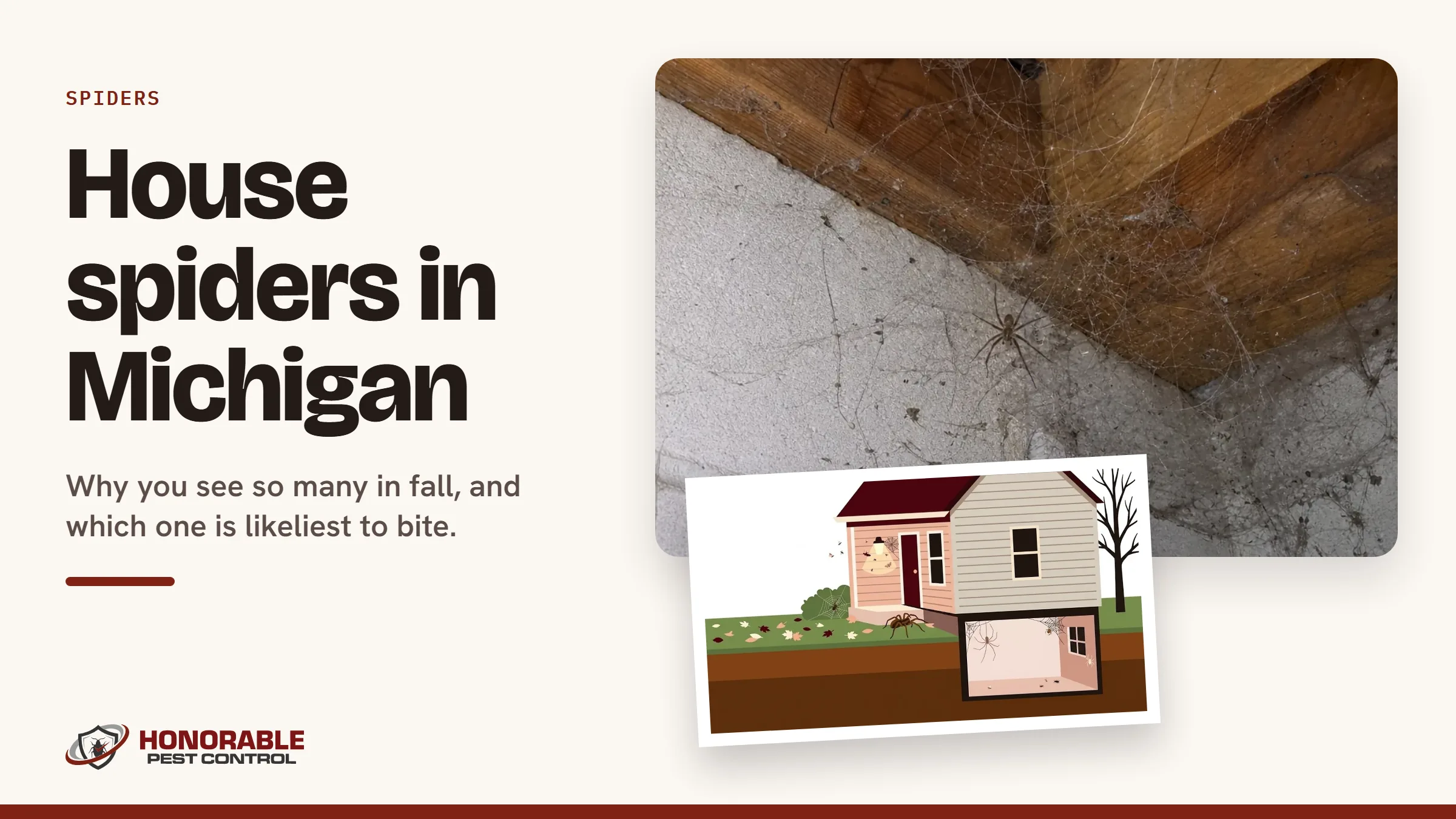
Summary
The short answer
The big one on the basement floor is usually a wandering wolf or grass spider. Webs in the basement corners belong to house and cellar spiders that live there all year. A small silk sac in a ceiling corner often means a yellow sac spider, the one most likely to bite. Most fall wanderers are males looking for mates, not escaping the cold. Bug bombs and hedge apples do not work. A vacuum does.
You see more spiders in a Michigan house in fall because outdoor spiders are on the move, mostly males looking for mates, and some wander in by accident. Iowa State Extension says those strays usually live less than a day or two indoors.
Prefer to listen? 50 seconds.
The short version, read aloud. Read by a synthetic voice, not one of our technicians.
Why there are more spiders in fall
Fall is mating season for many outdoor spiders: male grass spiders go looking for females and sometimes wander into homes, Ohio State Extension says. Wolf spiders occasionally slip in around doors and windows while hunting, Iowa State says.
True house spiders usually spend their whole lives in, on or under one building, the Burke Museum in Seattle says.
Mostly, they are not coming in to get warm. The Burke Museum's Rod Crawford calls that a myth, since spiders are cold-blooded. The Connecticut Agricultural Experiment Station does say wolf spiders come in as fall temperatures drop.
Where you find one tells you which kind it is:
| Where you found it | What it usually is | Lives indoors? | What to do |
|---|---|---|---|
| Running across the basement floor | A wolf spider or a male grass spider | Not usually; it wandered in | Catch it in a jar and put it outside |
| Big and dark, in a damp corner | A dark fishing spider | Not usually; it wandered in | Jar it, then dry out the space |
| Loose, messy web high in a corner | A cellar spider | Yes, all year | Vacuum the web |
| Tangled cobweb in a quiet spot | A common house spider | Yes, all year | Vacuum the web and egg sacs |
| Small silk sac where a wall meets the ceiling | A yellow sac spider | Often | Vacuum the sac |
| On a sunny window by day | A jumping spider | Sometimes, for the winter | Cup it and let it go outside |
From MSU Extension, Ohio State, Iowa State, Minnesota, Kentucky, the University of Michigan, the Connecticut station and the Burke Museum.
The big one on the basement floor: wolf and grass spiders
A big brown spider running across the basement floor in fall is likely a wolf spider or a wandering grass spider. MSU Extension says wolf spiders come in at ground level, and most homeowners see only one or two.
Ohio State says a grass spider's abdomen usually tapers to a point; a wolf spider's tends to be rounder.
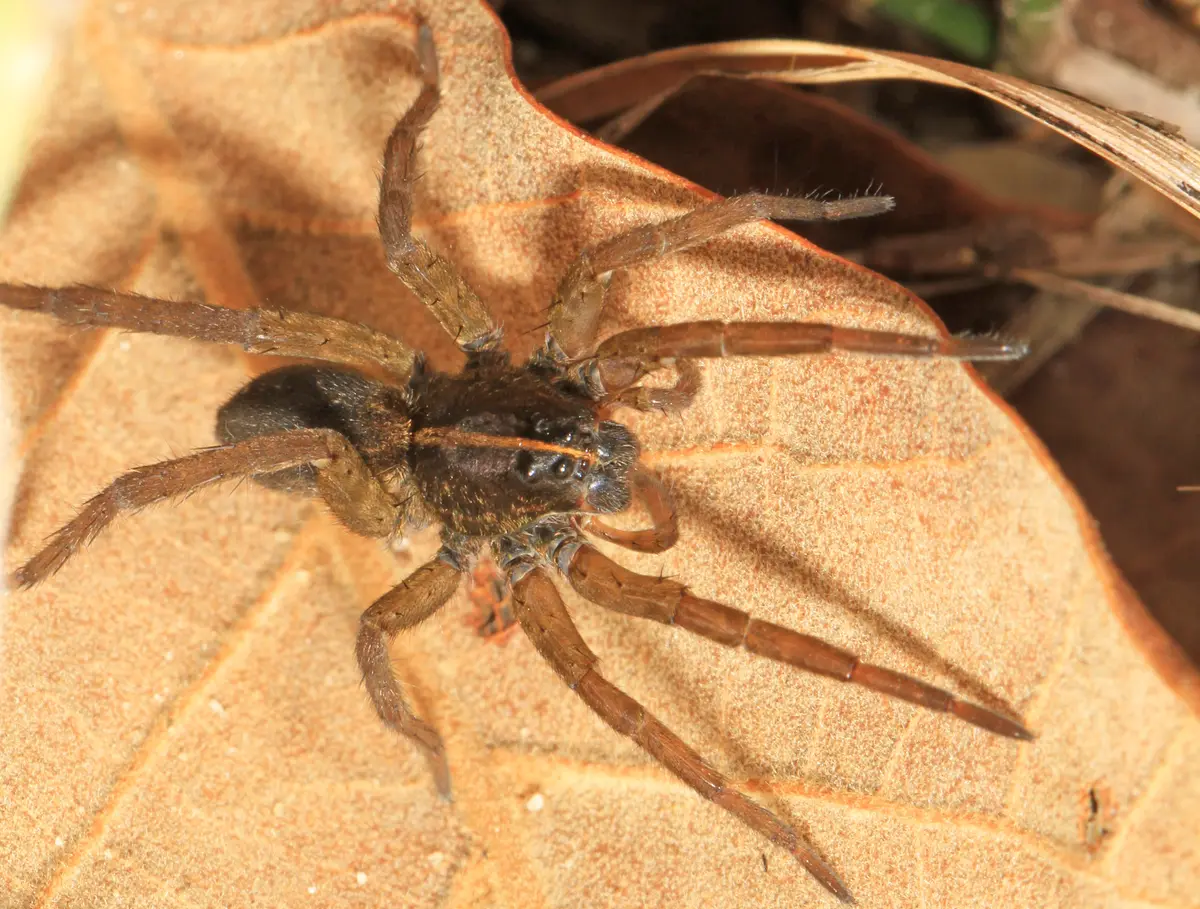
The fix is a jar: Iowa State says one caught in a large jar can go back outside.
If your phone says brown recluse, MSU's Duke Elsner says such scares almost always turn out to be a local look-alike; our brown recluse guide shows how to tell.
The webs in the basement corners: cellar and house spiders
The webs in the basement corners belong to spiders that live there all year. Cellar spiders, pale with very long legs, build loose webs in corners, Minnesota Extension says, and the University of Michigan says they are not dangerous to people. Tangled cobwebs are often the common house spider, which MSU says is beneficial to tolerate.
Use a vacuum:
- Tap the web first. A tap from the switched-off nozzle sends the spider out, Connecticut's station says.
- Get the egg sacs. Kentucky Entomology says each one can hold hundreds of young spiders.
- Dry it out. Spiders and their prey dislike dry places, the station adds, so run a dehumidifier and fix leaks.
Large, persistent spider numbers indoors mean a big insect population is feeding them, Wisconsin's extension says. In a damp basement, that food can be the tiny bugs of a damp floor, which house centipedes hunt too.
The small sac in a ceiling corner: yellow sac spiders
A yellow sac spider hides by day in a small silk sac, which indoors may sit in a corner where a wall meets the ceiling, MSU Extension says.
MSU counts it among three native spiders that are medically important in Michigan. It hunts at night, and bites happen when one gets trapped against skin in sheets, clothing or shoes.
The truth is more likely to be that we have more to worry about from frail anemic looking spiders, particularly, the yellow sac spiders.
Howard Russell, Michigan State University Extension (2008)
How big the spiders in a Michigan house get
Body length without the legs: the house spider's average, the top of the cellar and yellow sac spider ranges, and a female fishing spider, which can top an inch. The biggest, MSU says, is not particularly dangerous to people or pets; the pale yellow sac spider is the one most likely to bite. From MSU Extension on the house spider, yellow sac spider and dark fishing spider, and Minnesota Extension on the cellar spider.
Most bites are not serious. MSU says most are relatively painless; in worse cases one burns for up to an hour and can blister, and any sore that forms usually does not scar.
If someone is bitten, keep them calm and call Poison Control at 1-800-222-1222, the National Pesticide Information Center (NPIC) says.
What works, and what does not
What works:
- Dim the porch light. It draws the flying insects spiders eat, Penn State Extension says. Minnesota suggests yellow bulbs.
- Leave the firewood outside. Penn State says firewood stored indoors warms up, and spiders wintering in it may wake and crawl out.
- Tighten up at ground level. Iowa State says to seal cracks, fix the door sweep, trim shrubs and move debris back from the foundation.
Skip the bug bomb and the hedge apples
Kentucky Entomology says many bug bombs seldom kill spiders and tend to drive pests deeper into walls; NPIC says the mist misses the cracks where they hide.
Minnesota Extension says surface treatments and fogs are not effective, and neither are hedge apples.
Do it yourself, or call someone?
For a few wanderers and webs, you probably do not need anyone. Connecticut's station says spider control does not require pesticides.
Spraying the outside is no cure. Iowa State says it has little if any benefit, and Penn State says most sprays do little to keep spiders out. Minnesota and Kentucky do back a targeted treatment where spiders hide and get in.
Call when webs and egg sacs keep coming back, when large numbers turn up indoors, or if you suspect a black widow or brown recluse. Wisconsin's extension calls both very rare in the upper Midwest but says they need immediate attention.
That is what our spider control is for: on every visit we treat the outside, knock down webs and egg sacs, and cut down the insects that feed them. We also show you the gaps and torn screens to fix; we do not seal, caulk or repair. Spiders are on the Honorable Shield covered list.
Webs back in the basement corners as fast as you clear them?
Tell us what you are seeing. Webs and egg sacs come down on every visit, and quotes are free.
Common questions
Do wolf spiders bite?
Rarely. MSU says they are not known to be aggressive but will bite in self-defense if handled roughly. Penn State says a bite brings pain and redness that generally fade within 24 hours, with no serious medical effects noted.
Are cellar spiders, the daddy longlegs, dangerous?
No. Connecticut's station calls the story that they are highly venomous an urban legend: their venom is weak, and their mouthparts are too small to puncture skin. They are not related to the harvestmen also called daddy longlegs, the University of Michigan says.
Why do I see spiders in spring too?
Some spent the winter indoors. Penn State says mated females of the big wolf spiders common in Pennsylvania homes overwinter in sheltered spots, buildings included, and make egg cocoons the following May or June.
How can I find out what spider I have?
Catch it in a jar. MSU's Plant and Pest Diagnostics lab identifies spiders sent in, for a small fee, though it does not examine bites, and NPIC suggests your county Extension office.

About this page
Written by Nick Russler, owner of Honorable Pest Control in Ann Arbor, Michigan. The facts here come from Michigan State University Extension and its Plant and Pest Diagnostics lab, the University of Michigan, the Universities of Minnesota, Wisconsin and Kentucky, Iowa State, Ohio State, Penn State, the Connecticut Agricultural Experiment Station, the Burke Museum and the National Pesticide Information Center, all read on October 7, 2026. We do not diagnose bites; see a doctor about any symptoms. If something here is out of date or wrong, tell us and we will fix it.
Sources
- Michigan State University Extension, Wolf Spider
- Michigan State University Extension, Comb-footed spiders
- Michigan State University Extension, Yellow sac spiders
- Michigan State University Extension, Fishing spiders (2010)
- Michigan State University Extension, Don't panic over brown recluse spiders in Michigan (2018)
- Michigan State University Extension, Big ol' hairy spiders (2008)
- Michigan State University Extension, Spiders on the web (2011)
- Michigan State University Plant and Pest Diagnostics, services
- University of Michigan BioKIDS, Pholcidae (cellar spiders)
- University of Minnesota Extension, Spiders (reviewed 2019)
- University of Wisconsin-Madison Extension, Common Spiders In and Around Homes, A2135 (revised 2012)
- Iowa State University Extension and Outreach, Fall and Spiders Go Together (2020)
- Iowa State University Extension and Outreach, House Invader Spiders (2007)
- Iowa State University Extension and Outreach, Wolf and Fishing Spiders (2016)
- Ohio State University Extension, Ohio's Natural Enemies: Funnel Weaver Spiders, ENT-76
- Penn State Extension, Wolf Spiders (updated 2025)
- Penn State Extension, Commonly Encountered Pennsylvania Spiders (updated 2018)
- University of Kentucky Entomology, Common Spiders Found Around Homes and Buildings, ENTFACT-622
- University of Kentucky Entomology, Eliminating Spiders around Homes and Buildings, ENTFACT-623 (revised 2018)
- University of Kentucky Entomology, Limitations of Home Insect Foggers (Bug Bombs), ENTFACT-643
- Connecticut Agricultural Experiment Station, Spiders Found in the House
- Burke Museum, University of Washington, Myth: Spiders come indoors in the fall
- National Pesticide Information Center, Oregon State University, Spiders
- National Pesticide Information Center, Oregon State University, Total Release Foggers

Ann Arbor, MI · Licensed and insured
Webs in the basement every fall?
Tell us what you are seeing and where you live. We check we cover your street and give you the price first.
500+ Customer Reviews·Michigan pesticide business license #820457